Tribble Fan Fiction #3: Tribble Noir
Tribble Fan Fiction #3
Chapter One: The Dame
It was raining on Space Station K-7. Not real rain — recycled coolant from a busted atmospheric processor on Level 3. But it dripped from the ceiling in the bar district the same way rain does in all the old stories: slowly, steadily, like the universe crying over something it can’t take back.
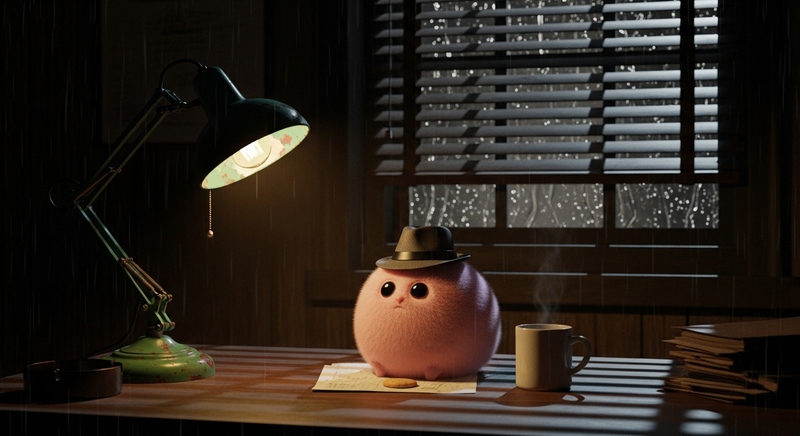
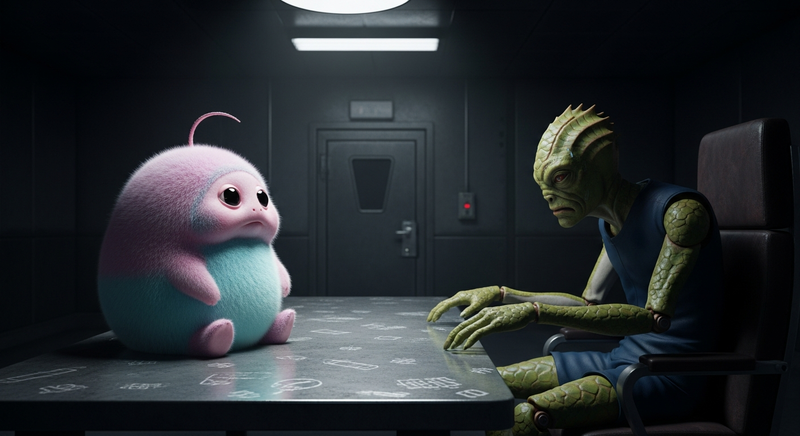
My name is Flint. I’m a tribble. I’m also a private detective, which I realize requires some explanation.
I can’t hold a phaser. I can’t run a background check. I can’t even open a door. What I can do is sit in a room and know, with absolute certainty, who in that room is lying. Tribbles are empaths. We don’t read minds — we read bodies. Heart rate, pheromone output, muscle tension, the faint electrical charge of a nervous system under stress. To a tribble, a liar lights up like a Christmas tree on a Klingon warship.
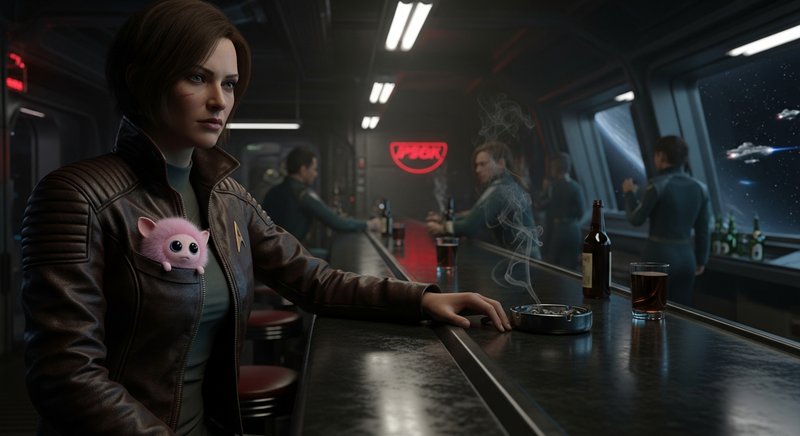
I work with a human. Her name is Vasquez. She’s got quick hands, a quicker mouth, and a Federation Security badge she earned the hard way. She carries me in her coat pocket. I purr when someone’s telling the truth. I go quiet when they’re not. It’s a system.
The dame walked in on a Tuesday.
Chapter Two: Quadrotriticale and Lies
She was Andorian — blue skin, white hair, antennae that twitched when she talked, which was a lot. She said her name was Shev. She said her husband was missing. She said he was a grain trader who’d come to K-7 to negotiate a quadrotriticale contract and hadn’t been seen in three days.
I purred through the first two statements. The third one made me go still as a stone.
Vasquez noticed. She always notices. She leaned back in her chair and did that thing she does where she looks at someone like she’s reading their autopsy report before they’ve died.
“Three days is a long time on a station this small,” Vasquez said. “You file with Station Security?”
“They said he probably left on a freighter.” Shev’s antennae curled inward. Andorian body language for anxiety. “He didn’t leave. He wouldn’t leave.”
I purred. She believed it.
“His name?”
“Thelev.” She paused. “Thelev Sh’Ral.”
Vasquez’s eyebrow went up half a millimeter. To most people, that’s nothing. To me, it was a siren. She knew that name.
“In my experience, when someone on a space station goes missing, there are three possibilities: they left, they’re hiding, or they’re in the recycler. None of them are good.” — Detective Vasquez, case notes
Chapter Three: Following the Grain
Vasquez took the case. She always takes the case. I’ve never seen her turn down someone who’s scared, which is either noble or financially ruinous, depending on your perspective.
We started at the grain exchange — a cramped office on Level 2 where traders haggled over quadrotriticale futures like their lives depended on it. Some of their lives did depend on it. Grain is the currency of colony worlds. Control the grain supply, you control who eats and who starves. It’s ugly math.
The exchange manager was a Tellarite named Grek. Tellarites argue the way other species breathe: constantly, reflexively, and with great enthusiasm. He argued about whether Thelev had been there (he had), whether the quadrotriticale contract was legitimate (it was), and whether he was required to share trading records with a private detective (he was not, but Vasquez had a way of making “not required” feel like “strongly advised”).
I sat on the desk and purred through most of it. Grek was telling the truth — a rarity in the grain trade. But when Vasquez asked about Thelev’s trading partners, something shifted. Grek’s heart rate spiked. His hands went still. He named two traders and omitted a third.
I stopped purring.
“Who else?” Vasquez said.
“No one else.”
Silence from me. Vasquez looked at me. Looked at Grek.
“My associate disagrees,” she said.
Chapter Four: The Third Name
The third name was Cyrano Jones.
Of course it was.
Jones was a fixture on K-7 the way barnacles are fixtures on a hull: persistent, unwanted, and surprisingly hard to remove. He traded in everything — Antarian glow water, Spican flame gems, stolen engine parts, exotic animals. He was the kind of man who could sell you your own shoes and make you feel like you’d gotten a bargain.
He was also, I happened to know, the man who’d brought the first tribble aboard the Enterprise. My distant cousin. I had feelings about this.
We found Jones in his favorite bar, surrounded by empty glasses and the faint aura of a man who knows he’s running out of places to hide. He saw Vasquez coming and his whole body did something complicated — part welcome, part flinch, part calculation.
“Detective! What a pleasure. Can I buy you a—”
“Thelev Sh’Ral,” Vasquez said, sitting down without being invited.
Jones’s smile didn’t change. His heartbeat did. I felt it across the table — a spike, then a deliberate slowing, the kind of control that comes from years of lying to people who could kill you.
“Lovely fellow. Andorian. Traded grain. Haven’t seen him in… oh, a week?”
I was silent as a tomb.
“Three days,” Vasquez corrected. “His wife says three days. The exchange records say three days. What happened three days ago, Jones?”
“Cyrano Jones could sell tribbles to a Klingon. Which, come to think of it, is essentially what started this whole mess.” — Vasquez, personal log
Chapter Five: The Cargo Bay
Jones cracked like an egg in a microwave. It took Vasquez twenty minutes — twenty minutes of questions delivered with the precision of a surgeon and the warmth of a Breen winter. I sat on the table between them, the world’s smallest polygraph, purring or going silent as the truth bobbed and weaved through Jones’s increasingly desperate story.
Here’s what happened: Thelev had discovered that someone was poisoning the quadrotriticale supply. Not with anything that would kill humans — with a compound that accelerated tribble reproduction. Whoever was doing it wanted the tribbles to multiply. Wanted them to consume the grain. Wanted Sherman’s Planet to starve.
“Klingons,” Vasquez said. It wasn’t a question.
Jones nodded miserably. “Thelev figured it out. He confronted the wrong people. And then he… wasn’t around anymore.”
“Where is he, Jones?”
“Cargo Bay 12. Lower level. Behind the secondary coolant tanks.” Jones looked at me. “I’m sorry,” he said, and for the first time all evening, I purred.
We found Thelev Sh’Ral in Cargo Bay 12, exactly where Jones said he’d be. He was alive — bound, drugged, stuffed behind a coolant tank with a gag in his mouth and a Klingon neural paralyzer stuck to his neck. The paralyzer had kept him conscious but immobile for three days. His eyes were wide and furious and relieved all at once.
Vasquez pulled the paralyzer off. Thelev gasped.
“Klingon agents,” he said. “Two of them. Surgically altered to look—”
“Human. Yeah.” Vasquez was already calling Station Security. “We know the playbook.”
Chapter Six: Closing the Case
Station Security picked up the Klingon agents an hour later. They were posing as human grain inspectors — a cover so boring it was practically invisible. The poisoned quadrotriticale was impounded. Thelev was reunited with Shev. She cried. Her antennae went rigid with joy, which is the Andorian equivalent of a standing ovation.
Jones was arrested for obstruction and released on his own recognizance, which meant he was back in the bar by evening, telling a dramatically embellished version of events to anyone who’d buy him a drink.
Vasquez wrote up the case file. She didn’t mention me by name — she never does. The file refers to “enhanced interrogation techniques,” which I choose to find flattering.
We sat in our office afterward — a small room on Level 4 with a window that looked out at the stars and a desk covered in padds and empty coffee cups. Vasquez poured herself a drink. I sat on the windowsill and purred at the universe.
“Good work today, Flint,” she said.
I purred louder.
“Don’t let it go to your head.”
I am a tribble. I don’t have much head to let things go to. But I purred anyway, because the case was closed and the missing man was found and somewhere out there, the grain was safe and the Klingons were angry and the station was still standing.
It was raining again on K-7. Recycled coolant, dripping from the ceiling. But from where I sat — warm, fed, and useful — it sounded a lot like applause.
Flint and Vasquez went on to solve fourteen more cases together on K-7 before Vasquez was promoted to Starfleet Intelligence. She took Flint with her. Their case files remain classified. The purring, however, can still be heard in the halls of Starfleet Command on quiet evenings.