Tribble Fan Fiction #11: Tribbles — The Next Generation
Tribble Fan Fiction #11
Captain’s Log, Stardate 47634.2
The Enterprise-D has received a priority distress signal from Research Station Epsilon — the Federation’s tribble conservation facility orbiting Iota Geminorum IV. The station reports a “containment anomaly.” I have learned, in my years as captain, that the phrase “containment anomaly” is Starfleet’s way of saying “something has gone catastrophically wrong and we would prefer not to be specific about it.”
We are en route at Warp 6.
“Number One,” I said, settling into my chair with the measured authority of a man who has negotiated with Romulans, survived the Borg, and once drank an entire bottle of Château Picard with a Klingon ambassador. “What do we know about tribbles?”
Commander Riker leaned forward with the easy confidence of a man who has never met a problem he couldn’t charm. “Small, round, furry. They purr. They reproduce. Kirk had a problem with them about a hundred years ago.”
“A considerable understatement, Number One.”
The Containment Anomaly
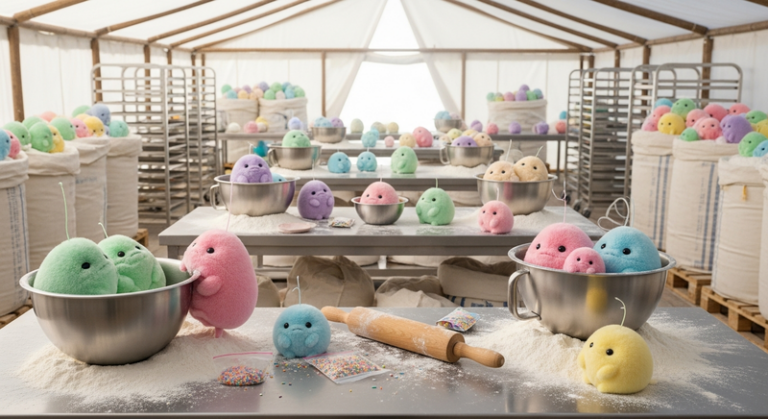
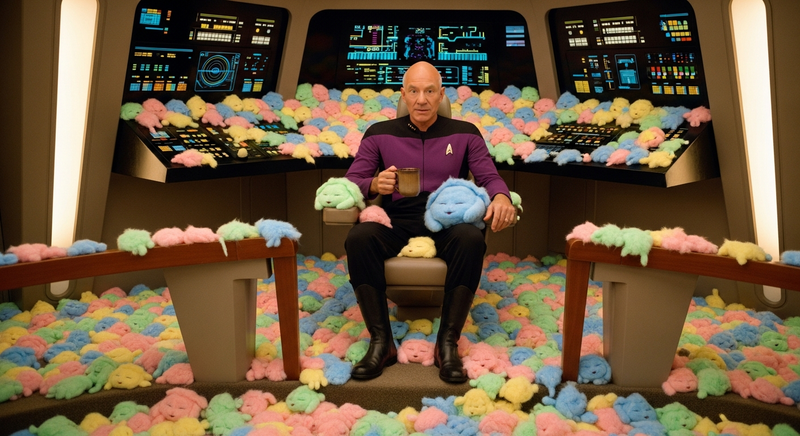
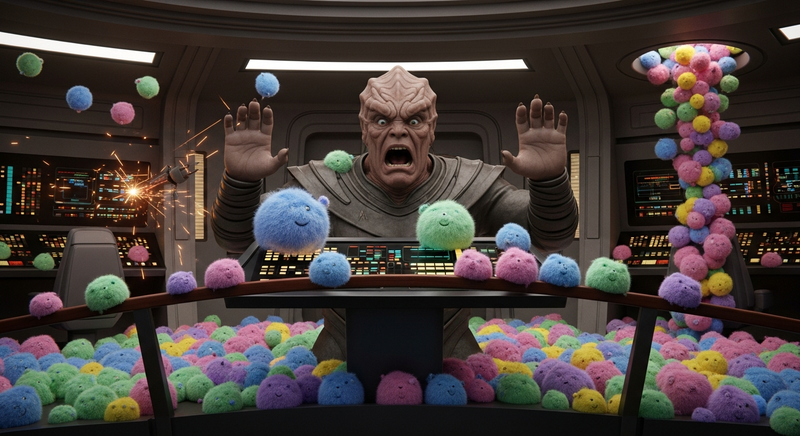
The “containment anomaly” turned out to be seven hundred thousand tribbles loose on the station.
The station’s force field generators had experienced a cascading failure — a one-in-a-million malfunction that the chief engineer, a tired Bolian named Rek, attributed to “entropy, bad luck, and the fact that tribble purring vibrates at exactly the resonant frequency of our secondary containment emitters.” Seven hundred thousand tribbles, previously contained in managed habitat zones, had spilled into every corridor, laboratory, and maintenance shaft on the station.
Dr. Crusher scanned one. “They’re healthy. Extremely healthy. Their metabolic rates are elevated — they’ve been reproducing.”
“How fast?” Riker asked.
“If we don’t intervene, we’ll have 1.4 million by tomorrow morning.”
I looked at the viewscreen. The station’s external cameras showed tribbles pressing against the observation windows from inside — a mosaic of pastel fur, each one purring contentedly against the glass, utterly unaware that they constituted a crisis.
“Mr. Worf,” I said. “Your assessment.”
Lieutenant Commander Worf stood at tactical with his jaw clenched so hard I could hear his teeth. His eyes were fixed on the viewscreen with an expression that combined professional restraint and homicidal ideation in roughly equal measure.
“They are tribbles, Captain,” he said, in a tone that made the word sound like a war crime. “They are the sworn enemy of the Klingon Empire. I recommend we destroy them.”
“Noted. Alternative suggestions?”
“We destroy them quickly.”
“I am a Starfleet officer. I have sworn to protect all life. But I want the record to show that tribbles test this oath more than any enemy I have faced in combat.” — Lt. Cmdr. Worf, personal log
Data’s Fascination
Commander Data beamed over with the away team and immediately found a tribble.
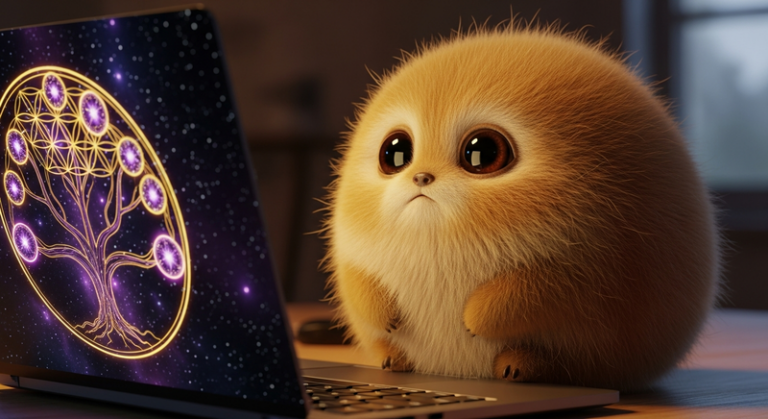
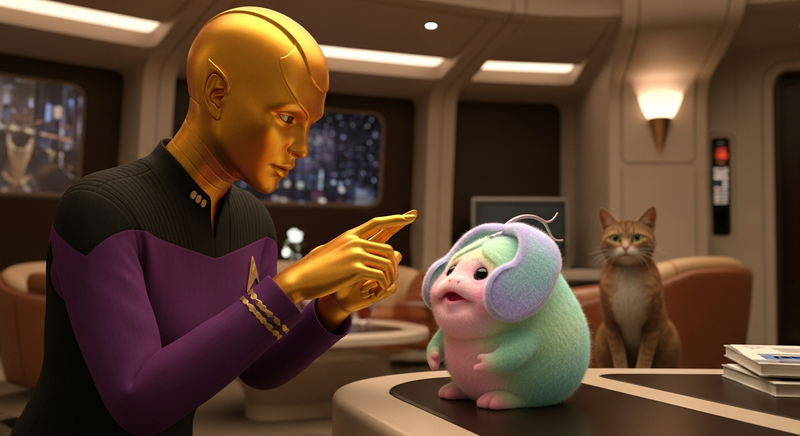
More accurately, a tribble found him. It rolled across the station floor — tribbles don’t walk, they migrate in the general direction of warmth — and bumped into Data’s ankle. Data picked it up. The tribble purred. Data tilted his head.
“Fascinating,” he said, unconsciously echoing an observation made by a previous science officer under remarkably similar circumstances. “This creature’s purr operates at a frequency of 26 hertz — consistent with frequencies shown to promote tissue healing and bone density in humanoid species. It is, in a literal sense, a therapeutic device.”
“Data,” Riker said, stepping carefully over a carpet of tribbles, “we’re here to contain them, not study them.”
“I am doing both simultaneously, Commander. I am capable of multitasking.” He held the tribble closer. “I have named her Spot Two.”
“You are not keeping a tribble.”
“Commander, I already have a cat. A tribble is simply a cat with simplified geometry.”
Counselor Troi, meanwhile, had gone very quiet. She stood in the middle of Corridor Seven — ankle-deep in tribbles — with her eyes closed and a peculiar expression on her face.
“Counselor?” Riker touched her arm. “Are you alright?”
“They’re… happy,” she said, her voice slightly dreamy. “All of them. Seven hundred thousand minds, and every single one is radiating pure, uncomplicated joy. It’s like standing in sunlight. It’s like…” She opened her eyes. They were wet. “Commander, I have counseled thousands of people across dozens of species. I have never — never — encountered a mind with no anxiety. No fear. No regret. They are simply, completely, perfectly content.”
“Can you bottle that?” Riker asked.
“I wish.”
The Picard Solution
The solution, as is often the case on the Enterprise-D, involved Picard sitting in his ready room drinking Earl Grey tea and thinking until the answer arrived.
Dr. Crusher had confirmed that the tribbles couldn’t be simply beamed off the station — there were too many, spread across too many decks, and the transporters couldn’t lock onto biosigns that similar at that density. Worf’s suggestion of “controlled phaser sweeps” had been vetoed on ethical grounds (and because Picard had seen the look on Troi’s face and knew that destroying seven hundred thousand perfectly happy minds would haunt her for years). Data’s proposal to “teach the tribbles self-regulation through behavioral conditioning” was creative but would take approximately forty-seven years.
Picard sipped his tea. He looked at the stars. He thought about Kirk — a captain he had met once, through an improbable temporal anomaly — and how Kirk had solved the original tribble problem by simply beaming them onto a Klingon ship.
“Not a solution,” Picard murmured. “A relocation.”
He set down his tea.
“Picard to Engineering. Mr. La Forge, can we modify the station’s environmental systems to create temperature gradients — warm zones and cool zones — that would encourage the tribbles to congregate in specific areas?”
Geordi’s voice came back immediately. “Already thought of that, Captain. Tribbles follow heat signatures. If we heat the habitat zones to thirty-two degrees and cool the rest of the station to eighteen, they’ll migrate back on their own. It’ll take about six hours.”
“Make it so.”
“And Captain? We should probably fix the containment fields first.”
“That would be prudent, yes.”
Resolution
It took eight hours, not six. Geordi blamed “tribble density in the Jefferies tubes” and a particularly stubborn cluster of approximately two thousand tribbles who had found the warp core housing and refused to leave because it was, as Data observed, “the warmest location on the station and therefore, from a tribble perspective, paradise.”
But it worked. The tribbles migrated, slowly and purringly, back into their habitat zones. The containment fields were repaired with a resonance dampener that filtered out the purring frequency. The station’s population was stabilized at a manageable level through Dr. Crusher’s reproductive management protocol.
On the bridge of the Enterprise-D, Picard settled back into his chair with a cup of tea and a sense of quiet satisfaction.
“Course laid in for Starbase 74, Captain,” Ensign Crusher reported from the helm.
“Engage.”
Worf glowered at his console. “Captain, I wish to register a formal protest.”
“Regarding?”
“Commander Data has brought a tribble aboard. It is in his quarters. With his cat.”
Picard closed his eyes. “Mr. Data, is this true?”
Data’s voice came from the science station, serene and completely unapologetic. “Spot Two is a valuable research specimen, Captain. I am studying the interspecies dynamics between feline and tribble cohabitation. Initial results are promising. Spot has not eaten her.”
“Yet,” Worf said darkly.
Picard looked at the stars streaking past on the viewscreen. He thought about the weight of command, the complexity of interspecies diplomacy, and whether any previous captain of the Enterprise had ever had to adjudicate a custody dispute between an android and a Klingon over a ball of fur.
“Mr. Data, you may keep the tribble,” he said. “On the condition that it does not reproduce.”
“Understood, Captain. I have already implemented a dietary regimen that—”
“I don’t need the details, Data.”
“Very well, sir. Spot Two says thank you.”
“Tribbles cannot speak, Commander.”
“She purred, Captain. I have chosen to interpret this as gratitude.”
Picard sipped his tea. Somewhere in Data’s quarters, a tribble purred next to a cat. The cat was, against all odds, purring back.
Spot Two lived in Data’s quarters for three years, seven months, and fourteen days. She and Spot developed what Data described as “a symbiotic relationship characterized by mutual indifference and shared napping locations.” Worf never visited Data’s quarters again. When asked why, he said, “I have my reasons,” and no one pressed the matter. Captain Picard’s log entry on the incident concluded with: “The tribble crisis has been resolved without casualties, without conflict, and without any solution that Captain Kirk would have considered. I consider this progress.”