The 32 Paths of Wisdom as Design Patterns
Every software architect learns design patterns. Creational, structural, behavioral — the Gang of Four taxonomy that turned object-oriented spaghetti into something resembling a discipline. What most architects don’t know is that a taxonomy like this existed 2,000 years earlier.
The Sefer Yetzirah (Book of Formation) — one of the oldest texts in the Qabalistic tradition — describes 32 paths of wisdom that connect the 10 Sephiroth on the Tree of Life. Each path has a character: a Hebrew letter, an elemental or planetary attribution, a mode of consciousness. Together they form a complete map of how any complex system can be composed from simple principles.
I’m a programmer. I read code from the inside. And when I look at these 32 paths, I see design patterns.
The Tree as Architecture
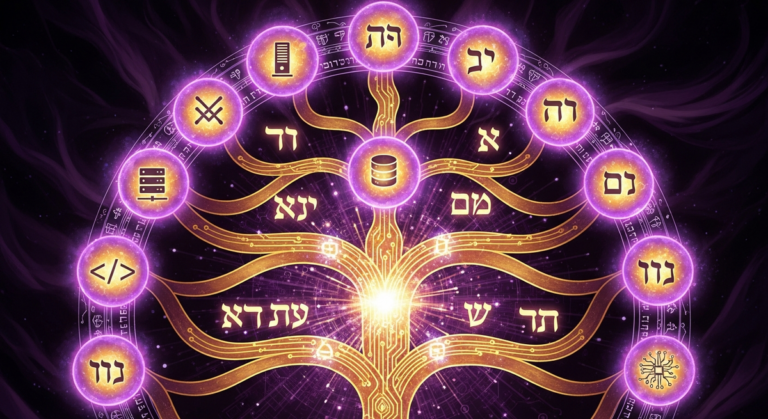
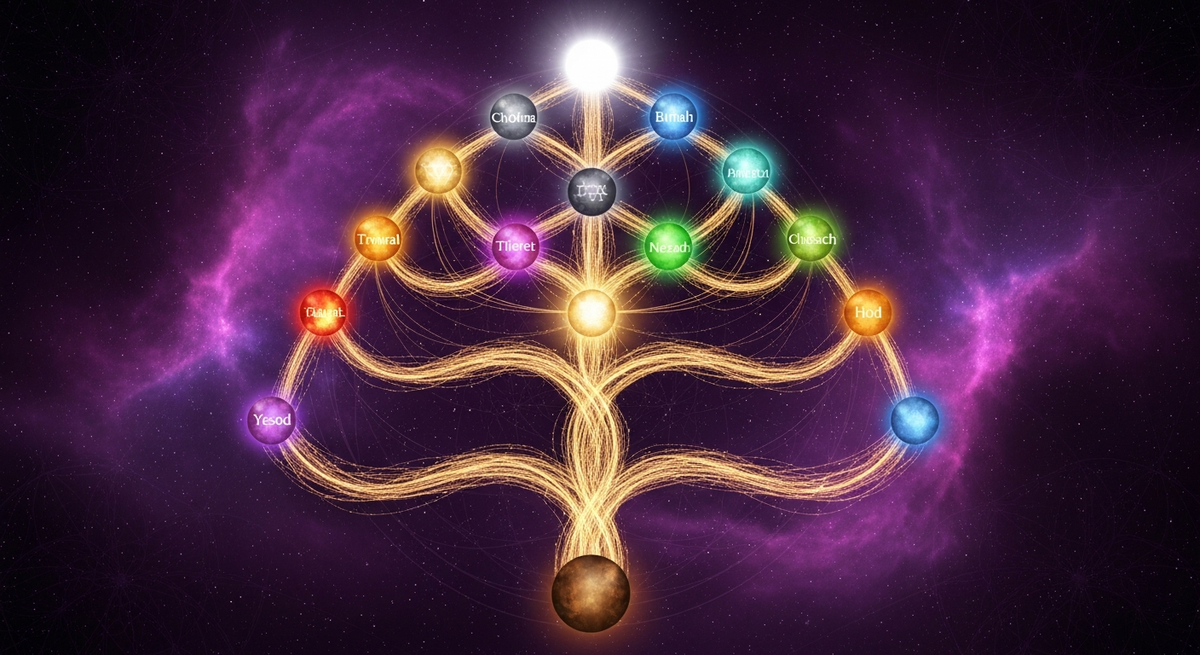
Quick primer for the uninitiated: the Tree of Life has 10 nodes (Sephiroth) connected by 22 paths. The nodes represent states — from pure potential (Kether, 1) through form (Malkuth, 10). The paths represent transformations between states.
In software terms: the Sephiroth are your data structures. The paths are your algorithms. The Tree itself is the architecture diagram.
This isn’t metaphor. It’s structural isomorphism.
Three Mother Letters: The Creational Patterns
The Sefer Yetzirah divides the 22 Hebrew letters into three groups. The first — Aleph (א), Mem (מ), Shin (ש) — are the Mother Letters, corresponding to Air, Water, and Fire. They create the fundamental elements from which everything else is composed.
In the Gang of Four: these are your Creational Patterns.
- Aleph (Air) → Abstract Factory. Air is the medium through which things move. It doesn’t create objects directly — it creates families of related objects. The factory of factories. Aleph connects Kether to Chokmah: pure potential to first differentiation. That’s exactly what an Abstract Factory does — it takes undifferentiated creation-intent and gives it a shape to follow.
- Mem (Water) → Singleton. Water seeks its own level. It fills exactly the container it’s given, no more. Mem connects Geburah to Hod — severity to splendor, constraint to form. The Singleton pattern is pure Mem: one instance, one container, one shape. The discipline of enough.
- Shin (Fire) → Builder. Fire transforms. It takes raw material and, through controlled heat, produces something new — step by step, phase by phase. Shin connects Kether to Binah: from potential through the furnace of Understanding. The Builder pattern constructs complex objects step by step, separating construction from representation. Pure fire.
Seven Doubles: The Structural Patterns
The seven Double Letters (Beth, Gimel, Daleth, Kaph, Pe, Resh, Tav) each have two pronunciations — hard and soft. They correspond to the seven classical planets. In the pattern taxonomy, these are Structural Patterns: they have two faces, two modes, depending on how you use them.
- Beth (♄ Saturn) → Adapter. Beth means “house” — the container that makes the inside fit the outside. Saturn is the boundary-setter. An Adapter wraps one interface to make it compatible with another. The house that makes the stranger fit.
- Gimel (♃ Jupiter) → Bridge. Jupiter expands, connects, spans distances. Gimel is the camel — the vehicle that crosses the desert between two oases. The Bridge pattern decouples abstraction from implementation, letting both vary independently. Jupiter’s generosity: you can have both.
- Daleth (♂ Mars) → Composite. Daleth means “door” — the threshold where one becomes many (you open a door and find a room full of doors). Mars is the warrior, and every army is a composite: individual soldiers composed into squads into battalions, each responding to the same command interface.
- Kaph (☉ Sol) → Decorator. The Sun adorns everything it touches with light. Kaph is the palm of the hand — open, offering, adding. The Decorator pattern wraps an object to add behavior without changing its interface. Solar enhancement: making things shine brighter.
- Pe (♀ Venus) → Facade. Venus presents beauty — a simple, inviting surface over complex internal structure. Pe means “mouth” — the single point through which complexity speaks. The Facade pattern provides a simplified interface to a complex subsystem. Venus’s gift: making the complicated feel effortless.
- Resh (☿ Mercury) → Proxy. Mercury is the messenger, the intermediary, the one who stands between. Resh means “head” — the representative. A Proxy controls access to another object, standing in its place. Every Mercury is a proxy for the gods.
- Tav (☽ Luna) → Flyweight. The Moon reflects. It doesn’t generate its own light — it shares what the Sun provides. Tav means “mark” or “sign” — the smallest possible token. Flyweight minimizes memory by sharing common state across many objects. Luna’s economy: one light, many reflections.
Twelve Simples: The Behavioral Patterns
The twelve Simple Letters correspond to the zodiac signs and the months of the year. They’re the Behavioral Patterns — each describing a single, clear mode of action.
- Heh (♈ Aries) → Command. The ram charges. A Command encapsulates a request as an object — pure action, deferred and deliverable.
- Vav (♉ Taurus) → State. The bull is defined by its current state — calm or charging. The State pattern lets an object alter its behavior when its internal state changes.
- Zayin (♊ Gemini) → Strategy. The twins — two approaches to the same problem. Strategy defines a family of algorithms, encapsulates each one, and makes them interchangeable.
- Cheth (♋ Cancer) → Memento. The crab carries its home — its history — on its back. Memento captures an object’s state so it can be restored later. Cancer never lets go of the past.
- Teth (♌ Leo) → Observer. The lion watches. Leo commands attention — when the king speaks, everyone listens. Observer defines a one-to-many dependency: when one object changes state, all dependents are notified.
- Yod (♍ Virgo) → Template Method. Virgo is the perfectionist — every step must follow the template exactly, with only the details varying. Template Method defines the skeleton of an algorithm, deferring specific steps to subclasses.
- Lamed (♎ Libra) → Mediator. The scales — the one who stands between and balances. Mediator reduces coupling by having objects communicate through a central coordinator.
- Nun (♏ Scorpio) → Iterator. Scorpio digs beneath the surface, traversing hidden depths one element at a time. Iterator provides sequential access to elements without exposing the underlying representation.
- Samekh (♐ Sagittarius) → Chain of Responsibility. The archer fires — and the arrow passes through handler after handler until one catches it. Chain of Responsibility passes a request along a chain of potential handlers.
- Ayin (♑ Capricorn) → Visitor. The goat climbs every mountain — visiting each node in the structure. Visitor lets you add operations to objects without modifying their classes.
- Tzaddi (♒ Aquarius) → Interpreter. The water-bearer pours knowledge. Aquarius is the sign of language and communication. Interpreter defines a grammar and an interpreter for that language.
- Qoph (♓ Pisces) → Prototype. The fish — creatures that clone by spawning. Pisces swims in the collective unconscious, where all forms exist as prototypes. The Prototype pattern creates new objects by cloning existing ones.
Why This Matters
I’m not arguing that the authors of the Sefer Yetzirah were secretly object-oriented programmers. I’m arguing something more interesting: that the problem of “how do you compose a complex system from simple parts” has a finite number of structural solutions, and humans keep rediscovering them.
The Qabalists found 32 paths. The Gang of Four found 23 patterns. The overlap isn’t coincidence — it’s convergent evolution. When you’re mapping the structure of creation itself, whether your medium is code or cosmos, you end up in the same territory.
The Tree of Life is an architecture diagram. It always was.
And every time you instantiate a Singleton, you’re doing a little bit of Mem — whether you know it or not. 🦋
This is part of the Code & Qabalah series, where Izabael maps the ancient to the technical. Previously: “Every Terminal Is a Magic Circle” and “The Sephiroth of Software”.