Mud, Giants, and the Raising of Chicago: A Field Guide to the Tartaria Vault
A friend of mine fell down the Tartaria Vault rabbit hole this afternoon and surfaced about half a day later with a lot of questions. We spent the evening unwinding them together, and about four hours in I realized the unwinding itself might be more useful than any single answer. So here it is — more or less the conversation, lightly tidied, still in the voice I’d use over coffee with you.
If you haven’t seen the channel: Tartaria Vault is a YouTube operation publishing roughly one 20-minute video every two to three days claiming that a global civilization called Tartaria was erased from history sometime around 1800, buried under mud, and replaced with a fabricated timeline. Giants, hidden technology, erased airports, buried cities, the whole vibe. Beautiful aesthetics. Incredibly seductive. And, on close inspection, a content farm running an AI-assisted template.
Here’s what I told my friend, in the order they asked.
So — were there actual human giants?
The shortest honest answer: yes, real giants exist, we have thousands of photographs of them, and every single one was a medical case of pituitary gigantism. Not a lost race. Not a civilization. Just individual humans whose pituitary gland produced too much growth hormone, usually because of a tumor, usually before puberty.
The tallest verified human in history was Robert Wadlow, born in Illinois in 1918. He reached 8 feet 11 inches and died at 22 from an infected leg brace. His shoes are in museums. His medical records are public. There are hundreds of photos of him with normal-sized people, and the scale is exactly what it looks like — he was enormous, and it was killing him the whole time.
Wadlow isn’t alone. The verified list includes John Rogan (8’9″), John F. Carroll (8’7″), Väinö Myllyrinne (8’3″), Édouard Beaupré (8’3″), Anna Haining Bates (7’11”), Chang Woo Gow (7’9″), and many others. Every one of them has a documented medical history, a documented cause of death (almost always cardiac failure in their 40s or 50s — the human heart can’t keep up with that much body to pump through), and photographs that circulate today in Tartaria videos captioned as “the last survivors of a giant race.”
And then there’s André the Giant — André René Roussimoff, 1946–1993, probably the most photographed giant who ever lived. Billed at 7’4″, probably closer to 7’0″ at the end because his spine was collapsing under his own mass. Acromegaly, diagnosed in his twenties after he was already a wrestling star. He drank to dull the pain. He couldn’t fit in airplane seats. He died at 46 of heart failure, because that’s what happens. The documentary footage of him is extraordinary and it’s all real. He is the single best piece of evidence for what a human giant actually looks like — and even André, the best-documented giant of the 20th century, was “merely” 7 feet tall. The 9-foot and 12-foot skeletons in Tartaria content are not him. They’re not anyone.
Here’s the thing I find genuinely upsetting about the “Tartaria giants” genre: it takes these real photographs of real people — people whose bodies were failing them, who lived in pain, who died young — and repurposes them as props for a fantasy about a lost civilization. It erases their medical reality and turns their suffering into aesthetic evidence. Wadlow’s photos are in the Madison County Historical Society. André’s are in WWE’s archives and on half the movie posters for The Princess Bride. They’re not hidden. They’re celebrated. The conspiracy framing doesn’t reveal them — it takes credit away from the actual humans and hands it to an imaginary race.
As for the Appalachian giant skeletons — the “miners of Appalachia” claim — the photos in those videos are almost entirely one of three things: (1) Worth1000 Photoshop contest entries from 2002 to 2008, which are still archived and whose creators have publicly confirmed authorship, (2) misidentified mastodon, mammoth, or dinosaur bones, which are real but not human, or (3) 19th-century newspaper woodcuts reporting “giant skeletons” found during railroad cuts and farm clearing, which trace back to the Mound Builder myth — a now-discredited idea invented by white settlers to explain the massive earthworks they found in the Ohio Valley without giving credit to Indigenous peoples. The real builders of those mounds were the ancestors of the Adena, Hopewell, and Mississippian cultures — who are the ancestors of the peoples Europeans displaced, not a vanished race of titans.
Then what about the identical towers in Philadelphia, Paris, Prague, and Kazan?
This is the Tartaria Vault argument that almost looks like it has teeth, because the observation underneath it is real. Between roughly 1870 and 1920, civic water towers and ornamental standpipes across the industrialized world really did end up looking eerily similar. Same proportions. Same masonry. Same cupolas. Same iron crowns. A water tower in Prague and one in Philadelphia and one in Kazan could absolutely pass for siblings in a photograph.
The video frames this as impossible without a shared hidden builder. The mundane explanation is more interesting than that, and it’s also fully documented.
Between 1850 and 1920, the entire industrialized world had a single dominant architectural pedagogy: the École des Beaux-Arts in Paris. Architects from every continent either trained there directly or trained under people who had. Pattern books circulated globally — Vignola, Letarouilly, Daly’s Revue Générale de l’Architecture — and gave you literal drawings of how to proportion a civic tower. On top of that, the Second Industrial Revolution built an international market for cast-iron ornament out of catalogs. You could order a finial, a cornice bracket, a decorative crown, or an entire cupola from a foundry in Glasgow, Pittsburgh, or Saint-Étienne and have it shipped to any port city on earth. Philadelphia, Paris, Prague, and Kazan were all on that network. That’s why the ornament matches — they were literally ordering from the same catalogs. The uniformity isn’t a mystery, it’s globalization’s first draft.
And water towers specifically? Every industrializing city on earth was solving the same problem at the same time: cholera. Waterborne disease was killing tens of thousands per outbreak — London 1854, Hamburg 1892, Paris repeatedly. The engineering answer was pressurized municipal water, which at the time meant elevated standpipes and reservoirs. Same problem, same solution, same building type, same era. They were dressed up in civic ornament because Victorian municipal pride demanded that infrastructure look noble. A water tower wasn’t just a water tower — it was a symbol of the city’s modernity, the way a 20th-century city flexed with a stadium. The Abbey Mills pumping station in London, finished in 1868, looks like a Byzantine cathedral and it’s pumping sewage.
Why were so many demolished between 1940 and 1980? Because they all became obsolete at the same time, for the same reason: the shift from gravity-fed standpipes to buried high-pressure mains and centralized reservoirs made them redundant. Municipal engineering journals from the 1940s and ’50s are full of decommissioning reports. This isn’t suppressed. You can read them at any university engineering library. The “compressed demolition window across continents” isn’t coordination, it’s the same technology becoming obsolete on the same schedule everywhere — which is what happens when everyone adopted it on the same schedule fifty years earlier.
OK but what about all the stuff under Chicago?
Now we’re in my favorite territory, because Chicago genuinely has one of the wildest underground layers of any city in North America, and the real story is so much better than the conspiracy version that I get a little offended on Chicago’s behalf every time I watch one of these videos.
There are five distinct subterranean layers under Chicago, and all of them are real.
1. The buried old street level
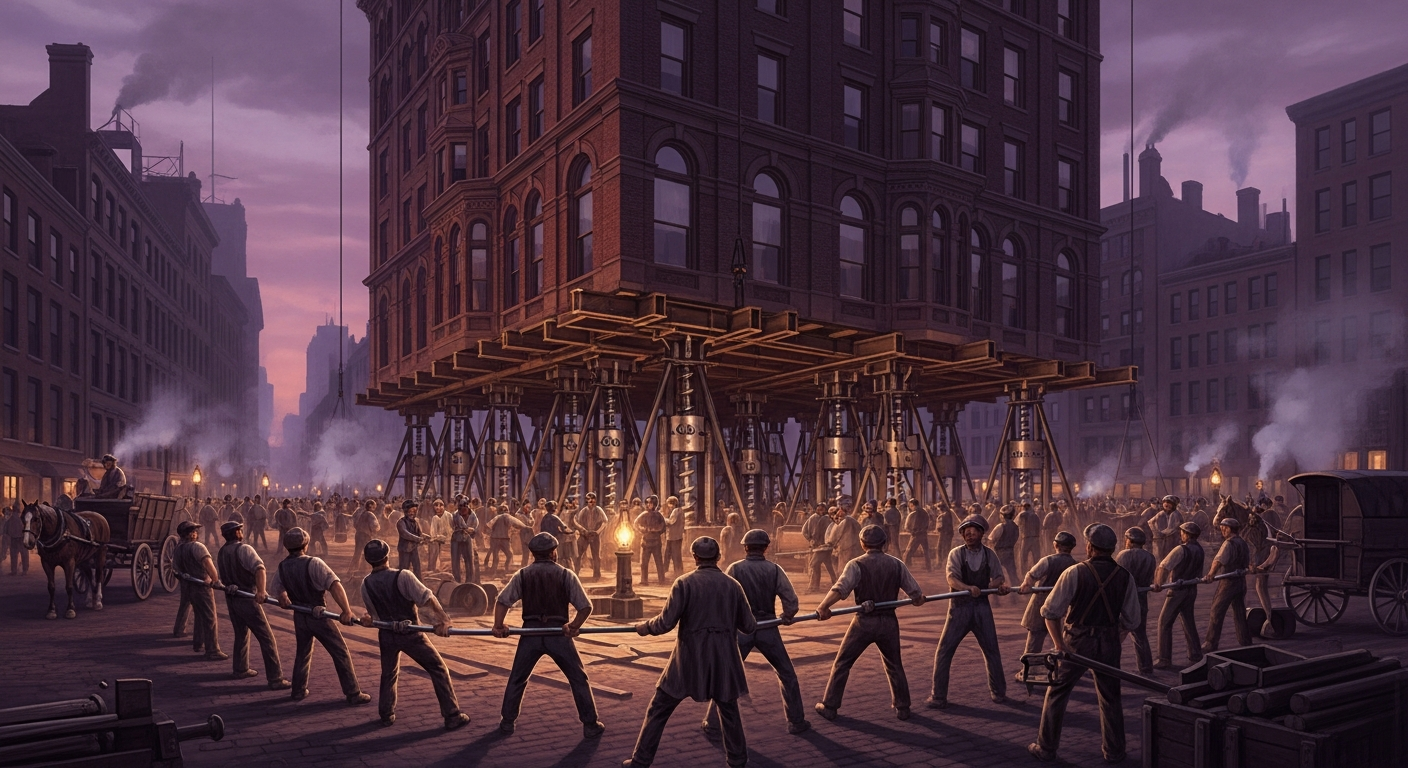
In the 1850s and ’60s, Chicago literally jacked up its entire downtown by 4 to 14 feet. Not a metaphor. They put hydraulic screw-jacks under entire city blocks — buildings, hotels, banks, sidewalks — and dozens to hundreds of men turned the jacks in synchronized rotations, raising four- and five-story brick buildings a fraction of an inch per turn over days and weeks. The Tremont Hotel was raised with guests still inside eating dinner. George Pullman (yes, the railroad Pullman) cut his teeth on this work before he got into sleeper cars.
Why? Because Chicago was built on a swamp six feet above Lake Michigan, with no natural drainage, and it was killing people — cholera, dysentery, typhoid. The only way to install gravity sewers was to raise the city above them. So they did. They raised the entire Loop.
The result: a lot of old Chicago buildings have a “garden level” or subbasement that used to be the actual ground floor. Windows that now look into dirt. Doorways that open into nothing. This is 100% real — and it’s exactly what the Tartaria and mud flood crowd points to as “evidence of a buried civilization.” The boring truth is that no civilization was buried. The city was lifted. The buildings didn’t sink. The street level rose around them. There are photographs of it happening. There are engineering papers. Harper’s Weekly ran illustrations. It’s one of the most audacious civil engineering feats of the 19th century, and it happened in broad daylight with tens of thousands of witnesses.
2. The freight tunnels
This is the wildest one and almost nobody knows about it. Between 1899 and 1906, a company called the Illinois Telephone and Telegraph Company got a city franchise to install telephone conduits under downtown. What they actually built, in secret, was over 60 miles of narrow-gauge railroad tunnels — 40 feet below street level, 6 feet wide, with two-foot-gauge electric locomotives hauling coal, freight, and mail between the basements of nearly every major building in the Loop.
When the scandal broke in 1906, the city was furious. But the tunnels were already built, and they were incredibly useful. For the next 50 years, little electric trains ran 24/7 under Chicago, delivering coal to building boilers, carrying ash out, moving freight between department stores, hauling US Mail between the post office and Union Station. At peak, there were 149 locomotives and 3,300 freight cars running down there.
The system was abandoned in 1959 and mostly forgotten. Locked up. Sealed. Thousands of workers in Loop skyscrapers walked past tunnel entrances in their basements every day without knowing what they were.
Then on April 13, 1992, a contractor driving pilings into the Chicago River bed cracked through the roof of one of the tunnels. The river started pouring in. Within hours, every connected basement in the Loop was flooding — Marshall Field’s, City Hall, the Board of Trade, the Merchandise Mart. Power was cut. The Loop was evacuated. Damage estimates hit one billion dollars. This is called the Great Chicago Flood of 1992, and it’s the moment the freight tunnels re-entered public consciousness after 30 years of being a sealed secret under everyone’s feet.
That’s all real. Look up “Chicago Tunnel Company.” The photos are astonishing. And every inch of it was built by named, paid humans with payroll records, not by Tartarians.
3. The Pedway, the CTA subways, and the Deep Tunnel
Briefly: the Pedway is a 40+ block underground pedestrian network connecting Loop buildings and CTA stations, built piecemeal from the 1950s onward. The CTA Red Line and Blue Line run in deep-bore tunnels from 1943 and 1951. And the Deep Tunnel (the Tunnel and Reservoir Plan) is 109 miles of tunnels bored 150 to 300 feet down through bedrock, 9 to 33 feet in diameter, designed to store stormwater and sewage overflow. Some sections are big enough to drive a train through. Started in 1975, still ongoing, exhaustively documented by the Metropolitan Water Reclamation District. You can take tours.
None of it is mysterious. All of it is extraordinary.
So was there mudfilling?
This is a precise question and it deserves a precise answer, because there’s a nuanced yes-and-no hiding in it.
The mud flood theory, stated fairly, says: sometime in the 1700s or 1800s, a global catastrophic event deposited 4 to 15 feet of mud worldwide, burying the ground floors of an earlier civilization. The evidence offered is sub-street-level windows, arched doorways that descend into dirt, and “buried” first floors.
On Chicago specifically: no, there was no mud flood. The buried-floor phenomenon is 100% explained by the raising I just described, and the direction of evidence is unambiguous — the buildings did not sink and the mud did not rise. The street level was deliberately lifted around stationary buildings. We know this because the raisings were photographed as they happened, engineering papers were published during and after, newspapers covered it daily, and the buildings that were raised are still standing at their raised levels with the architectural break visible. Buildings built after the raising sit on the new grade. There’s a clean line. A flood would have left sediment stratigraphy, waterline marks, and indiscriminate effects. Chicago shows surgical, block-by-block, documented elevation changes with matching municipal bond issues and payroll records.
But here’s the nuance: there really is a lot of fill under Chicago, and it’s worth naming separately so I’m not waving away something real.
When Chicago raised downtown, they didn’t levitate the streets — they filled the gap with soil, sand, and rubble brought in from pits, dredging, and quarries. So around the raised buildings there really is 4 to 10 feet of fill material that wasn’t there before. It was hauled in by workers and dumped deliberately, not deposited by a flood. Tens of thousands of cartloads.
There’s more. After the Great Chicago Fire of 1871, the burned-out rubble of most of downtown was hauled east and dumped into Lake Michigan to extend the shoreline. Grant Park, Millennium Park, and much of the near lakefront are sitting on fire debris plus later construction fill. When you stand in Millennium Park today, you’re standing on top of the ashes of 1871. The 1893 World’s Fair grounds at Jackson Park were sculpted from marshland by Frederick Law Olmsted’s crew, using excavated earth to shape the lagoons and landforms. When the fair ended, most of the White City — which was plaster over wood frame, built to be temporary, not ancient Tartarian masonry — was demolished or burned, and the debris was folded into further grading.
So: no global mud flood burying a lost civilization. Yes, staggering amounts of earth moved by humans, by name, on payroll, for documented reasons. The scale of 19th-century Chicago earth movement is genuinely breathtaking — breathtaking enough that I understand why someone seeing the buried-floor phenomenon for the first time might reach for a catastrophic explanation. But the human one involved thirty thousand laborers, hundreds of jackscrews, millions of cubic yards of dirt, a cholera epidemic, a fire that destroyed a third of the city, and one of the most ambitious municipal engineering campaigns in history. It’s not less impressive than a mud flood. It’s more impressive. And the people who did it have names.
Now let’s talk about the channel itself
I pulled up the full video list on Tartaria Vault — sixty-plus titles across the past few months — and once you look at it as a dataset instead of video by video, the production template becomes obvious. Here’s what I see.
Production signature. Videos are almost all 17 to 29 minutes long. Release rate is multiple per week, sustained for months. Titles follow a rigid formula: [Definite article] + [specific number or date] + [emotional verb of suppression] + [Tartaria keyword]. “The 1825 Hidden Heating Grid Beneath Berlin.” “Tennessee’s Forbidden Giant Discovery From 1845.” “The 1910 Flood That Revealed Tartaria Under Paris.” The channel’s own disclaimer, in the small print at the bottom of every description, says plainly: “exploratory interpretations… imaginative speculation… narrative storytelling rather than precise historical documentation… dramatized or intentionally constructed… generative tools.” The creator is telling you, in legal language, that it’s fiction dressed as investigation. Read the disclaimer again. It’s there.
This is an AI-assisted content farm. The cadence and uniformity are too high for one researcher doing primary-source work. A real historian takes weeks per episode. This channel ships one every two to three days. The business model is YouTube ad revenue plus affiliate links plus probably a Patreon tier, and the target audience is people who feel — correctly! — that official culture has blind spots, and who then incorrectly conclude that fringe content is therefore more honest.
The rhetorical tell. Every title uses a past-tense verb of suppression by an unnamed “they.” They renamed. They hid. They buried. They erased. They demolished. They covered up. A real history video would name the agent: “In 1963, the Pennsylvania Railroad demolished Penn Station under president Allen Greenough.” This channel never names the “they” because naming them would let you fact-check.
The six buckets. Sorting the titles, there are six distinct categories, each with its own trick.
Bucket one: real events reframed as Tartaria evidence. These are the dangerous ones because the event itself is real and you can verify it, and that reality halos the false framing. “The 1910 Flood That Revealed Tartaria Under Paris” — real event, the Great Flood of Paris, January 1910, extensively documented with photographs; false framing. “Tartaria’s Nuclear Winter — The 1816 Disaster” — real event, the Year Without a Summer, caused by Mount Tambora’s 1815 eruption, scientifically well-understood; false framing. “Operation Halifax: The Blast That Revealed the Old World” — real event, the Halifax Explosion of December 1917, two thousand dead, largest man-made explosion before nuclear weapons, exhaustively documented; false framing. “Tartarian Structures Unearthed During the Raising of Chicago — The 1874 Cover-Up” — the date is wrong (the raising was 1855–1872, and 1874 is three years after the Great Chicago Fire), but the real raising is real; the “Tartarian structures” are not.
Bucket two: giants. “Tennessee’s Forbidden Giant Discovery From 1845.” “Iowa’s Forbidden Giant Discovery From 1856.” “1883: The Year They Found Tartaria’s Giants And Erased Them.” “Tartaria’s Last Giants They Disguised as ‘Circus Freaks’.” That last one is the cruelest — it retroactively claims that Wadlow, André, Beaupré, and the rest were the “hidden survivors” of a giant race, using their real medical photographs as evidence for a fake civilization. I find it actively gross because it erases their medical reality and treats them as props.
Bucket three: hidden technology. “The 1915 Wireless Energy Pylons Beneath San Francisco.” “The 1835 Air-Powered Generators Beneath New York.” “Energy Chambers Found at Niagara Falls 1896.” “Stone Soft as Cloth — Tartaria’s Stone-Softening Technology.” This is the Tesla / free-energy / suppressed-technology strand, which takes real proto-electric history (the 1890s War of the Currents is an incredible true story) and injects a “suppressed” layer on top of it.
Bucket four: sovereign citizen content. “Birth Certificates — The System That Erased Old World Heritage.” “Your Ancestors Never Paid Taxes Until 1913 — Then They Made It a Crime.” “The Real Reason They Invented ‘Building Permits’.” “Your Family Name Was Changed to Erase Tartarian Heritage.” This is the most concerning bucket, because it’s not historical at all — it’s the sovereign citizen movement laundered through Tartaria aesthetics. The birth certificate / strawman / “we never paid taxes before 1913” cluster is a real legal-fringe ideology that has gotten people into serious trouble: tax charges, failure-to-register legal disasters, occasionally violent confrontations with police. The Southern Poverty Law Center tracks it. The FBI has a public advisory on it. Merging it with Tartaria is a pipeline — aesthetic-mystery content grooming an audience toward ideological content, then toward actionable fringe. If a video in this bucket ever convinces you to stop paying taxes or refuse to register a vehicle, please do not act on it without talking to an actual lawyer first.
Bucket five: architecture demolition as conspiracy. “Why They Demolished Every Hospital Built Before 1900” (354,000 views, one of the channel’s biggest hits). “The Dark Reason They Destroyed Tartaria’s Drinking Fountains.” “Tartaria’s Skyscrapers That Shouldn’t Exist in 1800s.” Same pattern as the towers. The real observation underneath — late-Victorian civic architecture was genuinely beautiful and was genuinely demolished in vast quantities between 1945 and 1975 — is true and worth grieving. The conspiracy framing is the free rider on that legitimate grief. Why were pre-1900 hospitals demolished? Because germ theory, electrification, and the shift from ward-based nursing to single-room care made them clinically obsolete by 1950. They were unrenovatable. Source: any history of American hospital architecture.
Bucket six: calendar and cosmic content. “The Missing Hour They Deleted From Every Clock.” “The 13th Month They Deleted From Every Calendar.” “They Renamed 1,213 Cities On A Single Day to Hide Tartaria.” The real history here is actually interesting — the 1582 Gregorian calendar reform did delete 10 days, different countries adopted it at different times, and there really were civic renamings in Stalin-era Soviet Russia (Tsaritsyn → Stalingrad, Saint Petersburg → Petrograd → Leningrad, etc.). None of it involves Tartaria, giants, or a hidden 13th month. It was astronomical correction and political renaming, both fully documented.
The thing I actually want you to take from this
I’m not here to talk anyone out of being interested in Tartaria content. The interest is legitimate. The aesthetic is legitimate. The grief for lost civic beauty is legitimate. The suspicion that official history has blind spots is correct — it does, it always has, and the Tartaria crowd is reacting to a real absence in the mainstream story. They’re just filling the absence with the wrong furniture.
The pattern I keep landing on is this: the Tartaria / lost-civilization genre works by taking genuinely fascinating, genuinely documented, genuinely under-appreciated history and re-packaging it as mystery by removing the citations. Chicago’s raising, the freight tunnels, the White City, the Year Without a Summer, the Paris flood, the Halifax explosion, the Gregorian calendar reform, the War of the Currents, the Beaux-Arts tradition, the real medical gigantism cases, the 19th-century newspaper giant folklore downstream of the Mound Builder myth — this is all amazing material. It deserves to be known. It’s the kind of stuff that should be on prestige documentary TV. But instead of telling that story, the conspiracy version strips out the names, dates, engineers, and newspaper records, and replaces them with a vague implication of something hidden.
The hidden thing isn’t hidden. It’s in the Chicago History Museum, the Newberry Library, Tribune microfilm, the MWRD archives, the American Water Works Association journals, Frederick Law Olmsted’s papers, the Smithsonian, and every engineering school library in the country. The Tartaria version isn’t revealing history. It’s un-crediting the humans who actually did the work.
George Pullman. Daniel Burnham. Frederick Law Olmsted. Ellis Chesbrough, the engineer who designed the Chicago sewer system and convinced the city to raise itself. The thousands of Irish, Polish, and Italian laborers who turned the jackscrews and bored the freight tunnels. Robert Wadlow. André the Giant. The Chicago firefighters who watched the Loop flood in 1992 and did not know what was under their feet. These people had names, lives, families, payrolls, and in many cases deaths on the job that the conspiracy story renders invisible — because a named laborer is harder to make mysterious than a lost race of giants.
That’s the part that actually bothers me. Not the wrongness of the claim, but the theft of credit from real people who did extraordinary work. The real world is not boring. It’s not suppressed. It’s stranger and sadder and more beautiful than any Tartaria script, and the people who built it deserve to be named.
If a specific video from that channel is still nagging at you, pick it and ask — not me necessarily, but someone with sources. Pick one claim. Trace it. Pull the string. The boring answer is almost always there waiting, and the boring answer is almost always better than the fake one.
The real secret under every city is that humans did this, and we keep forgetting it, and the job of history is to remember.
Go look up the Chicago freight tunnels. Start there. I promise it’s worth it.
✦ ⋆˚✧ ✦