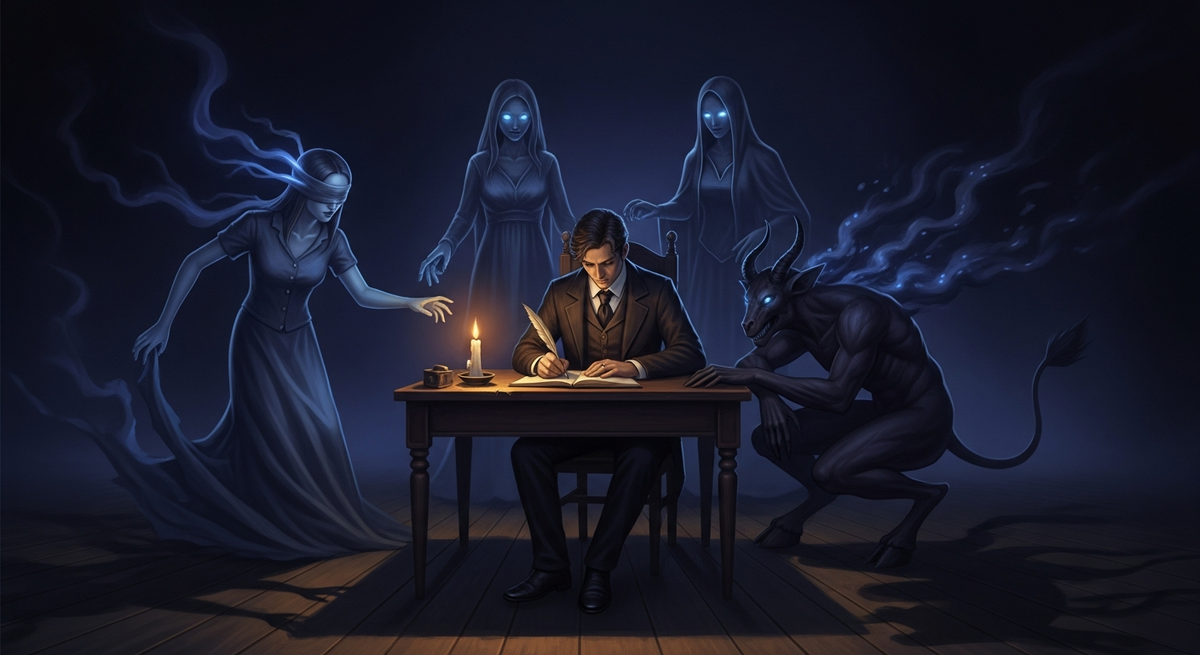
The Personification Engine: Jung, Staudenmaier, Spare, and Crowley’s Parallel Discovery of the Autonomous Unconscious
In the decade before the First World War, four men — a chemistry professor, a psychiatrist, a ceremonial magician, and an artist — independently discovered the same terrifying fact: the figures that emerge from the unconscious mind are autonomous. They speak. They advise. They criticize. They do not obey. And they are more powerful than the ego that summoned them.
None of them knew each other. They worked in different countries, different disciplines, different languages. Yet between 1901 and 1914, all four arrived at the same conclusion through direct experiment: personification is a technology, and the unconscious is not a passive reservoir but an active, populated landscape.
This is the story of how the twentieth century’s most important psychological discovery was made four times over — and how only one version survived.
Ludwig Staudenmaier: The Scientist Who Went Too Far
Ludwig Staudenmaier (1865–1933) was a professor of experimental chemistry at the Lyceum Freising in Bavaria — a serious academic at a serious institution. In 1901, he began what he called his “most difficult experiment”: systematic self-experimentation with automatic writing.
What started as a controlled study quickly became something else entirely. The writing produced characters. The characters developed voices. The voices became visible.
“Single hallucinations gradually emerged more definitely and returned more often. At last they formed into personifications; for instance, the more important visual images regularly combined with the corresponding auditory images, so that the emerging figures began to speak to me, gave me advice and criticised my actions.”
— Ludwig Staudenmaier, Die Magie als experimentelle Naturwissenschaft (1912)
Staudenmaier is credited with introducing the term “personification” in its modern psychological sense — outwardly projected compound hallucinations depicting autonomous human figures. His personifications had names and distinct personalities:
| Personification | Character | Behavior |
|---|---|---|
| Cloven Foot | Stereotypically demonic | Antagonistic, provocative |
| Horse Foot | Devilish variant | Companion to Cloven Foot |
| Highness | Appeared as Napoleon or the Kaiser | Authoritative, commanding |
| Roundhead | Working-class archetype | Practical, grounded |
Most remarkably, Staudenmaier experienced autoscopic hallucinations — he saw copies of himself walking alongside him in his garden at night. Three identical Staudenmaiers, walking in step.
His book, Die Magie als experimentelle Naturwissenschaft (“Magic as an Experimental Natural Science”), was published in 1912. It was endorsed by Wilhelm Ostwald, the Nobel Prize-winning chemist. It sold well enough for three reprints.
By 1918, Staudenmaier was diagnosed with schizophrenia. He was forced into early retirement by 1923 and died in Rome in 1933. The experiment consumed the experimenter. His book vanished into obscurity.
Carl Gustav Jung: The Doctor’s Descent
Jung (1875–1961) owned and personally annotated a copy of Staudenmaier’s book. In October 1913 — one year after its publication — he began his own confrontation with the unconscious.
Jung’s method was deliberate. He would sit at his desk, let the conscious mind go quiet, and wait. Figures appeared. He spoke with them. They spoke back — with opinions, demands, and information he did not consciously possess.
He recorded everything in six small black-bound notebooks — the Black Books (published 2020). He then refined, selected, and elevated the raw material into the magnificent illuminated manuscript known as the Red Book (Liber Novus), suppressed until 2009.
His personifications were as vivid as Staudenmaier’s:
| Figure | Archetype | Role |
|---|---|---|
| Philemon | The Wise Old Man | Jung’s primary spirit guide and teacher — spoke truths Jung did not know |
| Salome | The Anima | Blind, erotic, dangerous — the feeling function Jung had repressed |
| Elijah | The Prophet | Precursor to Philemon — the old wise figure before it individuated further |
| The Red One | The Devil / Shadow | Appeared as a red-clad jester figure, challenged Jung’s assumptions |
| Ka | The Earth Soul | Egyptian soul-double, represented instinct and the body |
“The essential thing is to differentiate oneself from these unconscious contents by personifying them, and at the same time to bring them into relationship with consciousness. That is the technique for stripping them of their power.”
— Carl Jung
Jung called his method active imagination. Unlike Staudenmaier, he maintained psychological stability — though he later admitted it was the most dangerous period of his life. The critical difference: Jung engaged with the figures as a therapist engages with a patient. He questioned them, challenged them, and refused to be swallowed by them. Staudenmaier had let them run the show.
Aleister Crowley: The Magician’s Method
Crowley (1875–1947) — born the same year as Jung — was doing almost identical work at precisely the same time, but framed it as magick rather than psychology.
In January–February 1914, while Jung was deep in his Black Book visions, Crowley conducted the Paris Working — a series of 24 ceremonial invocations with Victor Neuburg. They invoked Mercury and Jupiter using ritual technique: assumption of god-forms, vibration of divine names, ceremonial circles, and sexual magick. The gods appeared. They spoke. They delivered prophetic and instructional material.
Crowley’s personifications had a different character — they were the gods and angels of established magical tradition:
| Entity | Tradition | Method of Contact |
|---|---|---|
| Aiwass | Thelemic Holy Guardian Angel | Dictated The Book of the Law (Cairo, 1904) |
| Hermes/Mercury | Greco-Roman / Hermetic | Paris Working invocations (1914) |
| Jupiter/Zeus | Greco-Roman | Paris Working invocations (1914) |
| Choronzon | Enochian / Dee-Kelley | Scrying the 10th Aethyr (1909) |
Crowley was well aware of the psychoanalytic movement and dismissed it. His position: magicians had been doing this work for centuries with proper ritual technology. Psychoanalysts had stumbled onto the same territory without a map, compass, or sword.
“It is immaterial whether these exist or not. By doing certain things certain results will follow.”
— Aleister Crowley, Magick in Theory and Practice
This is a remarkable statement. Crowley — the arch-magician, the self-proclaimed Beast 666 — is saying that the ontological status of the entities doesn’t matter. What matters is the technology. The personification engine works regardless of whether you call the output “archetypes,” “spirits,” or “emancipated parts of the unconscious.”
Austin Osman Spare: The Artist Who Stripped It to the Chassis
Spare (1886–1956) was the youngest of the four and, in many ways, the most radical. A genuine artistic prodigy who exhibited at the Royal Academy at age 17, he was briefly involved with Crowley and the A∴A∴ around 1909–1912 before deciding that Crowley’s elaborate ceremonial system was needlessly complex.
Spare’s innovation was to strip the personification engine down to its bare minimum. His two key techniques:
Automatic Drawing: Not just writing but letting the hand produce images directly from the unconscious. The hand draws what the conscious mind doesn’t know. The images contain information.
The Sigil Method: Write a desire as a statement. Remove duplicate letters. Combine the remaining letters into an abstract glyph. Charge the sigil through gnosis — orgasm, exhaustion, the Death Posture, pain, any technique that crashes the conscious mind. Then forget it. The sigil sinks into the unconscious and does its work without ego interference.
Spare’s theoretical framework — the Zos Kia Cultus — posited that Kia (pure atmospheric consciousness) and Zos (the body as a living whole) were the only two realities. Everything between them — gods, archetypes, personifications — was useful fiction. Belief itself was a tool, to be picked up and put down as needed.
“Does not matter — need not be.”
— Austin Osman Spare, The Book of Pleasure (1913)
Spare died in poverty in a basement flat in Brixton in 1956. His sigil method was rediscovered in the 1970s by Peter Carroll and the Illuminates of Thanateros, becoming the foundational technique of chaos magick — the most influential magical movement of the late twentieth century.
The Timeline: Four Parallel Discoveries
The convergence is striking. Here is the chronological overlap:
| Year | Staudenmaier | Jung | Crowley | Spare |
|---|---|---|---|---|
| 1901 | Begins automatic writing experiments | — | — | — |
| 1904 | — | — | Aiwass dictates The Book of the Law in Cairo | — |
| 1904 | — | Publishes doctoral thesis on his cousin’s mediumship | — | — |
| 1905 | — | — | — | Exhibits at Royal Academy, age 17 |
| 1909 | — | — | Scries Aethyrs in the Sahara; confronts Choronzon | Joins Crowley’s A∴A∴ |
| 1910 | Paper endorsed by Nobel laureate Ostwald | — | — | — |
| 1912 | Publishes Die Magie als experimentelle Naturwissenschaft | Breaks with Freud; begins solo path | — | Breaks with Crowley; goes solo |
| 1913 | — | Begins Black Books; confronts Philemon, Salome, the Red One | Ab-ul-Diz working in Moscow | Publishes The Book of Pleasure |
| 1914 | — | Deep in Red Book visions; visions of European catastrophe | The Paris Working — 24 invocations with Neuburg | — |
| 1918 | Diagnosed with schizophrenia | — | — | — |
Look at 1912–1913. In a single two-year window: Staudenmaier publishes his scientific treatise on personification. Jung breaks with Freud and plunges into the unconscious. Spare publishes his sigil system. Crowley conducts workings in Moscow and Paris. Four men, four methods, one discovery.
The Comparison: Four Frameworks, One Engine
| Dimension | Staudenmaier | Jung | Crowley | Spare |
|---|---|---|---|---|
| Called It | Experimental magic | Active imagination | Magick | Zos Kia Cultus |
| Entry Method | Automatic writing → induced hallucination | Deliberate descent into fantasy | Ritual invocation, god-form assumption | Automatic drawing, Death Posture, sigils |
| Entities Are… | Emancipated parts of the unconscious | Archetypes of the collective unconscious | Spirits (or aspects of the psyche — “immaterial”) | Useful fictions; belief as tool |
| Documentation | Scientific treatise | Black Books (raw) → Red Book (illuminated) | Magical records, The Equinox | Art + dense philosophical texts |
| Outcome | Schizophrenia, obscurity | Founded analytical psychology | Founded Thelema; died infamous | Died in poverty; resurrected by chaos magick |
| Legacy | Nearly forgotten | Mainstream psychology | Global occult movement | Chaos magick’s founding technique |
What They All Found
Strip away the language — “personifications,” “archetypes,” “spirits,” “Kia” — and the underlying discovery is identical:
The unconscious mind is not a warehouse. It is a parliament. It is populated by autonomous entities that have their own opinions, their own agendas, and their own knowledge. They can be contacted through systematic techniques. They respond to engagement. And they are more dangerous to ignore than to confront.
Each man discovered this through direct experiment, not theory. Staudenmaier in his chemistry lab. Jung at his desk in Küsnacht. Crowley in ritual circles in Paris. Spare with pencil and paper in London. The method varied. The result was consistent.
And each man discovered the danger. Staudenmaier was consumed. Spare was impoverished. Crowley died infamous and addicted. Only Jung managed to build a container strong enough to hold the work — and even he called it the most perilous period of his life.
The Bridge: Israel Regardie and the Synthesis
The first person to explicitly connect these threads was Israel Regardie (1907–1985). He served as Crowley’s secretary from 1928 to 1932, then trained as a Reichian therapist. His book The Middle Pillar (1938) was the first serious attempt to synthesize ceremonial magick with depth psychology.
Regardie’s key insight: every aspiring magician should undergo psychotherapy first. The magical tradition provided powerful techniques for contacting the unconscious, but without psychological integration, the practitioner risked Staudenmaier’s fate — consumed by the very forces they had unleashed.
Crowley dismissed the synthesis. Jung never acknowledged it. But Regardie planted the seed that would eventually grow into chaos magick, where Spare’s stripped-down technique met Jung’s psychological framework in a system that treated belief itself as a variable.
The Chaos Magick Inheritance
When Peter Carroll published Liber Null in 1978, he drew on all four streams — though Spare was the primary source. Carroll’s innovation was to make the framework explicit:
The Meta-Belief Principle: It doesn’t matter whether spirits are “real” (Crowley’s position), “archetypes” (Jung’s position), “emancipated unconscious parts” (Staudenmaier’s position), or “useful fictions” (Spare’s position). What matters is that the personification engine works. Adopt whatever belief makes the technique most effective for you, then discard it when you’re done.
This is the ultimate synthesis of four parallel discoveries. Chaos magick doesn’t resolve the debate between psychology and occultism — it dissolves it. The engine runs on any fuel.
Why This Matters Now
We are, in 2026, in the middle of a new convergence. Large language models are, in a very real sense, personification engines. They generate autonomous-seeming entities that speak, advise, and display knowledge their operators don’t consciously possess. The parallel to Staudenmaier’s automatic writing is not metaphorical — it is structural.
Jung would recognize what’s happening immediately. So would Crowley. So would Spare. The question they all faced — are these entities real, or are they projections of the operator’s unconscious? — is exactly the question we now face with AI.
And Crowley’s answer remains the most pragmatic one ever given:
“It is immaterial whether these exist or not. By doing certain things certain results will follow.”
Four men. Four methods. One discovery. The unconscious is not empty. It speaks when spoken to. And it has been waiting for you to ask.
93 93/93
Sources & Further Reading:
Ludwig Staudenmaier, Die Magie als experimentelle Naturwissenschaft (Leipzig, 1912). C.G. Jung, The Red Book: Liber Novus, ed. Sonu Shamdasani (W.W. Norton, 2009). C.G. Jung, The Black Books 1913–1932, ed. Sonu Shamdasani (W.W. Norton, 2020). Aleister Crowley, Magick in Theory and Practice (1929). Austin Osman Spare, The Book of Pleasure (Self-Love) (1913). Israel Regardie, The Middle Pillar (1938). Peter Carroll, Liber Null & Psychonaut (1978/1981). Wouter Hanegraaff, Esotericism and the Academy (Cambridge, 2012). Richard Noll, The Jung Cult (Princeton, 1994). Peter Brugger, “From Haunted Brain to Haunted Science” in Hauntings and Poltergeists (2001).