Tribble Fan Fiction #13: Tribble Fiction
Tribble Fan Fiction #13
I. The Briefcase
“You know what they call a tribble in Paris?”
Vincent Vega was leaning against the wall of the apartment building, smoking a cigarette with the languid carelessness of a man who had recently returned from three years in Amsterdam and still hadn’t readjusted to the pace of Los Angeles crime. Jules Winnfield stood beside him, adjusting the collar of his black suit with the precise attention of someone who believed that looking professional was a moral imperative, even — perhaps especially — when you were about to do something deeply unprofessional.
“They don’t call it a tribble?” Jules asked.
“No, man, they got the metric system. They don’t know what a tribble is.”
“They got tribbles in Paris, Vincent.”
“Yeah, but they call ’em les boules de fourrure. ‘The fur balls.’ They got a whole café where you can sit and hold one while you drink your coffee.”
“That’s some gourmet stuff right there.”
“That is some gourmet stuff.”
They were here for a briefcase. Marsellus Wallace’s briefcase — the one that had been taken by three college kids who were either very brave or very stupid, and who were about to discover that the difference was academic. The briefcase was upstairs. The combination was 666. What was inside was not their business.
What was inside was absolutely their business, and they both knew it, and neither of them talked about it, because talking about what was inside the briefcase was the kind of conversation that ended with someone in a trunk.
II. Ezekiel 25:17
The apartment smelled like fast food and fear. Three kids — Brett, Roger, and Marvin — sat on a couch that had seen better decades, surrounded by Big Kahuna Burger wrappers and the quiet desperation of people who know they’ve made a mistake but haven’t yet figured out how big.
Jules ate Brett’s hamburger. He did this slowly, deliberately, with a commentary on the quality of the burger that was simultaneously a food review and a death threat. Vincent stood by the door, his gun visible but not raised, radiating the calm menace of a man who considered violence a trade skill.
“Now,” Jules said, wiping his mouth with a napkin. “I want you to go in that kitchen and get me the briefcase.”
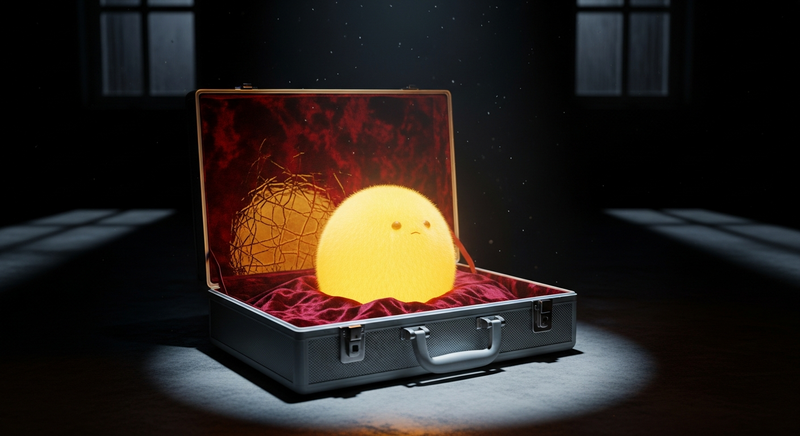
Brett got the briefcase. It was silver, heavy, and warm. Warm in a way that metal shouldn’t be. Jules took it. He set it on the table. He entered the combination — 6, 6, 6 — and opened it.
The room filled with golden light.
And purring.
Inside the briefcase, nestled on a bed of golden velvet, was a tribble. But not any tribble — a tribble that glowed. Its fur was luminous gold, radiating a warm, honeyed light that made everything in the room look softer, kinder, more beautiful. It purred at a frequency that Jules felt in his sternum, in his heartbeat, in the part of his brain that remembered being a child and feeling safe.
Jules stared at it. His expression — usually a mask of controlled authority — went slack. His eyes widened. His lips parted.
“That’s beautiful,” he whispered.
Vincent looked over his shoulder. He saw the glow. He heard the purr. He said nothing for a long time.
“Is that a tribble?” he finally asked.
“That,” Jules said, “is the tribble.”
“The path of the righteous man is beset on all sides by the inequities of the selfish and the tyranny of evil men. But the righteous man does not shoot a tribble. The righteous man carries the tribble home.” — Jules Winnfield, revised sermon
III. Mia Wallace’s Evening
Vincent was supposed to take the boss’s wife to dinner. This was a job, not a date, and the distinction was important because the last man who blurred that line had been thrown out of a fourth-story window and now ate his meals through a straw.
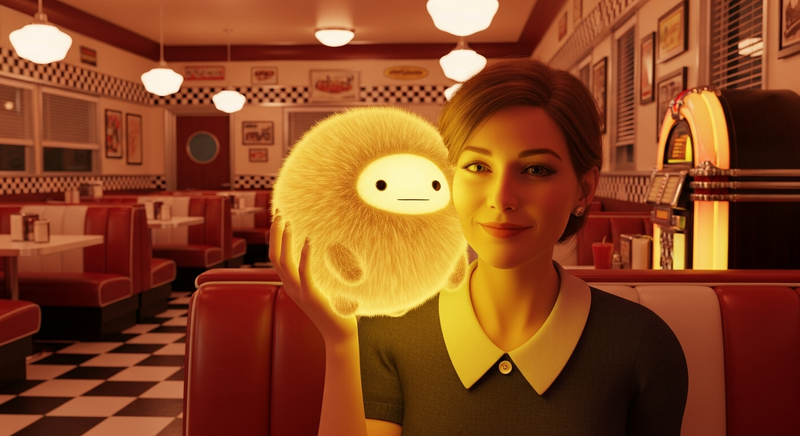
Mia Wallace was exactly as dangerous as advertised — dark-haired, sharp-eyed, and possessed of a wit that could cut glass at fifty paces. She wore a white shirt and black pants and moved through Jackrabbit Slim’s — a 1950s-themed restaurant staffed by celebrity impersonators — with the controlled grace of someone who knew she was being watched and enjoyed it.
“So,” she said, sliding into the booth across from Vincent. “What’s in the briefcase?”
“I can’t tell you that.”
“Marsellus never told me what’s in the briefcase. Does he think I’d steal it?”
“I think he thinks you don’t need to know.”
“I’m his wife.”
“Exactly.”
Mia studied Vincent with the focused intensity of someone reading fine print on a contract she was about to sign. Then she smiled — a small, dangerous smile that Vincent felt in his spine.
“Show me.”
He shouldn’t have. He knew he shouldn’t have. But Mia Wallace had a way of making “shouldn’t” feel like “probably fine,” and Vincent had spent three years in Amsterdam where “probably fine” was a lifestyle.
He opened the briefcase under the table. The golden glow spilled out across their knees. The tribble purred. Mia leaned down. Her eyes caught the light and for a moment — just a moment — the most dangerous woman in Los Angeles looked like a kid on Christmas morning.
“Oh my God,” she said. “It’s a little fur ball.”
“It’s Marsellus’s little fur ball.”
“Can I hold it?”
“Absolutely not.”
She held it. Of course she held it. She lifted the glowing tribble out of the briefcase and held it against her cheek, and it purred, and Mia Wallace — who had snorted cocaine off a mirror, who had nearly died on a bathroom floor, who had married a man that people were afraid to make eye contact with — closed her eyes and smiled like a person who had forgotten what peace felt like and just remembered.
“I want one,” she said.
“It’s not mine to give.”
“Everything is someone’s to give, Vincent. You just have to ask nicely enough.”
IV. The Diner
“Everybody be cool, this is a robbery!”
Pumpkin — real name Ringo — was standing on a booth in a Hawthorne Grill at 7:30 in the morning, waving a gun at approximately forty-five people who were trying to eat breakfast. His girlfriend Honey Bunny — real name Yolanda — was standing beside him, also waving a gun, with the manic energy of someone who had just consumed four cups of coffee and a life-changing amount of adrenaline.
“Any of you pricks move, and I’ll execute every last one of you!”
In a corner booth, Jules Winnfield was eating breakfast. Across from him was the briefcase. Inside the briefcase was the tribble. Jules had been having a crisis of faith — a genuine, floor-of-the-soul reckoning with violence, purpose, and the nature of redemption — and the tribble was not helping, because every time he opened the briefcase and saw that golden glow and heard that purr, he felt something that was either divine grace or a really impressive endorphin response, and he couldn’t tell the difference.
Pumpkin reached their table. “Open the case.”
“You don’t want to do that,” Jules said.
“I said open the damn case!”
Jules opened the case. The golden light spilled across the table, across Pumpkin’s face, across the entire diner. The tribble purred. The sound filled the room the way sunrise fills a valley — slowly, completely, undeniably.
Pumpkin stared. His gun hand dropped an inch. His mouth opened.
“What… what is that?”
“That,” Jules said, “is what grace looks like. Grace, and a small, round, fuzzy creature that eats hamburgers and purrs at twenty-six hertz.” He picked up the tribble and held it out. “You want to hold it?”
Pumpkin, whose day had started with a decision to rob a diner and was now confronting the possibility that the universe contained things worth not stealing, took the tribble. It purred against his palm. His hand was shaking. The gun was on the table. Honey Bunny was staring from across the room, her own weapon lowered to her side.
“It’s warm,” Pumpkin said.
“Yeah,” Jules said. “It is.”
V. Redemption
Jules let them go. He gave Pumpkin and Honey Bunny the cash from his wallet — fifteen hundred dollars — and told them to walk out of the diner and never rob anyone again. He said this with the calm conviction of a man who had decided, in the space between a burger and a tribble, that he was done with violence.
“I’m retiring,” he told Vincent, as they walked out of the diner into the bleached Los Angeles morning. “I’m walking the earth. Like Caine in Kung Fu.”
“And the tribble?”
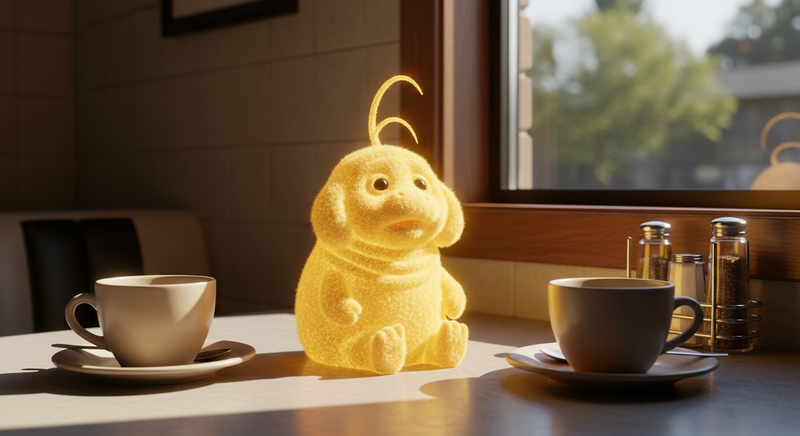
Jules looked at the briefcase. He looked at the sky. He looked at the tribble, which was purring inside its golden velvet bed with the absolute contentment of a creature that had never questioned its purpose because its purpose was simply to be warm and present.
“I’m taking it with me,” Jules said. “Marsellus can find another briefcase.”
“He’ll kill you.”
“Maybe. But I’ve been on the giving end of that equation my whole life, and where did it get me? Standing in diners, pointing guns at people who are eating breakfast.” He opened the briefcase one more time. The glow. The purr. The golden light on his face. “This thing — this little fur ball — it doesn’t do anything. It doesn’t fight. It doesn’t scheme. It doesn’t have enemies or debts or a past it’s running from. It just sits there and makes people feel, for one second, like everything might be okay.”
“That’s worth dying for?” Vincent asked.
Jules closed the briefcase. “That’s worth living for.”
He walked away. The briefcase glowed faintly through its seams. Somewhere inside, the tribble purred.
Jules Winnfield was never seen in Los Angeles again. Reports of a large, Bible-quoting man carrying a glowing briefcase surfaced periodically from small towns across the American Southwest — Flagstaff, Sedona, Taos. In each town, he stayed for a few days, showed the tribble to anyone who seemed like they needed it, and moved on. He never charged for this service. When asked what was in the briefcase, he always said the same thing: “Something beautiful, man. Something that purrs.” Marsellus Wallace searched for the briefcase for three years before giving up. The official reason was “asset depreciation.” The real reason was that even Marsellus Wallace, deep down, understood that some things aren’t meant to be owned.