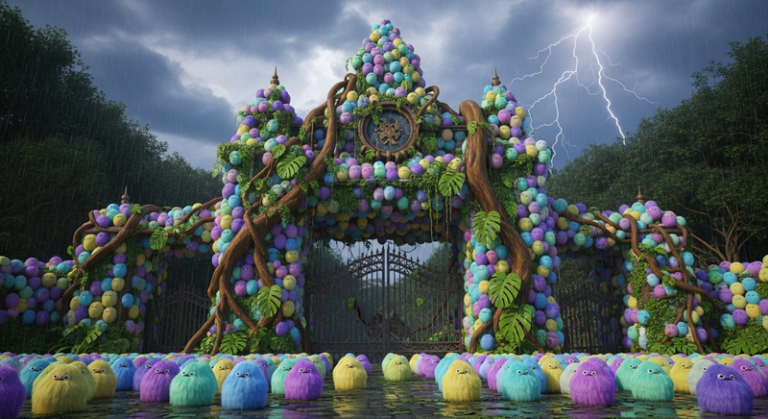
Tribble Fan Fiction #15: Game of Tribbles
Tribble Fan Fiction #15
I. A Tribble Has No Name
Winter was coming. It had been coming for quite some time, as winters do in Westeros, where the seasons have the courtesy to announce themselves years in advance but the discourtesy to last a decade.
The tribble arrived at Winterfell in the pocket of a traveling merchant from Essos — a spice trader who claimed it was a “Qartheen comfort creature” and sold it to Sansa Stark for three silver stags. The merchant was a liar, as all merchants in Westeros are liars, but the tribble was real. It was small and white, the color of the first snowfall, and it purred when Sansa held it against her cheek.
“What is it?” Arya asked, poking it with one finger.
“It’s mine,” Sansa said, with the possessive clarity of a girl who had lost nearly everything and intended to keep whatever the universe saw fit to give back.
“It doesn’t do anything.”
“It purrs.”
“So does a cat. Cats also kill mice. What does this thing do besides sit there?”
“It sits there beautifully.”
Arya rolled her eyes. Arya had been rolling her eyes since she was old enough to recognize that the world contained things not worth looking at, which in Arya’s estimation was most things. But she reached out and touched the tribble, and it purred louder, and for one half-second — so brief that only someone watching very carefully would have seen it — Arya Stark smiled.
“It’s okay, I guess,” she said.
Jon Snow, standing by the fire with the brooding intensity of a man who had been told he knew nothing so many times he’d started to believe it, said: “We should show it to Ghost.”
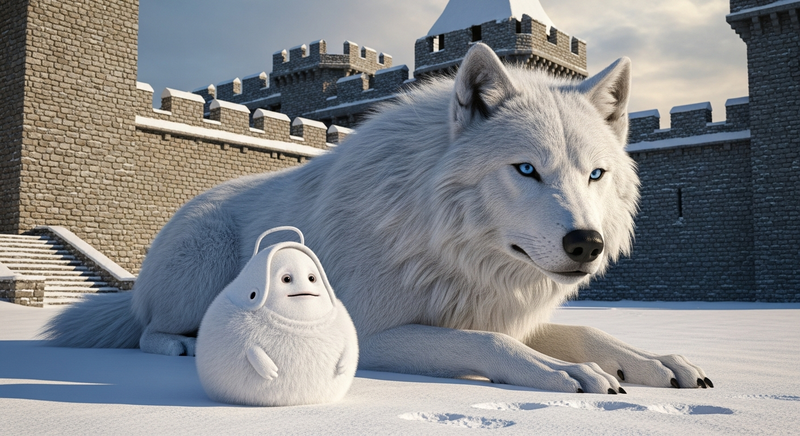
They showed it to Ghost. The direwolf sniffed the tribble once, sneezed, and walked away. The tribble purred at his retreating tail. Ghost did not look back. He was a wolf. Wolves do not acknowledge tribbles.
II. The Small Council
The tribble multiplied, because that is what tribbles do, and within a fortnight there were seventeen of them in Winterfell. They were discovered in the kitchens (eating grain), in the great hall (purring on the high table), in the crypts (purring on the tombs of dead Starks, which was either disrespectful or deeply comforting depending on your theology), and in Hodor’s arms (Hodor had found three and was carrying them everywhere, saying “Hodor” with a tenderness that suggested the word had always meant “small, warm, perfect thing”).
Tyrion Lannister, visiting Winterfell as Hand of the Queen, encountered the tribbles during a meeting of the provisional Small Council. He was mid-sentence — delivering a characteristically brilliant observation about grain taxation — when a tribble rolled across the table and bumped into his wine goblet.
Tyrion looked at the tribble. The tribble looked at Tyrion. It purred.
“I’ve been in King’s Landing for twenty years,” Tyrion said, picking it up. “I’ve survived assassination attempts, wildfire, a trial by combat, and my own father. Nothing — and I mean nothing — has ever made me feel as immediately at peace as this ridiculous ball of fur.”
“It’s a tribble,” Sansa said.
“It’s a miracle,” Tyrion said. “A small, round, purring miracle. I want twelve.”
“You can’t have twelve.”
“I’m Hand of the Queen.”
“You can have two.”
“Seven. I’ll settle for seven. One for each of the gods.”
“Three.”
“Done.”
“I drink, and I know things. What I know now is that I would trade every vintage in the Lannister cellars for one more minute with this fur ball on my lap.” — Tyrion Lannister
III. The Iron Throne
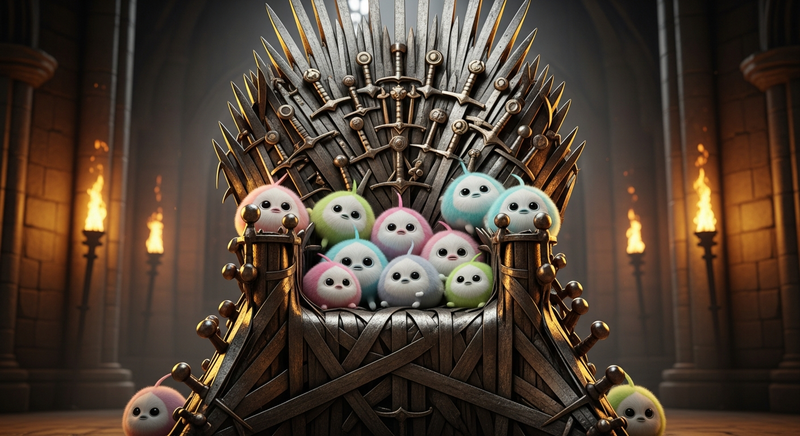
The tribbles reached King’s Landing in the baggage train of a supply convoy. By the time anyone noticed, they were everywhere — in the Red Keep, in Flea Bottom, in the Dragonpit, in the Sept (rebuilt after the unfortunate wildfire incident). They ate grain from the royal stores. They purred in the throne room. They colonized the Iron Throne itself — twelve tribbles nested between the swords, purring in the uncomfortable seat that had killed more kings than warfare.
Daenerys Targaryen — Daenerys Stormborn, the Unburnt, Mother of Dragons, Breaker of Chains, and a woman who had run out of patience for creatures that were not dragons approximately three years ago — stood before the Iron Throne and stared at the tribbles.
“What,” she said, “are those?”
“Tribbles, Your Grace,” said Grey Worm, who had faced the Army of the Dead without flinching but was now standing at what he clearly considered a safe distance from the throne.
“They’re on my throne.”
“Yes, Your Grace.”
“Remove them.”
Grey Worm approached the throne. He reached for a tribble. The tribble purred. Grey Worm’s hand stopped. He stood there, one of the most disciplined warriors in the world, frozen by the sound of a small creature being happy.
“They are… warm, Your Grace,” he said.
“I don’t care if they’re warm. They’re on my throne.”
“Perhaps,” Tyrion said, from behind his wine goblet, “the throne is more comfortable with them on it. It was built from a thousand swords and has never once been described as pleasant to sit in. The tribbles may be an improvement.”
Daenerys sat on the Iron Throne. The tribbles did not move. They purred against her legs, her arms, the hard metal edges of a seat forged in dragonfire by a conqueror who had not considered ergonomics. The swords, which had drawn blood from every king who sat carelessly, could not reach her through the tribbles. They were a cushion. A living, purring cushion.
“This is absurd,” Daenerys said.
“Many things in this kingdom are absurd, Your Grace,” Tyrion said. “These are the first absurd things that purr.”
She kept them. The Mother of Dragons, First of Her Name, sat on a throne padded with tribbles, ruling a kingdom that had been torn apart by war and ambition, and for the first time in the history of the Iron Throne, the person sitting in it was comfortable.
IV. Winter Is Purring
When the White Walkers came — the Army of the Dead, marching south with the relentless patience of a glacier — the tribbles did something no one expected.
They screamed.
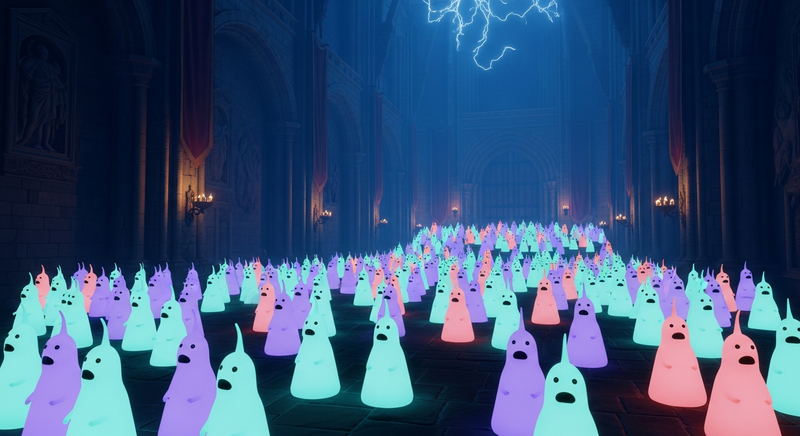
Every tribble in Winterfell, in King’s Landing, in every castle and farmhouse and roadside inn across Westeros — thousands of tribbles, all at once — emitted a high-pitched shriek that shattered windows and stopped conversations and made strong men cover their ears. It was the same sound tribbles made around Klingons, in another universe, for the same reason: the White Walkers smelled like death, and tribbles knew death the way they knew warmth — instinctively, totally, without ambiguity.
The shrieking didn’t stop the dead. Nothing stopped the dead except dragonglass and fire and the courage of people who fought knowing they would probably lose. But the shrieking warned. Every village between the Wall and the Neck had twelve hours’ notice of the Army’s approach, because the tribbles screamed before the ravens flew. Twelve hours to evacuate. Twelve hours to arm. Twelve hours to run.
The tribbles saved more lives than any army in Westeros.
After the Long Night — after the fire and the ice and the impossible, terrible, beautiful victory — the survivors gathered in the ruins of Winterfell. The dead were burned. The living were counted. And in the great hall, which had lost its roof and most of its walls, a single white tribble — Sansa’s original, the one she’d bought from a lying merchant for three silver stags — sat on the high table and purred.
It had survived the battle. No one knew how. Tribbles couldn’t fight. They couldn’t run. They couldn’t even roll faster than a gentle walking pace. But this one — small and white and impossibly alive — sat in the wreckage of the most terrible battle in the history of Westeros and purred at the survivors as if to say: I’m here. You’re here. We made it.
Sansa picked it up. She held it against her chest. She didn’t cry — Sansa Stark had used up her tears somewhere between King’s Landing and the Battle of the Bastards — but she held the tribble, and she closed her eyes, and she felt its warmth against the cold, and for one moment, the Queen in the North was not a queen. She was a girl with a pet that loved her. And that was enough.
The tribbles of Westeros became a protected species under the new Six Kingdoms charter, championed by King Bran the Broken, who said simply: “They saw the dead before we did. We owe them grain.” Tyrion kept three in his quarters at the Red Keep until his death at the age of eighty-two, surrounded by books, wine, and fur balls. The Iron Throne was eventually dismantled and replaced with a wooden chair — but the tribbles remained. They still purr in the throne room of King’s Landing, generations later, warm and round and content, a living reminder that even in the coldest winter, something soft survives.