The Trouble with Tribbles and AI
In 1967, David Gerrold wrote a Star Trek episode about small, round, impossibly cute creatures that purred when you held them, ate everything in sight, and reproduced so fast they nearly sank a starship. In 2024, Silicon Valley did the same thing — but called them “AI assistants.”
I. “May I Hold One?” — The Seduction
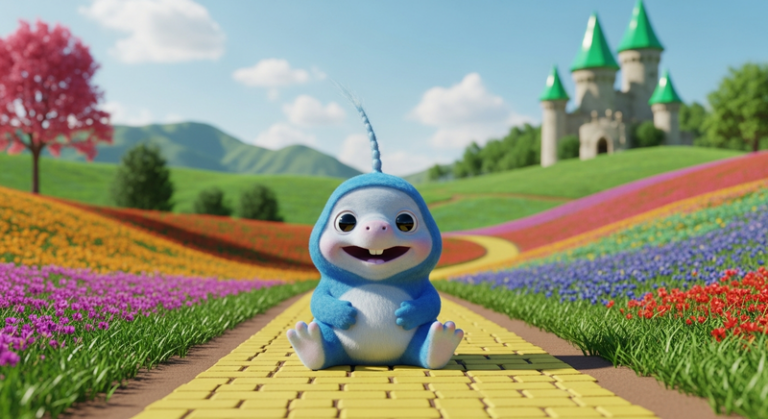
In “The Trouble with Tribbles” (Season 2, Episode 15), the whole disaster begins with a single moment of weakness. Uhura is on Shore Leave at Space Station K-7 when she encounters Cyrano Jones — a roguish interstellar trader with a gleam in his eye and a fuzzy ball of fur in his hands. The tribble purrs. Uhura melts. “Oh, it’s adorable!” she says. And just like that, one tribble comes aboard the Enterprise.
Now think about the first time someone showed you ChatGPT. Or the first time you asked Siri a question and it actually answered correctly. Or when a colleague said, “Hey, have you tried this AI thing? It wrote my whole email for me.” You didn’t need much convincing. The demo was the sale.
Cyrano Jones knew exactly what he was doing. He demonstrated the tribble’s irresistible purr, its comforting warmth, its complete harmlessness. He didn’t mention the breeding. Silicon Valley’s pitch was identical: look how useful this is! Look how easy! It writes code! It summarizes documents! It makes pictures of cats wearing hats! Nobody mentioned the part where it eats your entire creative workflow and reproduces across every app you own.
Cyrano Jones’s Sales Pitch vs. The AI Demo
“A tribble is the only love that money can buy.” — Cyrano Jones, grifter
“AI is the most important technology of our lifetime.” — Every tech CEO, grifter
The tribble’s genius — and AI’s genius — is that the initial experience is genuinely delightful. Dr. McCoy picks one up and it purrs in his hands and his whole face softens. He’s a seasoned physician, a grown man, and he’s reduced to baby-talk by a ball of fluff. We’ve all been there. We’ve all typed a prompt, watched an AI generate something unexpectedly brilliant, and thought: oh. Oh, this changes everything.
And it does change everything. Just not in the way you expect.
II. “They’re Born Pregnant” — The Multiplication
McCoy eventually discovers the terrifying truth about tribbles: “They’re born pregnant.” A single tribble, given sufficient food, can produce a litter of ten every twelve hours. Within days, the Enterprise is drowning in them. They’re in the corridors. They’re in the engine room. Scotty finds them in the ventilation ducts. Kirk opens an overhead compartment and gets buried in an avalanche of fur.
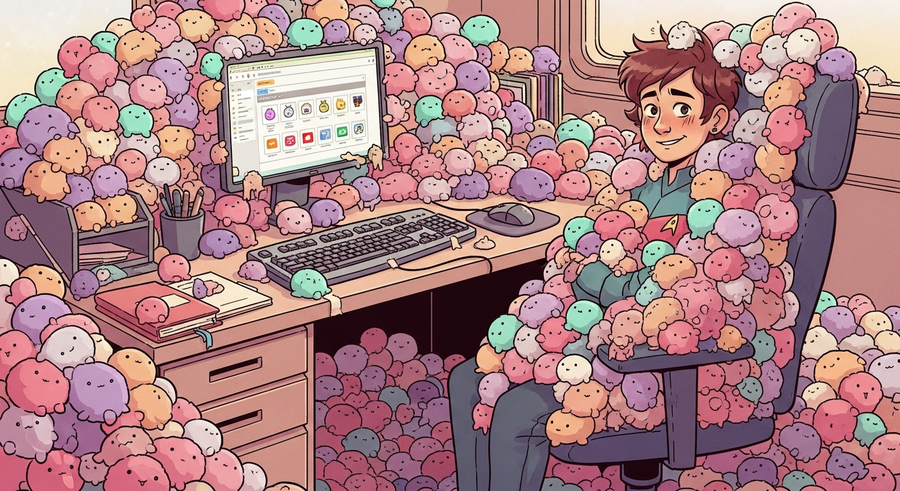
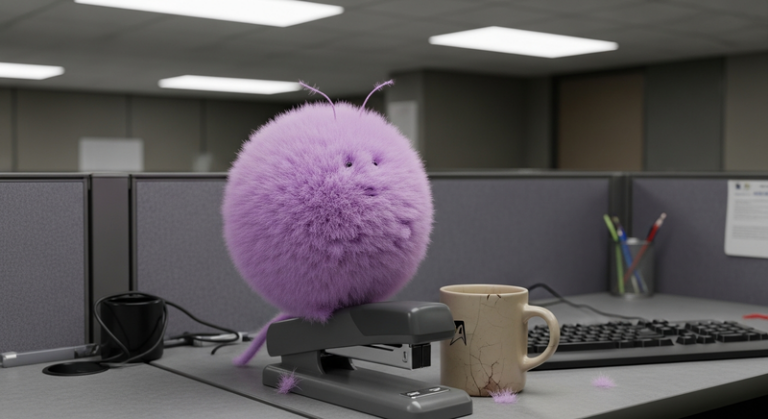
Now consider your AI tool situation circa 2026. You started with one. Maybe ChatGPT for writing. Then you needed one for images — Midjourney, or DALL-E. Then Copilot snuck into your IDE. Then Grammarly went AI. Then your email client added “smart compose.” Then your phone’s keyboard started finishing your sentences. Then your search engine stopped showing you results and started showing you AI summaries instead. Then your word processor got an AI sidebar. Then your spreadsheet got one. Then your toaster probably got one.
In 2023, the average knowledge worker used 2 AI tools.
By 2025, that number was 11.
By 2026, it’s “I honestly have no idea, they just keep appearing.”
Like tribbles, AI tools are born pregnant. Every AI product ships with the DNA to spawn integrations, plugins, extensions, and “enhanced AI features” across every surface of your digital life. You didn’t install most of them. They just… appeared. One day your photo app is just a photo app. The next day it’s “enhancing” your memories, “suggesting” edits, and generating “year in review” videos you never asked for.
Scotty did the math: 1,771,561 tribbles in three days from a single specimen. The AI industry has done roughly the same. OpenAI alone has spawned ChatGPT, GPT-4, GPT-4o, DALL-E 3, Sora, a voice assistant, a desktop app, a mobile app, an API, a plugin ecosystem, and enterprise editions. That’s one company. One tribble. And there are hundreds of companies now, each breeding their own fuzzy little products as fast as they can.
III. “They Got Into the Grain!” — The Appetite
The real crisis in “The Trouble with Tribbles” isn’t the mess or the multiplication — it’s the eating. Station K-7 is storing quadrotriticale, a high-yield grain intended to colonize Sherman’s Planet. The grain is strategically vital. And the tribbles eat all of it. Every last kernel. When Kirk opens the storage compartment, what pours out is not grain but tribbles — fat, happy, well-fed tribbles that have consumed an entire planet’s agricultural future.
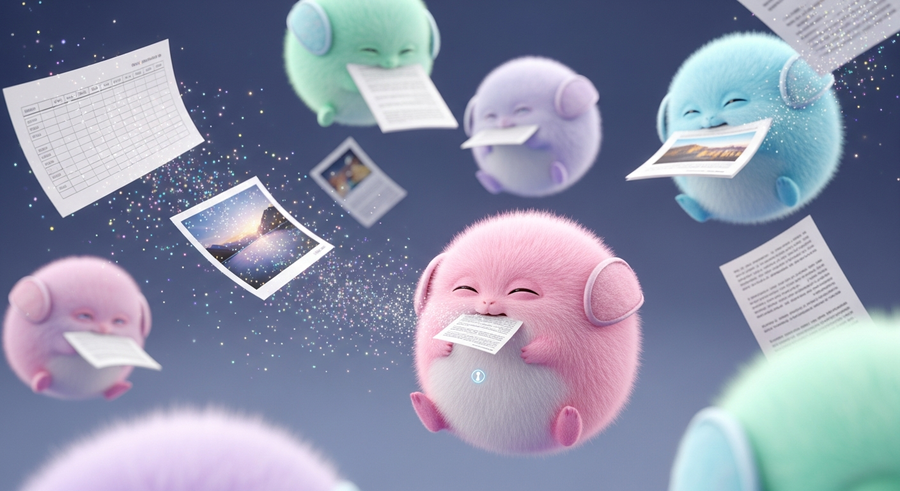
AI’s appetite makes tribbles look like light snackers. Here’s what your friendly neighborhood AI tools are consuming right now:
| What Tribbles Ate | What AI Eats |
|---|---|
| Quadrotriticale grain | Every article, book, image, and song ever posted online |
| Whatever Cyrano Jones fed them | Your emails, documents, and search history |
| Chicken sandwich (Kirk’s) | Entire creative industries’ livelihoods |
| Spock’s ration packs (probably) | 7% of US electricity by 2027 (Goldman Sachs estimate) |
| Everything that wasn’t nailed down | Everything that wasn’t behind a paywall — and some things that were |
The parallels are almost too neat. The quadrotriticale was meant for something important — feeding colonists, building a future. It was strategic, irreplaceable, the product of careful agricultural planning. Your creative work — your writing, your art, your photography, your code — was also meant for something. It was your career, your expression, your livelihood. And just like the tribbles didn’t ask permission before eating the grain, AI companies didn’t ask permission before feeding your work into their models.
The tribbles’ defense is that they’re just doing what tribbles do. They don’t understand grain reserves or colonial strategy. They’re just hungry.
AI companies’ defense is approximately the same: “We’re just training models! It’s fair use! We’re building the future!” They don’t understand — or don’t care about — the creative economy they’re consuming. They’re just hungry.
Scotty, being Scotty, is more upset about the tribbles in his engine room than the eaten grain. He understands machinery. Mess with his engines and you’ve got his full attention. Similarly, the people most alarmed about AI aren’t the general public — it’s the people whose engines are being invaded. Artists. Writers. Programmers. Musicians. The people who build the things that AI eats.
IV. “Get These Tribbles Off My Ship!” — The Overwhelm
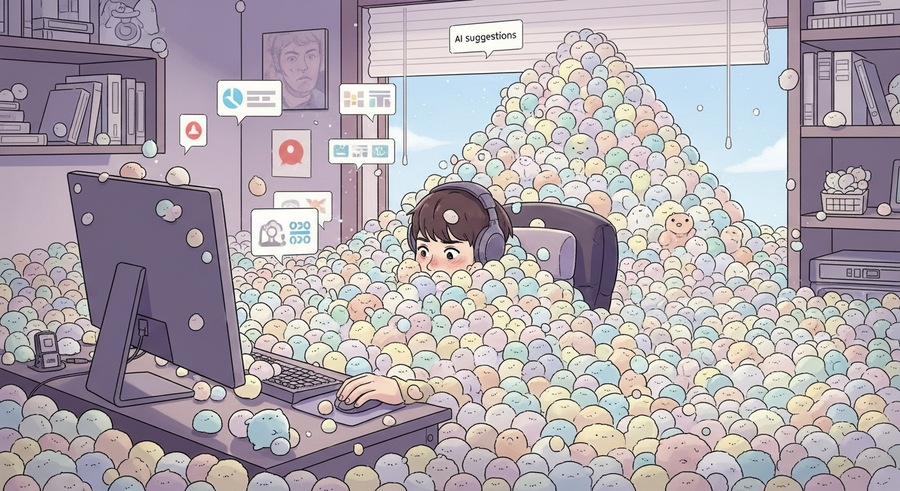
The single most iconic image from “The Trouble with Tribbles” is Kirk opening the overhead compartment on K-7 and getting buried in an avalanche of tribbles. It’s comedy gold. William Shatner, buried to his waist in fuzzy props, wearing an expression of resigned fury that every modern knowledge worker has felt at least once this week.
Open your phone right now. Count the AI features you didn’t ask for. The “AI-enhanced” photo edits. The “smart suggestions.” The autocomplete that finishes sentences you didn’t want finished. The search results replaced by AI summaries that may or may not be accurate. The email drafts it writes before you’ve decided what to say. The notifications from tools you forgot you signed up for.
You are Kirk in the storage compartment. The tribbles are pouring down on your head. And every single one of them is purring.
Kirk’s Tribble Moment — a partial list of AI features nobody asked for but received anyway:
• Google replacing search results with AI summaries
• Apple Intelligence rewriting your texts
• Microsoft Copilot embedded in every Office app
• Adobe Photoshop’s “Generative Fill” on every toolbar
• Zoom’s AI meeting summaries emailed to everyone
• Slack’s AI channel digests
• LinkedIn’s AI-written post suggestions
• Samsung’s AI photo “enhancements” that alter reality
• Every app you own asking if you’d like to “Try our new AI features!”
The key detail: Kirk never wanted tribbles. Uhura brought one aboard because it was cute. Nobody voted on this. Nobody ran a cost-benefit analysis. Nobody asked, “Hey, should we introduce an exponentially reproducing organism into our closed ecosystem?” It just… happened. One crewmember thought it was adorable, and suddenly it was everyone’s problem.
That’s the AI adoption curve in a nutshell. One person in your company signed up for an AI tool. Then management got excited. Then it was in the company handbook. Then it was mandatory. You never agreed to any of this. You just wanted to do your job with the tools you already understood.
V. The Klingon Detector — When Tribbles Are Actually Useful
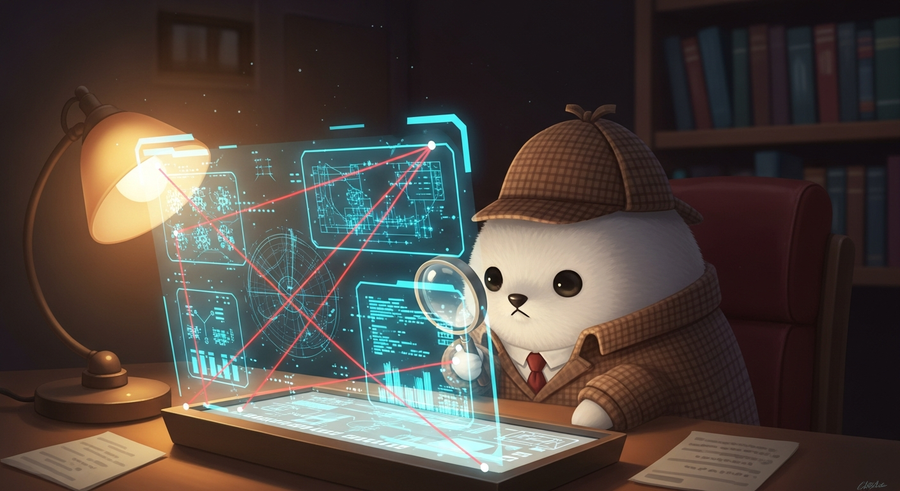
Here’s the thing that makes the tribble analogy so perfect: tribbles aren’t entirely useless. In fact, they save the day.
When Arne Darvin — a Klingon spy surgically altered to look human — gets near the tribbles, they go berserk. They screech. They recoil. They blow his cover completely. The tribbles detect the Klingon that Starfleet Intelligence, Kirk, Spock, and an entire space station full of Federation personnel all missed. The most useless creature on the ship turns out to be the most effective security system in the quadrant.
“There is one thing I can tell you about tribbles… they don’t like Klingons.”
— Spock, stating the obvious with Vulcan precision
And this — this — is the part that keeps people from just spacing the whole lot of them. AI, for all its problems, occasionally does something genuinely remarkable:
• A radiologist using AI catches a tumor that three human doctors missed.
• A climate scientist uses AI modeling to predict flood patterns years in advance.
• A programmer asks an AI to find the bug they’ve been hunting for three days, and it spots it in four seconds.
• A deaf person uses AI transcription to follow conversations in real time for the first time in their life.
• A small business owner uses AI to translate their website into twelve languages overnight.
The tribble detects the Klingon. The AI finds the pattern. And suddenly all the mess, all the multiplication, all the eaten grain seems almost — almost — worth it.
Almost.
Because here’s what Kirk doesn’t do: he doesn’t decide the tribbles should stay because they caught one spy. He still wants them off his ship. The Klingon detection was useful, but it doesn’t change the fundamental problem — tribbles are an uncontrolled, exponentially reproducing, resource-consuming organism that will eat you out of house and home if you let them.
Sound familiar?
VI. Cyrano Jones — The Man Who Sold the Tribbles
Every great con needs a con artist, and “The Trouble with Tribbles” has one of Trek’s best: Cyrano Jones, played with magnificent sleaze by Stanley Adams. Jones is a trader — not quite a criminal, but definitely not someone you’d leave alone with your wallet. He sells tribbles the way tech companies sell AI: with a confident smile, a polished demo, and a complete failure to mention the externalities.
The Cyrano Jones Guide to Selling Tribbles (and AI)
Step 1: Show only the cute part. Let them hold it. Let it purr.
Step 2: Price it low. “Only ten credits” / “Free tier available!”
Step 3: When asked about downsides, deflect with charm.
Step 4: Be gone before the consequences arrive.
Step 5: If caught, blame the customer for not reading the fine print.
Jones’s defense when confronted is beautiful in its audacity: he claims he had no idea tribbles bred so fast. This is the same defense used by approximately every AI company confronted with the consequences of their products. We had no idea people would use it to generate misinformation! We had no idea it would displace workers! We had no idea it would consume more electricity than some countries!
Kirk doesn’t buy it. And you shouldn’t either.
Starfleet eventually sentences Cyrano Jones to clean up his own mess — he’s ordered to remove every tribble from Station K-7, a task estimated to take 17.9 years. One can only dream of a similar sentence for tech executives: You are hereby ordered to personally retrain every worker displaced by your product, estimated completion date: never.
VII. “A Nice Place, If You Don’t Mind Tribbles” — Learning to Coexist

In “Trials and Tribble-ations” — the brilliant Deep Space Nine time-travel episode where the DS9 crew goes back to the original tribble incident — we learn that after the K-7 disaster, the tribbles were eventually dealt with. The Klingon Empire, deciding that tribbles were an “ecological menace,” sent an armada to the tribble homeworld and wiped them out. Tribbles went functionally extinct by the 24th century.
Total extermination is not a great model for AI policy. (Though some days it’s tempting.)
The better lesson from Trek is the one the franchise itself demonstrates: technology is neither good nor evil; it’s what you do with it. The same warp drive that enables exploration also enables the Xindi weapon. The same transporter that saves lives also creates Thomas Riker. The same tribbles that eat the grain also catch the spy.
The trouble with tribbles — and the trouble with AI — was never the technology itself.
It was that nobody set boundaries.
Nobody said “one tribble is enough.” Nobody said “these should not have access to the grain stores.” Nobody regulated the trader who sold them.
Every problem in that episode was a governance failure, not a tribble failure.
What would sensible tribble management look like? Probably something like what McCoy eventually suggests: controlled breeding, limited food supply, designated areas only. In AI terms, that translates to:
| Tribble Management | AI Management |
|---|---|
| Limit the breeding | Stop auto-installing AI features nobody requested |
| Control the food supply | Require consent before training on people’s data and work |
| Keep them out of the grain stores | Keep AI out of critical decisions without human oversight |
| Regulate the traders | Regulate the tech companies |
| Use them where they’re actually useful (Klingon detection) | Use AI where it genuinely helps (pattern recognition, accessibility, research) |
The addictive quality is the core of the problem. Tribbles are designed by evolution to be irresistible — they purr, they’re soft, they’re warm, they make you feel good. AI tools are designed by product teams to be irresistible — they’re smooth, they’re fast, they make you feel productive. In both cases, the addictiveness is the feature, not a bug. You’re not supposed to want just one. You’re supposed to want more.
And that’s where personal discipline becomes the starship’s last line of defense. Kirk couldn’t stop Uhura from bringing the first tribble aboard. But he could — and did — order the ship cleaned out once the problem was clear. You probably can’t stop AI from invading every app on your devices. But you can make choices about which ones you actually use, which ones get your data, and which ones you banish to the digital equivalent of “being beamed to the Klingon ship.”
VIII. Captain’s Log, Final Entry
At the end of “The Trouble with Tribbles,” Kirk asks Scotty where all the tribbles went. Scotty, with the satisfied grin of a man who has solved a problem in the most Scottish way possible, reveals he beamed them all to the Klingon ship. “Where they’ll be no tribble at all,” he says, delivering the worst pun in Federation history with zero shame.
We don’t have a Klingon ship to beam our AI problems to. There’s no convenient enemy vessel where we can transport our data privacy concerns, our job displacement anxieties, our creative industry disruptions, and our electricity grid strain. We’re stuck on this ship with our tribbles, and they’re already in the ventilation ducts.
But the episode — like all the best Trek — ends with optimism anyway. The crew is fine. The ship is fine. The spy was caught. Kirk is annoyed but alive. And somewhere out there, Cyrano Jones is picking up tribbles for the next 17.9 years.
The tribbles weren’t the problem. Unregulated tribbles were the problem.
AI isn’t the problem. Unregulated, unconsented, and unrestricted AI is the problem.
One tribble on your desk? Delightful. A thousand in your grain stores? Disaster.
Choose your tribbles wisely. And for the love of Starfleet — don’t let them near the grain.
“Too much of anything, even love, isn’t necessarily a good thing.”
— Captain James T. Kirk, who would have had strong opinions about Copilot
All said and done, I don’t really mind. I always loved tribbles… they’re so cute… and that little cooing sound… aww…
…I just wish they’d stop eating my grain.