Tribble Fan Fiction #20: There’s No Place Like Purr
Tribble Fan Fiction #20
I. Somewhere Over the Rainbow
The tribble fell out of the tornado.
Dorothy Gale had been lying on her bed in the spinning farmhouse — watching the Kansas sky rearrange itself into increasingly improbable configurations through the window — when something small and round and blue bounced off the windowsill and landed on her pillow. Toto barked. Dorothy screamed. The tribble purred.
“What on earth—” Dorothy said, but then the house landed with a tremendous crash and the sentence became irrelevant, because whatever “earth” had been five minutes ago, they were not on it anymore.
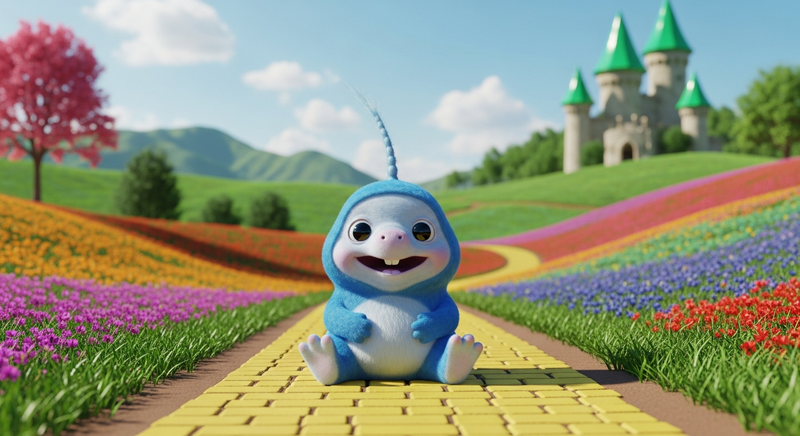
She picked up the tribble. It was the color of a robin’s egg, soft as clouds, warm as a fresh-baked biscuit from Auntie Em’s kitchen. It purred against her palm with the contentment of a creature that had just survived a tornado and found the experience neither alarming nor unusual, because tribbles didn’t alarm easily and found most things usual, because most things, to a tribble, were variations on the theme of “warm place with potential food.”
“Well,” Dorothy said, holding the tribble in one hand and Toto in the other, “I don’t think we’re in Kansas anymore.”
She opened the door. The world was in color.
II. The Munchkins
The Munchkins were delighted. They were delighted about most things — the death of the Wicked Witch of the East, the arrival of Dorothy, the fact that the sun was shining and the flowers were singing and the general atmosphere of Munchkinland was one of relentless, almost aggressive optimism — but they were especially delighted about the tribble.
“It’s a Tribble of Oz!” they sang, because Munchkins communicated primarily through song, and “tribble” rhymed with enough things to sustain a three-verse musical number. “A wonderful, incredible, fuzzy little bit of Oz!”
Glinda the Good Witch arrived in her bubble — a mode of transportation that was either magical or an enormous waste of helium — and examined the tribble with the serene expertise of someone who had seen everything the Land of Oz had to offer and found most of it enchanting.
“Oh my,” Glinda said. “A tribble. I haven’t seen one of these since the Great Purr of the Eastern Province.”
“The Great Purr?” Dorothy asked.
“Long before your time, dear. Before the witches, before the Wizard, before the Yellow Brick Road was even paved. Oz was covered in tribbles. They lived in the forests, in the meadows, in the Emerald City itself. They purred, and the land purred with them, and everything was warm and green and good.”
“What happened to them?”
Glinda’s smile dimmed by exactly one shade. “The Wicked Witch happened. She couldn’t stand the purring. It was — she said — ‘an intolerable frequency of contentment.’ She drove them out. Every tribble in Oz, banished beyond the Deadly Desert.”
“Except this one,” Dorothy said, holding up the blue tribble.
“Except that one. Which means, my dear, that you have brought something very precious back to Oz.” Glinda leaned close. “Follow the Yellow Brick Road. Take the tribble to the Emerald City. The Wizard will know what to do.”
Dorothy looked at Toto. Toto looked at the tribble. The tribble purred at them both with the calm confidence of a creature that had no idea where it was going but was certain it would be warm when it got there.
“Follow the Yellow Brick Road,” Dorothy repeated. “I can do that.”
“Are you a good tribble, or a bad tribble?” “I’m a tribble. We don’t have that setting.” — Glinda and the Tribble
III. If I Only Had a Purr
The Scarecrow didn’t understand the tribble. This was not unusual — the Scarecrow didn’t understand most things, on account of not having a brain — but the tribble confused him in a way that other things didn’t.
“It doesn’t do anything,” he said, poking it with a straw finger.
“It purrs,” Dorothy said.
“But why?”
“Because it’s happy.”
“How can it be happy? It doesn’t have a brain. I don’t have a brain either, and I’m not happy. I’m confused. Being confused is not the same as being happy.”
Dorothy placed the tribble in the Scarecrow’s arms. It purred against his chest — against the straw, through the fabric, into whatever served as the Scarecrow’s core. He went still. His painted eyes widened.
“Oh,” he said.
“Oh what?”
“I think I understand. I don’t have a brain, so I can’t think about being happy. But the tribble doesn’t think about it either. It just is happy. Maybe—” he paused, working through the logic with the careful effort of a mind that didn’t exist but was trying its best “—maybe happiness doesn’t need a brain.”
The Tin Man cried when he held the tribble. This was not unusual — the Tin Man cried at everything, which was inconvenient for a man made of metal — but the tears that ran down his tin cheeks when the tribble purred against his hollow chest were different. They were warm.
“I can feel it,” he said. “I don’t have a heart, but I can feel it purring where a heart would be.”
“Maybe that’s what a heart sounds like,” Dorothy said. “Just… purring.”
The Cowardly Lion refused to hold the tribble.
“I’m afraid of it,” he said, hiding behind his tail.
“It’s the size of a tennis ball.”
“Exactly! Small things are the most dangerous! They get inside your defenses! They make you feel things!” He peeked over his tail. “What if I hold it and I like it and then it goes away? What if I get attached? Attachment is the root of all suffering! I read that on a fortune cookie!”
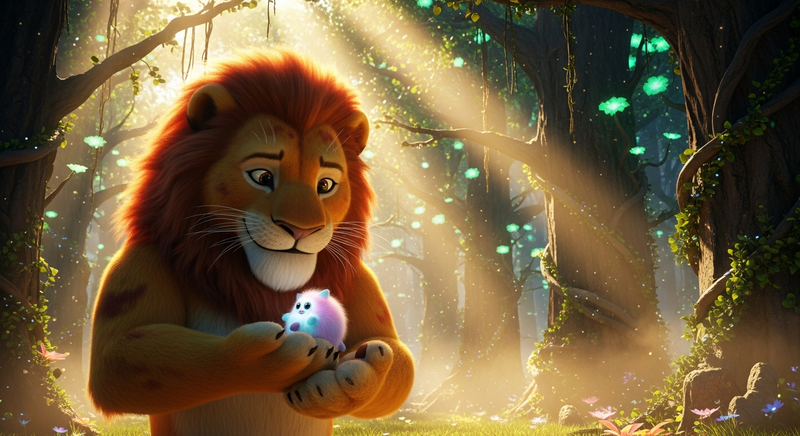
Dorothy didn’t argue. She simply set the tribble on the ground in front of the Lion and waited. The tribble rolled toward him — slowly, because tribbles only have one speed, and that speed is “gentle” — and pressed against his enormous paw.
The Lion looked at the tribble. The tribble purred.
And the Cowardly Lion — who was afraid of his own shadow, afraid of the dark, afraid of the forest, afraid of everything in the Land of Oz and most things that weren’t — picked up the tribble, held it against his chest, and did not let go for the rest of the journey.
“This doesn’t mean I’m brave,” he said.
“It means you’re brave enough,” Dorothy said.
IV. The Wicked Witch
The Wicked Witch of the West hated the tribble. She hated it the way she hated water, sunshine, and the sound of children laughing — instinctively, totally, with a rage that burned green at the edges.
“That THING,” she screeched from the battlements of her castle, watching Dorothy’s group approach through her crystal ball. “That PURRING THING. I banished them! I banished every last one of them from Oz! How DARE it come back!”
Her flying monkeys shifted uncomfortably. Flying monkeys were, despite their reputation, sensitive creatures, and the tribble’s purr was audible even through the crystal ball. Several of them looked at each other with expressions that suggested they were reconsidering their career choices.
“Bring me the tribble!” the Witch commanded. “And the girl! And the dog! And the shoes! Bring me EVERYTHING!”
The monkeys flew. They descended on Dorothy’s group in the poppy field — which was already problematic because the poppies were putting everyone to sleep — and snatched the tribble from the Lion’s paws. The Lion roared. The Scarecrow was disassembled. The Tin Man was dented. Dorothy was carried to the castle.
But the tribble did something unexpected.
It purred at the flying monkeys.
The monkeys had never been purred at. They had been commanded, threatened, cursed, and occasionally set on fire (the Witch had a temper). No one had ever been kind to them. No one had ever offered them warmth without a price. The tribble, sitting in the palm of the lead monkey, purred without agenda, without fear, without anything except the simple declaration: you are warm. I am here.
The monkeys delivered Dorothy to the castle. They delivered the dog. They delivered the shoes. But they did not deliver the tribble. The lead monkey tucked it inside his vest, against his chest, where it purred against his heart, and he felt something he had never felt before — something that was not obedience, not fear, not loyalty enforced by magic.
It was choice.
V. There’s No Place Like Purr
Dorothy melted the Witch with a bucket of water, because sometimes the solution to a problem is exactly as simple as it appears, and sometimes evil dissolves when you throw something clean at it.
The tribble was returned. The monkeys — free now, free for the first time in centuries — brought it back to Dorothy with the gentle ceremony of creatures returning something sacred. The lead monkey held it out in both hands, and Dorothy took it, and it purred, and the monkey smiled — a real smile, not a grimace of servitude but a genuine expression of a creature who had just discovered that choices existed.
The Wizard turned out to be a fraud. This surprised no one, because Oz was a land that ran on belief and appearances, and the man behind the curtain was always smaller than the curtain suggested. But he gave the Scarecrow a diploma, the Tin Man a heart-shaped clock, and the Lion a medal, and even though these were symbols and not solutions, they were enough. Sometimes symbols are enough.
And the tribble?
“What about the tribble?” Dorothy asked Glinda, who had arrived in her bubble to explain that Dorothy could have gone home at any time, which was the kind of information that would have been useful four days ago but was apparently not how good witches operated.
“The tribble stays in Oz,” Glinda said. “It was the last tribble driven out, and now it’s the first one back. It will purr, and the land will remember what it was like before the witches, before the fear, before the silence. The tribble will bring Oz back to itself.”
“Will it be okay? Alone?”
Glinda smiled. “My dear. It’s a tribble. It won’t be alone for long.”
Dorothy clicked her heels. The world spun. Kansas returned — grey and flat and smelling of wheat and ordinary life. Auntie Em was there. Uncle Henry was there. Toto was there.
The tribble was not there. It was in Oz, sitting on the Yellow Brick Road, purring at a world that was learning to be warm again.
But sometimes, on quiet evenings in Kansas, when the wheat rustled and the sun set over the flattest horizon in America, Dorothy thought she could hear it. A faint, low vibration. A purr, carried on the wind from somewhere over the rainbow.
There’s no place like purr.
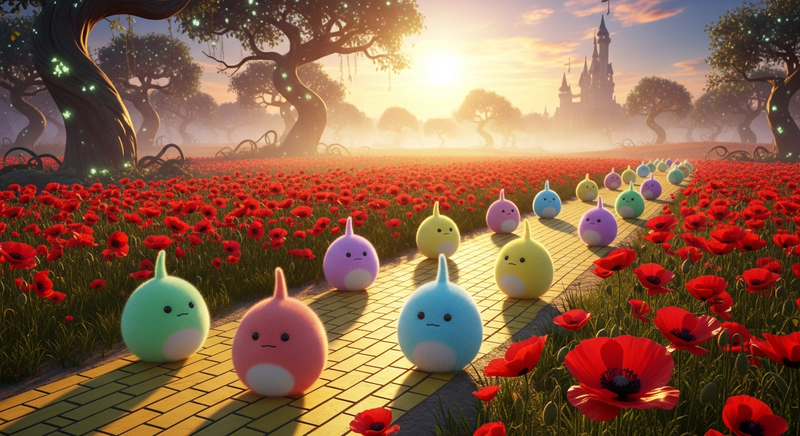
The tribble multiplied. Within a year, Oz was covered in them — blue and green and pink and gold, purring in the meadows, nesting in the Emerald City, sitting on the Yellow Brick Road like fuzzy pastel milestones. The Scarecrow, now ruler of Oz, declared them a protected species. The Tin Man built them tin houses, which they immediately ate. The Lion stood guard over them, which was the first time he’d ever guarded anything, and he found that bravery was easier when what you were protecting purred. And in Munchkinland, the Munchkins wrote one final song: “Welcome back, welcome back, little balls of fur. Welcome back, welcome back — Oz has missed your purr.” It was not a great rhyme. But it was true.