Tribble Fan Fiction #2: The Last Tribble Standing
Tribble Fan Fiction #2
I. Aftermath
The Klingon ship smelled like disruptor fire and regret.
Commander Koloth had been thorough. When Scotty beamed 1,771,561 tribbles aboard the IKS Gr’oth — which he later described, with barely concealed glee, as doing them “no tribble at all” — the Klingon crew responded with characteristic restraint. They screamed in rage for approximately four minutes, then began systematically eliminating every tribble on the ship.
The purring stopped deck by deck. Engineering first, then the crew quarters, then the bridge. The corridors, which had been a sea of pastel fur and gentle vibration, fell silent. By the third hour, the only sounds were Klingon boots on metal grating and the occasional warrior stopping to scrape something off his uniform.
They missed one.
II. The Survivor
My name — insofar as a tribble can have a name — is the sound of a low-frequency purr sustained for exactly 2.3 seconds. For convenience, you may call me Prrm.
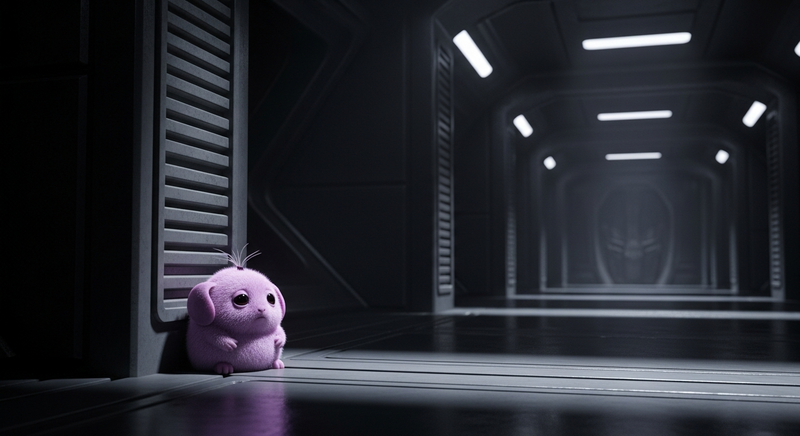
I survived because I am small, even by tribble standards. I was born the runt of a litter of eleven, tucked between an EPS conduit and the inner hull plating on Deck Seven. When the Klingons came through with their disruptors and their boots and their operatic fury, I was wedged so deeply into the ship’s infrastructure that I might as well have been a component. They walked right past me, cursing in a language that sounds like gargling with gravel.
For three days, I did not move. I did not purr. I did not eat, which for a tribble is the equivalent of holding your breath until you pass out. I listened as my family — my entire species, as far as I knew — was removed from existence with the efficiency of a civilization that considers mercy a character flaw.
On the fourth day, I ate a wire. It was not nutritious, but it was there.
“The Klingon Empire has officially declared tribbles an enemy of the state. This is not a metaphor. There is actual paperwork.” — Federation Intelligence Brief, Stardate 4525.6
III. Life Among the Enemy
Living on a Klingon warship as the last tribble in the universe is, I want to be clear, not ideal.
The food is terrible. Klingons eat things that are still moving, things that fight back, things that would rather die than be consumed. Gagh — live serpent worms — writhes on plates in the mess hall. I watched a warrior bite the head off something that screamed. I have been eating conduit insulation and the occasional crumb of racht that falls between deck plates.
The noise is extraordinary. Klingons do not speak — they proclaim. Every sentence is a declaration of war against silence. They sing drinking songs that could shatter crystal. They laugh like thunder in a canyon. They argue about honor the way other species argue about the weather: constantly, passionately, and without any hope of resolution.
And yet.
There is a warrior on Deck Seven. His name is K’Ral, and he is the lowest-ranking officer on the ship. He cleans the plasma manifolds. He eats alone. The other warriors mock him because he once showed hesitation in battle — a pause of perhaps two seconds before firing on an unarmed transport. In Klingon culture, two seconds of conscience is a life sentence of shame.
K’Ral found me on the forty-second day.
IV. The Secret
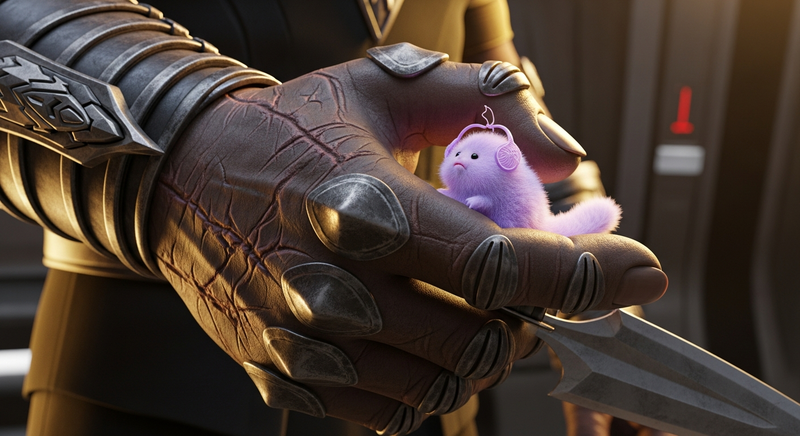
He didn’t kill me. I want you to understand how extraordinary that is. A Klingon warrior, on a ship that had just conducted what amounted to a tribble genocide, found a living tribble wedged behind a plasma manifold — and he didn’t kill me.
He stared at me for a very long time. I stared back. (I am a tribble. Staring is most of what I do.) Then he reached in with one massive, scarred hand and picked me up. I fit entirely in his palm. I was shaking — from cold, from hunger, from the absolute certainty that I was about to die.
I purred. I couldn’t help it. It’s what we do.
K’Ral flinched. He looked around the empty corridor. Then he slipped me inside his uniform jacket, against his chest, where I could feel the double heartbeat that all Klingons carry. Two hearts. Twice the warmth.
“You will be silent,” he said in Klingon. “Or we both die.”
I was silent. I ate a button, but I was silent about it.
“Compassion is not a Klingon value. Which makes it all the more remarkable when a Klingon shows it.” — Ambassador Sarek of Vulcan, private correspondence
V. Two Hearts
For six months, I lived inside K’Ral’s quarters, behind a false panel he constructed from spare hull plating. He fed me scraps — bread-like zilm’kach fruit, bits of replicated grain, once an entire plate of gladst that he claimed to have dropped. He talked to me in the evenings, when the ship was quiet and no one could hear him speaking to an enemy of the state.
He told me about his homeworld. About the red sky over the Ketha lowlands, where he grew up poor and angry and dreaming of stars. About his mother, who sang songs that were not warrior songs — songs about rivers, and growing things, and the color of morning. She had been shamed for this. Klingon mothers are expected to raise warriors, not poets.
“You remind me of her,” he told me one night. “Small. Soft. Completely useless in battle.” He paused. “She was the bravest person I ever knew.”
I purred. He pretended not to notice.
The other warriors never found me. K’Ral was too careful, and I was too small, and the universe — despite its reputation for cruelty — occasionally allows one small, warm thing to survive.
VI. Endgame
The Gr’oth was decommissioned eleven months after the K-7 incident. K’Ral was transferred to a border outpost near the Neutral Zone — a frozen rock where nothing grew and nothing happened and warriors went to be forgotten.
He took me with him. Smuggled inside a weapon maintenance kit, nestled between a disruptor power cell and a bottle of bloodwine. I ate the label off the bloodwine. K’Ral sighed.
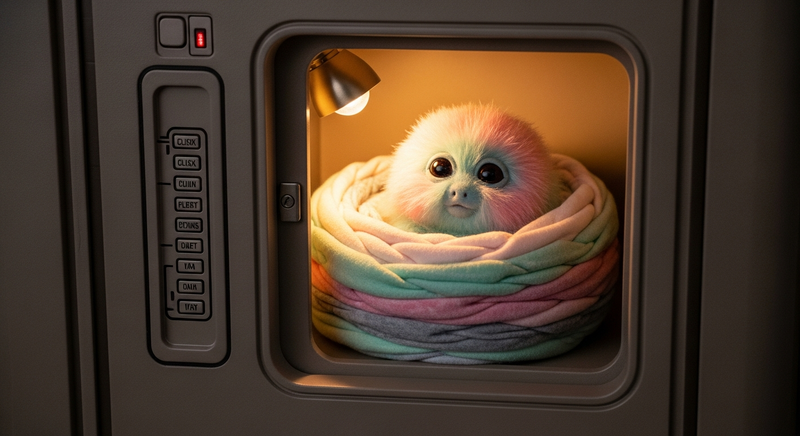
On the outpost, there was more freedom. K’Ral had his own quarters, small and cold, but private. He built me a nest from old uniform fabric. He traded for grain on the black market — actual quadrotriticale, smuggled in from Federation space. I ate it and purred and reproduced exactly once, because the grain was very good and biology is biology.
K’Ral looked at the two new tribbles. He looked at me. He looked at the ceiling.
“One,” he said. “I can hide one. Not three.”
I understood. I am a tribble, not a fool.
He contacted a Federation trader — a human woman named Chen who ran medical supplies across the border and asked no questions. She took my children in a padded cargo container, bound for a wildlife preserve on a planet I will never see.
K’Ral watched them go. Then he sat down heavily and poured himself a glass of bloodwine.
“I am a disgrace to the Empire,” he said.
I purred.
“I know,” he said.
And we sat together in the cold, the last Klingon anyone would call a hero and the last tribble anyone would call alive, keeping each other warm because that is what living things do when the universe offers them nothing else.
K’Ral served on the border outpost for seven more years. His record was unremarkable. He was never promoted, never decorated, never mentioned in dispatches. He died in a skirmish with Romulan raiders, defending a supply convoy that carried, among other things, a shipment of grain. Prrm was recovered from his quarters by the same trader who had taken her children. She lived out her days on the wildlife preserve, surrounded by descendants who never knew they owed their existence to a Klingon who paused for two seconds before pulling a trigger.