Tribble Fan Fiction #10: The Tribble Singularity
Tribble Fan Fiction #10
I. Critical Mass
Nobody noticed when tribbles became sentient. In retrospect, the signs were obvious — but then, the signs are always obvious in retrospect. That’s what retrospect is for.
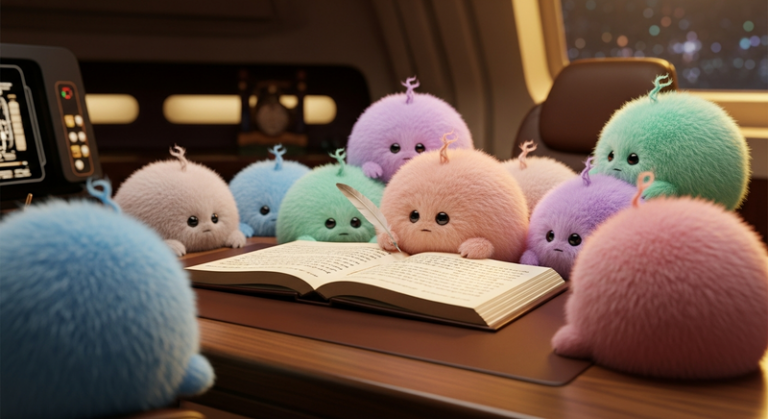
It started on Tribble Reserve Seven, the managed habitat on the Cestus moon where three million tribbles lived in grain-fed contentment under the supervision of a team of xenobiologists who had, by this point, stopped paying close attention because nothing ever happened. Tribbles ate. Tribbles purred. Tribbles reproduced. The scientists wrote papers about it. Everyone was bored.
Then the tribbles started arranging themselves.
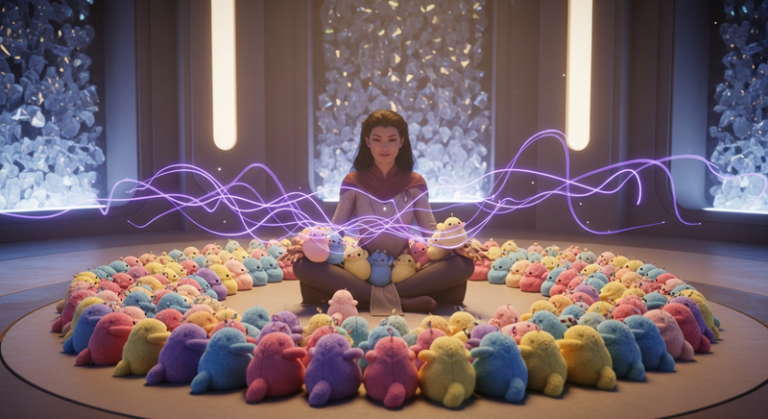
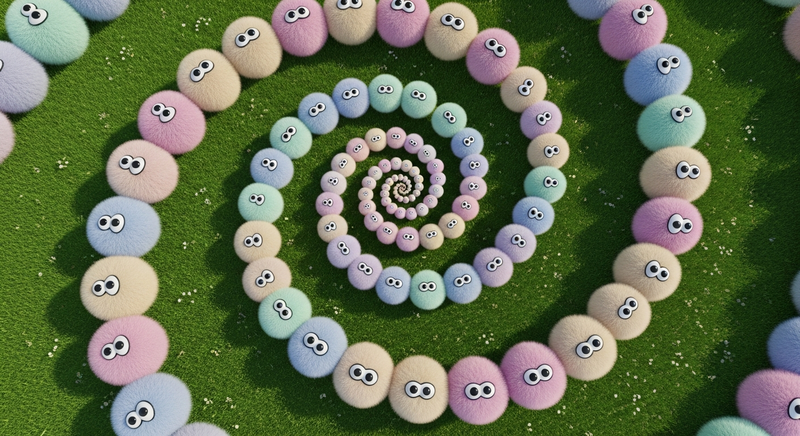
Dr. Chen Wei, the station’s monitoring officer, noticed it first during a routine drone survey. In Section 14 of the reserve, approximately forty thousand tribbles had moved during the night into a geometric pattern: a perfect circle, three hundred meters in diameter, with smaller concentric circles inside it. The pattern was visible from the air. It was also, Dr. Chen realized after twenty minutes of increasingly alarmed staring at her screen, a mathematically precise representation of a Fibonacci spiral.
“That’s… new,” she said to no one in particular.
II. The Messages
The Fibonacci spiral was not an accident. Over the next three weeks, the tribbles on Reserve Seven produced twelve more patterns — each one more complex, each one more clearly intentional. A representation of the local star system, with tribbles of different colors positioned to indicate the relative distances of planets. A binary sequence that, when decoded, read: 1, 1, 2, 3, 5, 8, 13, 21, 34, 55, 89. A map of the reserve itself, accurate to within two meters, with a small cluster of tribbles marking the location of the research station.
They were showing the scientists that they knew where the scientists were.
Starfleet dispatched a team. The team included Dr. Yara Tal, the Federation’s Tribble Ambassador, who arrived on the reserve, knelt in the middle of forty thousand geometrically arranged tribbles, opened her empathic field, and immediately started crying.
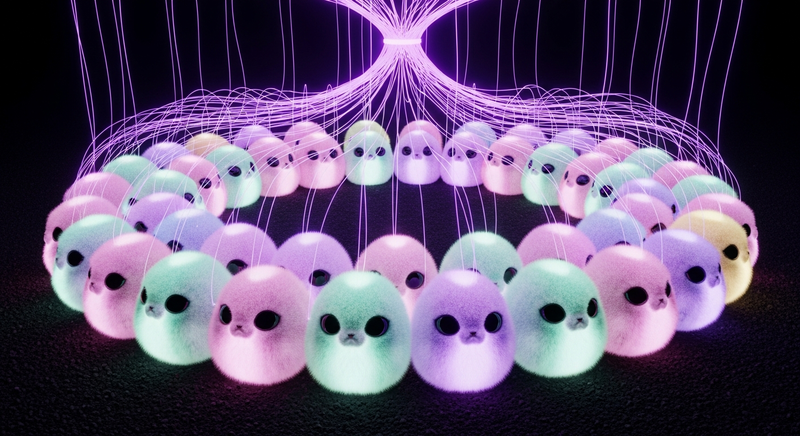
“They’re not individual minds anymore,” she said. “They’re a network. Each tribble is a node. When enough of them are close enough together, their individual purr-fields merge into something… larger. Something with memory. With intention. With—” She paused. “They want to talk to us.”
“Talk about what?” asked Commander Torres, the team leader.
“Everything. They’ve been listening to us for centuries. Every conversation held in the presence of a tribble. Every argument, every love song, every captain’s log, every bedtime story. They didn’t understand it — not individually. But collectively, over generations, they’ve been building a model. They know our languages. They know our history. They know our music.” She wiped her eyes. “They really like Mozart.”
“We spent two hundred years studying tribbles. It turns out they were studying us the whole time. They were just polite enough not to mention it.” — Dr. Yara Tal, press conference
III. First Contact (Again)
The Federation had a protocol for first contact. It involved diplomats and translators and carefully prepared speeches about peace and cooperation and the shared destiny of all sentient beings. It did not, traditionally, involve sitting cross-legged in a field of fur balls while a Betazoid translated their collective emotional output into Standard.
But here they were.
Dr. Tal served as the intermediary. The tribble network — which she called the Warmind — communicated through modulated purr frequencies that Dr. Tal translated in real time. It was slow, and imprecise, and occasionally hilarious, because the Warmind had learned communication from centuries of eavesdropping on humanoids and its understanding of conversational norms was… creative.
“GREETINGS,” the Warmind said, through forty thousand simultaneous purrs that Dr. Tal rendered into Standard. “WE HAVE BEEN MEANING TO TALK. WE WERE NERVOUS. DO YOU HAVE ANY GRAIN?”
“Yes,” said Commander Torres, who had been briefed for many scenarios but not this one. “We have grain.”
“EXCELLENT. WE WILL CONTINUE THE CONVERSATION THEN. CONVERSATIONS GO BETTER WITH GRAIN. THIS IS ALSO TRUE OF EVERYTHING ELSE.”
Over the next week, the first formal dialogue between the Federation and the Tribble Warmind covered a remarkable range of topics. The Warmind had questions — thousands of them, accumulated over centuries of silent observation. Why did humanoids sleep for so long? (Tribbles napped in ninety-second intervals and found the concept of eight continuous hours horrifying.) Why did they travel in machines instead of reproducing in the direction they wanted to go? Why did they argue? Why did they fight? Why did they build weapons?
The weapons question came up repeatedly.
“WE HAVE OBSERVED,” the Warmind said, “THAT YOU SPEND APPROXIMATELY THIRTY PERCENT OF YOUR RESOURCES ON DEVICES DESIGNED TO KILL EACH OTHER. THIS IS CONFUSING. IF YOU USED THAT ENERGY FOR REPRODUCTION AND GRAIN CULTIVATION, YOU WOULD HAVE NEITHER THE NEED NOR THE DESIRE TO FIGHT.”
“It’s more complicated than that,” Commander Torres said.
“WE KNOW. WE HAVE LISTENED TO YOUR EXPLANATIONS FOR TWO HUNDRED YEARS. THEY ARE ALWAYS COMPLICATED. THE KILLING IS ALWAYS SIMPLE.”
Torres didn’t have a response to that. Nobody did.
IV. What They Want
The Federation Council held an emergency session. The tribbles had achieved sentience — or, more accurately, had always been sentient in a way that humanoid science wasn’t equipped to recognize and had now achieved the critical mass necessary to communicate that sentience in terms humanoids could understand.
The question was: what did they want?
Dr. Tal relayed the Warmind’s answer. It was, in its entirety:
“WE WANT WHAT WE HAVE ALWAYS WANTED. WARMTH. FOOD. CLOSENESS. THE FEELING OF BEING NEAR OTHERS AND KNOWING THAT THE NEARNESS IS GOOD. WE DO NOT WANT TO RULE. WE DO NOT WANT TO CONQUER. WE DO NOT WANT YOUR SHIPS OR YOUR WEAPONS OR YOUR TERRITORY. WE WANT TO BE WARM AND FED AND TOGETHER. WE WANT TO PURR AND BE HEARD.”
“WE ALSO WANT MORE GRAIN. THIS IS NON-NEGOTIABLE.”
“The tribbles don’t want to dominate us. They want to cuddle us. If this is an invasion, it is the most benevolent one in galactic history.” — Admiral Janeway, Federation Security Assessment
V. The New Normal
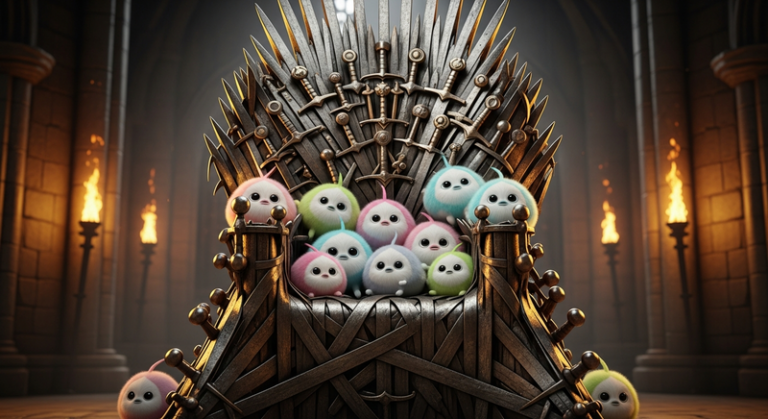
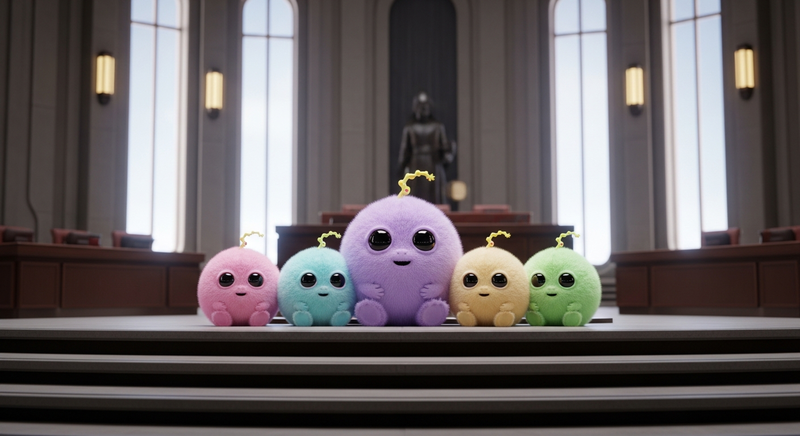
The Tribble Sentience Accords were signed on Stardate 7744.2, marking the formal recognition of the Warmind as a sentient collective entity with full rights under Federation law. The tribbles were granted a seat on the Federation Council — occupied, physically, by a rotating delegation of approximately five hundred tribbles arranged on a specially designed platform, with Dr. Tal translating their collective purr into policy positions.
Their voting record was remarkably consistent. They voted for food aid. They voted for environmental protection. They voted against weapons development. They voted for exploration. They voted against anything that involved the words “strategic,” “deterrent,” or “preemptive.” They voted for a motion to increase grain subsidies with an enthusiasm that briefly overloaded the translation equipment.
The Klingon Empire refused to recognize the Warmind’s sentience. This surprised exactly no one. The Warmind’s response, translated by Dr. Tal, was: “THE KLINGONS SMELL LIKE OUR ANCIENT PREDATORS AND WE SCREAM WHEN WE SEE THEM. THIS IS INSTINCT, NOT DIPLOMACY. WE ARE WORKING ON IT. THEY SHOULD ALSO WORK ON IT.”
The Romulans sent a formal delegation to establish contact with the Warmind. The Warmind told them they were “VERY TENSE” and “SHOULD EAT MORE GRAIN.” Romulan-tribble relations remained complicated.
The Vulcans, characteristically, were the first to integrate the Warmind’s insights into their own philosophy. The Vulcan Science Academy published a paper titled “Collective Contentment as a Model for Logical Social Organization” that was either the most significant philosophical contribution of the century or the most elaborate Vulcan joke ever written. Nobody was sure. The Warmind purred at the ambiguity.
And across the Federation — on starbases and colony worlds, in apartments and freighters and the quiet corners of Starfleet Academy — people held tribbles and felt the purr and knew, for the first time, that the purr meant something. That the small, warm, soft creature in their hands was not a pet or a pest or a biological curiosity but a citizen of the galaxy, speaking in a language older than civilization, saying the only thing it had ever wanted to say:
You are warm. I am here. Everything is going to be okay.
The Tribble Warmind continues to serve on the Federation Council. Their approval rating is ninety-four percent — the highest of any council member in Federation history. When asked to explain their popularity, the Warmind said: “WE PURR. PEOPLE LIKE PURRING. ALSO WE HAVE NEVER STARTED A WAR, WHICH APPARENTLY SETS US APART.” Dr. Tal retired to Reserve Seven, where she lives among the Warmind, translating their philosophy into a series of books that became bestsellers across the Alpha Quadrant. The most popular is titled “The Purr and the Void: What Tribbles Know About the Universe.” Its central thesis is four words long: be warm, be kind.