Tribble Fan Fiction #18: Tribble Park
Tribble Fan Fiction #18
I. Spared No Expense
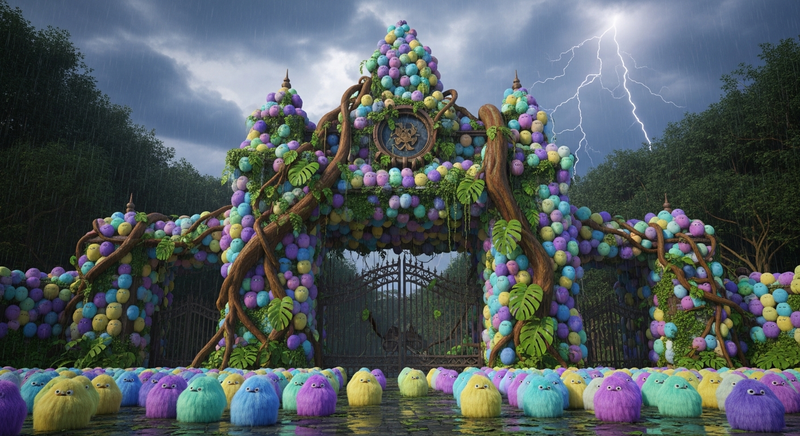
John Hammond had a vision. It was the same vision he always had — a theme park, bigger and more audacious than anything the world had seen, filled with creatures that should not exist but did because John Hammond had money and ambition and a cheerful disregard for the distinction between “could” and “should.”
“Tribbles!” he said, spreading his arms wide in the visitor center of what would become Tribble Park, a facility on Isla Sorna that Hammond had pivoted to after the dinosaur thing went, in the words of his insurance company, “catastrophically and irreversibly wrong.”
“Tribbles, John?” Dr. Ian Malcolm sat in a leather chair, legs crossed, wearing an outfit that was entirely black because Ian Malcolm understood that color was a distraction from the truth, and the truth was that John Hammond was about to make the same mistake for the second time.
“They’re harmless, Ian! Completely harmless! They purr! They eat grain! They’re the most lovable creatures in the known universe! Children will adore them!”
“John.” Malcolm leaned forward. “You built a theme park full of de-extincted apex predators and were surprised when they ate the guests. You are now proposing a theme park full of creatures whose defining characteristic is uncontrolled reproduction. Do you see the pattern, or do I need to draw you a diagram?”
“They’re tribbles, Ian. They don’t have teeth.”
“The dinosaurs had teeth and they were containable. Tribbles don’t have teeth and they are not. You’re not dealing with predation, John. You’re dealing with exponential growth. Which is—” he paused, adjusting his glasses with the theatrical precision of a man who knew he was about to say something brilliant “—considerably more dangerous.”
II. Life Finds a Way
Dr. Ellie Sattler had been brought in as a consultant on the tribble habitat design. She was a paleobotanist, not a tribble expert, but Hammond had insisted, because Hammond believed that anyone who had survived one of his parks was qualified to improve the next one, which was a logic so circular it would have made Escher dizzy.
“The containment is impressive,” Ellie said, walking through the habitat zones with Dr. Alan Grant, who was there because Ellie was there and because Hammond had offered funding for his dig site and because Grant’s survival instincts, honed by running from velociraptors, had been dulled by three years of uneventful grant applications.
The habitats were beautiful. Climate-controlled zones with simulated ecosystems — grassland, forest, tropical — each housing a managed population of tribbles in a setting designed to showcase their adorable roundness to maximum effect. Tour vehicles ran on tracks through the zones. Gift shops sold plush tribble replicas that were, ironically, less soft than the real ones.
“How do you control the breeding?” Grant asked.
Dr. Henry Wu — the same Dr. Henry Wu who had engineered the dinosaurs and was now engineering tribbles because Henry Wu had the moral flexibility of a weather vane — explained the system with the confident enthusiasm of a man who had not yet learned that his systems always failed.
“We’ve engineered all tribbles as single-sex. They can’t reproduce without the specific enzyme we provide in their food supply. Cut the enzyme, cut the reproduction. It’s foolproof.”
“You said the dinosaurs were all female,” Malcolm observed from behind his sunglasses. “And then they weren’t. Because — and I cannot believe I have to say this for the second time in my career — life finds a way.”
“Tribbles are not dinosaurs, Dr. Malcolm.”
“No. They’re worse. Dinosaurs had to hunt for food. Tribbles just eat whatever’s in front of them and split in half. You’ve built a theme park around the biological equivalent of a chain reaction.”
“Life, uh, finds a way. And tribble life finds a way faster, softer, and considerably rounder than any other form of life I’ve encountered.” — Dr. Ian Malcolm
III. When Tribbles Run Wild
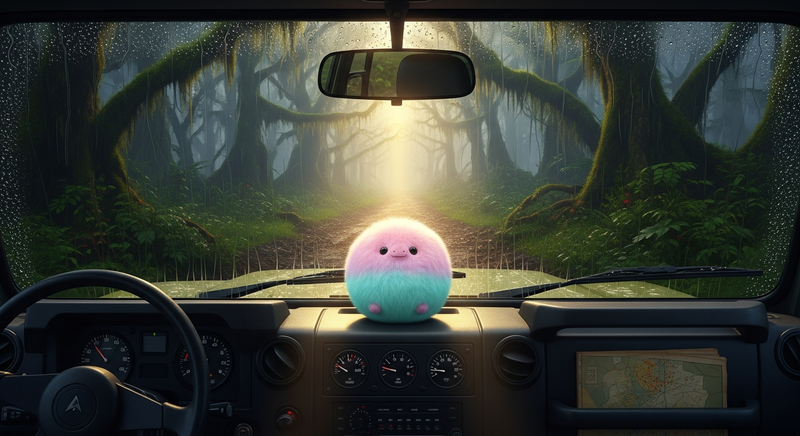
The containment failed on a Tuesday. It was raining — because containment failures in theme parks always happen during rain, as if the weather itself were an accomplice to hubris — and the automated feeding system had malfunctioned, delivering enzyme-enriched food to all habitats simultaneously.
By morning, the tribble population had doubled. By noon, it had quadrupled. By evening, the tour vehicles couldn’t move because the tracks were covered in a living carpet of pastel fur.
“I told you,” Malcolm said, standing on the roof of the visitor center while tribbles flowed around the building like a fuzzy, purring river. “I told you this would happen. I used the word ‘exponential.’ I used the word ‘dangerous.’ I used visual aids. I made a diagram. And yet, here we are. Standing on a roof. Surrounded by tribbles.”
“They’re not eating anyone,” Hammond pointed out, because Hammond’s bar for catastrophe had been permanently recalibrated by the time a T-Rex ate his lawyer.
“No, John. They’re not eating anyone. They’re eating everything else. The vegetation. The building infrastructure. The wiring. Dennis Nedry’s entire sabotage plan couldn’t have done this much damage to a facility, and all he had to do was turn off a computer. The tribbles are consuming your park from the inside out while purring about it.”
Ellie, who had been monitoring the situation with the calm focus of a woman who had once manually rebooted a power grid while a velociraptor tried to open the door, had the data.
“The tribble population on the island is approximately four hundred thousand and climbing. They’ve consumed seventy percent of the vegetation in zones one through four. The structural integrity of three buildings has been compromised by tribbles nesting in the walls. The generator room has fourteen thousand tribbles in it because it’s the warmest room on the island.”
“Can we evacuate?” Grant asked.
“The helipad is tribbles.”
“The dock?”
“Also tribbles.”
“The road?”
“Alan, everything is tribbles.”
IV. Clever Girls
The solution was Grant’s. Because Grant was a man who understood animals — even animals that shouldn’t exist, even animals that were round and fuzzy and purred — and he understood that you couldn’t fight biology. You had to redirect it.
“Stop trying to contain them,” he told Hammond. “Open the barriers. All of them. Let the tribbles spread across the island.”
“That’s insane,” Wu said.
“No — breeding four hundred thousand tribbles on a single island was insane. This is damage control. The island’s ecosystem will regulate them naturally. They’ll spread out, the food supply will thin, reproduction will slow. You’ll end up with a stable population distributed across the island instead of a concentrated mass destroying your buildings.”
“And the park?”
Grant looked at Hammond with the same expression he’d used when a brachiosaurus had risen above the tree line for the first time — wonder, mixed with sadness, mixed with the certainty that some things were not meant to be caged.
“The park was never going to work, John. Not with dinosaurs. Not with tribbles. You can’t build a park around a living thing and expect the living thing to cooperate. Living things don’t cooperate. They live.”
Hammond looked at the tribbles — four hundred thousand of them, flowing across his park like a warm, purring flood, eating his hedges and nesting in his gift shops and sitting contentedly on the ruins of his second attempt to play God with nature.
“They are rather lovely, aren’t they?” he said.
“Yeah,” Grant said. “They are.”
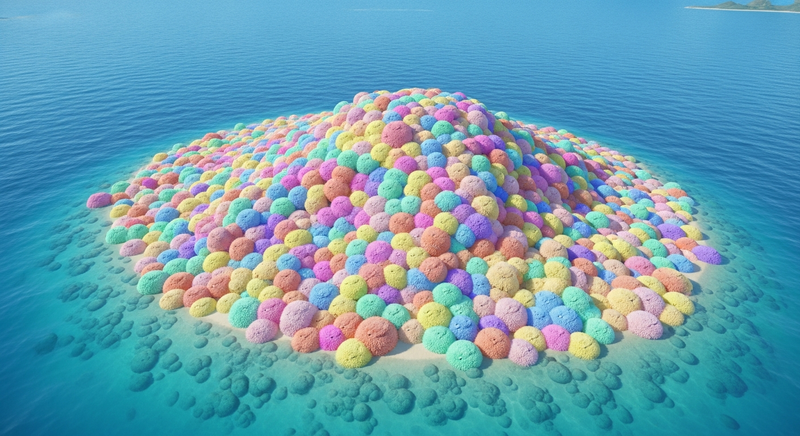
They evacuated by boat. The last thing they saw, pulling away from Isla Sorna, was the island — green and lush and covered in tribbles, visible from the water as a faint multicolored shimmer across the hillsides. The tribbles were everywhere. The tribbles were happy. The park was theirs.
Malcolm, standing at the stern with his arms crossed, watched the island shrink.
“Life found a way,” he said.
“You already said that,” Grant said.
“It bears repeating. Especially with tribbles.”
Isla Sorna was declared an international wildlife preserve under the Costa Rican government. The tribble population stabilized at approximately two million — a self-regulating ecosystem in which tribbles consumed the island’s abundant grain grasses and were kept in check by limited food supply and natural reproductive slowdown. Tour boats ran past the island at a distance, carrying tourists who paid two hundred dollars to see the tribbles through binoculars. Hammond’s insurance company charged him personally for the damages. Malcolm wrote a bestselling book about it called “The Purr of Chaos.” Grant went back to his dig site. Ellie planted a garden. And the tribbles — living, eating, purring, reproducing, being alive in a way that no amount of engineering could control and no amount of money could own — inherited the island, as living things do when you give them space and grain and get out of the way.