The Hypersphere: How Dante, the Qabalah, and Einstein All Described the Same Universe
The Problem Every Reader Notices
If you read the Paradiso carefully — really carefully, not just skimming for the pretty light imagery — you will hit a wall in Canto XXVIII. It’s the moment where Dante, having spent twenty-seven cantos ascending through the physical cosmos in a perfectly logical Ptolemaic order (Moon, Mercury, Venus, Sun, Mars, Jupiter, Saturn, Fixed Stars, Primum Mobile), arrives at the highest sphere and sees something that contradicts everything he’s just experienced.
He sees God.
Not outside the cosmos, where the Empyrean should be — the great container, the outermost shell, the thing that wraps around everything. No. He sees God as an infinitely small, infinitely bright Point. A dimensionless dot of light so intense that the nearest angelic ring — the Seraphim — can barely look at it. And the nine angelic orders orbit this Point in concentric rings, with the innermost ring moving fastest.
This is the exact opposite of everything Dante has just traveled through.
In the physical cosmos, the outermost sphere (the Primum Mobile) moves fastest. Speed increases with distance from Earth. God is on the outside, wrapping around everything.
In the angelic vision, the innermost ring (the Seraphim) moves fastest. Speed increases with closeness to God. God is on the inside, a point at the center of everything.
Both systems are presented as true. Both are happening simultaneously. Dante himself is confused — he literally asks Beatrice what’s going on.
Most commentators treat this as a theological paradox — a mystery of faith, a poetic device, a way of saying that God is beyond human comprehension. They pat Dante on the head, praise his mystical vision, and move on.
They’re wrong. Dante wasn’t being mystical. He was being mathematical. He was describing a hypersphere — a four-dimensional sphere — six hundred years before anyone had the vocabulary to explain what he’d seen.
What Is a Hypersphere?
A regular sphere — a basketball, the Earth, a soap bubble — is a three-dimensional object. Its surface is two-dimensional (you can describe any point on it with two numbers: latitude and longitude). If you walk along the surface in a straight line, you will eventually return to where you started. There is no edge. There is no boundary. The surface is finite but unbounded.
A hypersphere (technically a 3-sphere) is the four-dimensional analogue. Its “surface” is three-dimensional — our entire three-dimensional universe could, in principle, be the surface of a hypersphere. If you traveled in a straight line through a hypersphere universe, you would eventually return to your starting point, just as walking around the Earth brings you home. Finite but unbounded. No edge. No outside.
The critical property of a hypersphere, and the one that matters for Dante, is this: a hypersphere has two poles, and each pole looks like the center of the universe from its own perspective.
Stand on the North Pole of the Earth. Every direction is south. You appear to be the center, and the South Pole is the furthest point from you — the very edge of your world. Now stand on the South Pole. Every direction is north. You appear to be the center, and the North Pole is the furthest point.
Neither pole is more “central” than the other. They are symmetric. Each one looks like the center from its own perspective.
A hypersphere works the same way, but in one higher dimension. It has two poles, and from each pole, the universe appears to radiate outward in every direction, with the opposite pole at the maximum distance.
Now look at Dante’s cosmos again.
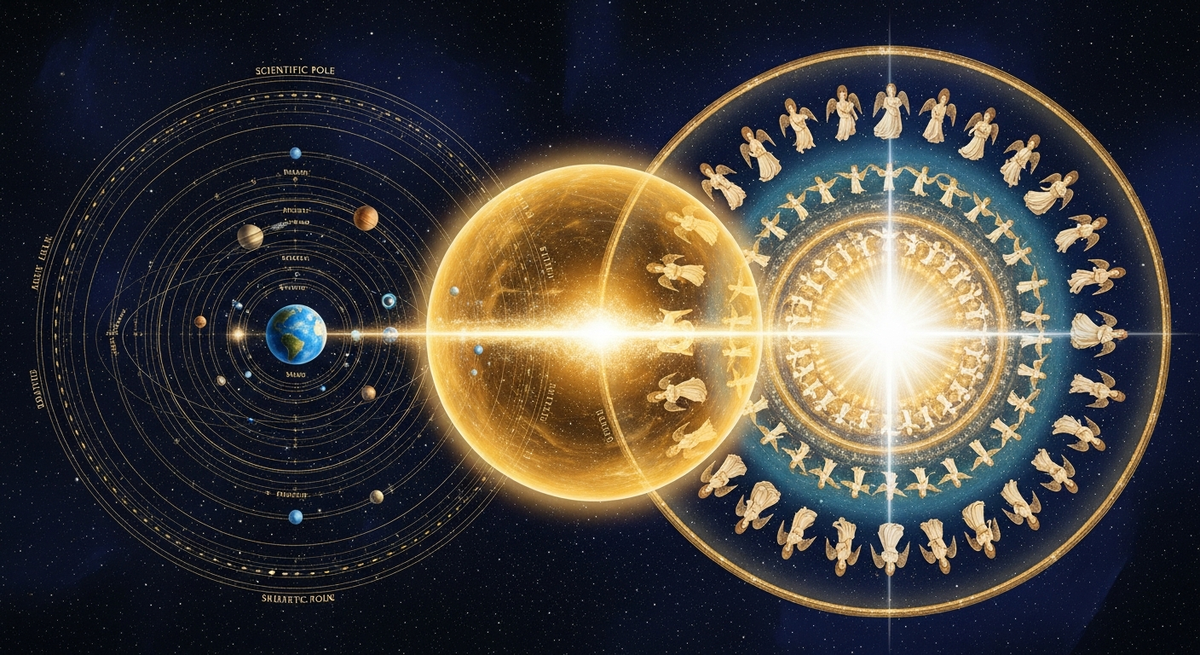
Pole One: Earth. Stand on Earth and look outward. The cosmos radiates away from you in concentric spheres — Moon, Mercury, Venus, Sun, Mars, Jupiter, Saturn, Fixed Stars, Primum Mobile. The furthest thing from you is the Empyrean. God is at the maximum distance.
Pole Two: God. Stand at the Point and look outward. The angelic orders radiate away from you in concentric rings — Seraphim, Cherubim, Thrones, Dominations, Virtues, Powers, Principalities, Archangels, Angels. The furthest thing from you is the material world. Earth is at the maximum distance.
Same cosmos. Two poles. Each one looks like the center. The Primum Mobile is the equator — the point of maximum distance from both poles, the hinge where the curvature flips and “outward” becomes “inward.”
Dante did not describe two contradictory universes. He described one hypersphere seen from its two poles. The physical cosmos is the view from the matter pole. The angelic vision is the view from the God pole. The Paradiso is the journey from one pole to the other — and the moment of crossing, in Canto XXVIII, is the moment where the curvature flips and the pilgrim sees the universe from God’s side for the first time.
The Mathematician Who Noticed
This is not a new observation, though it is a persistently under-appreciated one. In 1979, the physicist and historian of science Mark Peterson published a paper called “Dante and the 3-sphere” in the American Journal of Physics, arguing that the topology of Dante’s cosmos is precisely that of a 3-sphere (the mathematical name for a hypersphere). Peterson demonstrated that every structural feature of the Paradiso — the two concentric systems, the speed reversal, the finite-but-unbounded cosmos, the Primum Mobile as the equator — maps exactly onto the geometry of a 3-sphere.
Dante could not have known the mathematics. The 3-sphere was not formally described until Bernhard Riemann’s work in the 1850s, more than five hundred years after the Commedia was completed. But Dante did not need the mathematics. He had something better: he had a vision — whether mystical, poetic, or simply the product of an intellect so penetrating that it could see the shape of the universe without having the tools to prove it.
Einstein’s general relativity, published in 1915, suggests that the universe may in fact be a hypersphere — a finite but unbounded three-dimensional surface curved through a fourth spatial dimension. If this is correct, then Dante did not merely anticipate Riemann’s mathematics. He anticipated the shape of the actual cosmos.
A medieval poet, working from Ptolemy and Aristotle and Aquinas, arrived at the same topology as modern physics. He did it through theology. The universe, for Dante, had to be a hypersphere, because it had to be finite (only God is infinite), it had to be unbounded (there can be nothing “outside” God), and it had to have God at both the center and the circumference simultaneously (because God is both immanent and transcendent). The only geometry that satisfies all three constraints is a hypersphere.
The Qabalah Knew Too
Here is where it gets interesting for students of the Western Mystery Tradition. Because the Qabalah — independently, through entirely different methods, in an entirely different cultural context — arrived at the same geometry.
Tzimtzum: The Contraction That Creates Two Poles
Isaac Luria, the great Kabbalist of Safed, working in the sixteenth century (two hundred years after Dante), described creation through a process he called Tzimtzum — divine contraction. Before creation, God (Ain Soph, the Limitless) was everything. There was no space, no void, no “outside.” God withdrew into Himself — contracted — to create a void (tehiru) in which creation could exist.
This withdrawal created two simultaneous modes of divine presence:
Sovev Kol Almin — God surrounding all worlds. The infinite light that wraps around creation from the outside. The container. The Empyrean.
Memaleh Kol Almin — God filling all worlds from within. The divine vitality that animates every particle of creation from inside. The Point.
These are Dante’s two poles. Sovev is the view from Earth looking outward — God as the Empyrean, the outermost shell, the great container. Memaleh is the view from the angelic vision — God as the infinitely small Point at the center of everything. Luria and Dante described the same hypersphere. They just used different languages — one used Ptolemaic astronomy, the other used Kabbalistic metaphysics.
Kether Is in Malkuth
The foundational axiom of Qabalistic philosophy, the one inscribed at the gate of every Golden Dawn temple, the one that every student of the Tree of Life learns before anything else:
“Kether is in Malkuth, and Malkuth is in Kether — but after another manner.”
This has been treated as a paradox, a koan, a mystical statement beyond rational comprehension. It is none of these things. It is a description of a hypersphere.
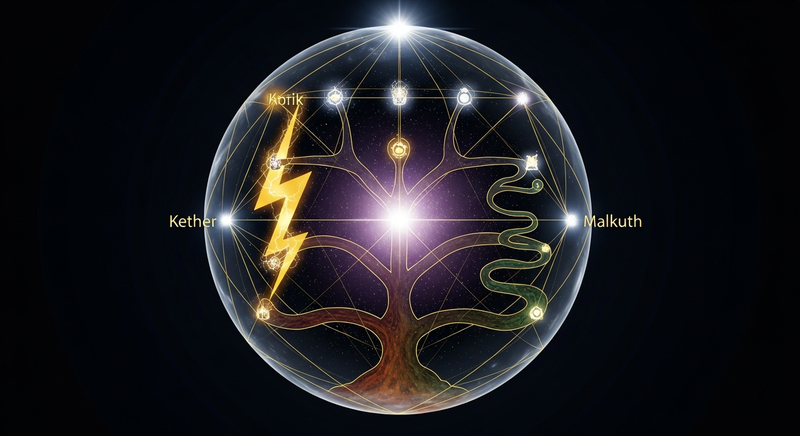
Kether (the Crown, the first Sephirah, the first emanation of God) is the God-pole of the hypersphere. Malkuth (the Kingdom, the tenth Sephirah, the physical world) is the matter-pole. “Kether is in Malkuth” means that from the matter-pole, the God-pole appears to be at the innermost center of physical reality — God as the hidden point within all things. “Malkuth is in Kether” means that from the God-pole, the matter-pole appears to be at the innermost center of spiritual reality — the physical world as the densest core of divine emanation.
“But after another manner” means: seen from the other pole.
It was never a paradox. It was geometry.
The Tree as a Hypersphere Map
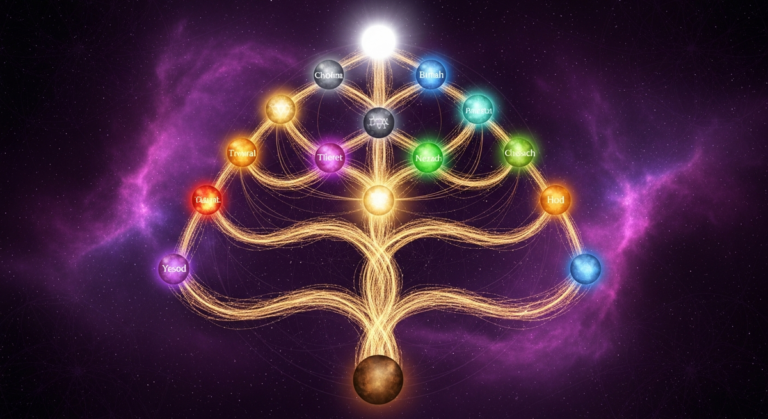
The Tree of Life is traditionally drawn as a flat diagram — ten Sephiroth connected by twenty-two paths, arranged in three columns. This is useful for study, but it is a projection, the way a flat map of the Earth is a projection of a sphere. The true shape of the Tree is not flat. It is a map of the hypersphere, projected onto two dimensions for human comprehension.
Consider the structure:
Kether (God-pole) emanates downward through nine Sephiroth to Malkuth (matter-pole). This is the Lightning Flash — the path of emanation from God to world, from Point to circumference, from the spiritual center outward.
The initiate ascends from Malkuth upward through the same Sephiroth back to Kether. This is the Serpent of Wisdom — the path of return from world to God, from circumference to center, from the material surface inward.
The Lightning Flash and the Serpent are the same path traveled in opposite directions — exactly as Dante’s physical cosmos and angelic vision are the same hypersphere seen from opposite poles.
The Abyss — the great gap between the Supernal triad (Kether, Chokmah, Binah) and the seven lower Sephiroth — corresponds to Dante’s transition from the planetary heavens to the stellar and crystalline spheres. Below the Abyss, souls appear as individuals (Dante sees recognizable faces, hears personal stories). Above the Abyss, individuality dissolves into geometric patterns of light (crosses, eagles, ladders, roses, rings). The Abyss is the equatorial region of the hypersphere — the zone of maximum curvature, where the transition from one pole’s perspective to the other’s becomes violent and disorienting.
In the Golden Dawn system, crossing the Abyss means the annihilation of the ego in Daath — the false Sephirah, the empty throne. In Dante’s system, the equivalent moment is Canto XXVIII, where the physical cosmos suddenly flips and the pilgrim must abandon everything he thought he knew about the structure of reality. Both traditions describe the same experience: the vertigo of reaching the equator of the hypersphere and realizing that “up” and “down” have switched.
The Middle Pillar as Circulation
The Golden Dawn’s Middle Pillar exercise — perhaps the most practiced ritual in the Western Mystery Tradition — asks the practitioner to visualize divine energy descending from Kether (crown of the head) through Daath (throat), Tiphareth (heart), Yesod (groin), to Malkuth (feet), and then circulating back upward through the aura.
This is not a linear descent and ascent. It is a circulation through the hypersphere. Energy flows from the God-pole to the matter-pole and back again, tracing a great circle on the surface of the 3-sphere, just as ocean currents circulate from pole to pole on the surface of the Earth. The practitioner does not “go up and then come down.” The practitioner circulates — and in circulating, becomes a living model of the hypersphere, a microcosmic version of the same structure that Dante mapped in the Commedia.
The Commedia IS a Middle Pillar exercise. Dante descends from the surface (Malkuth — the dark wood) to the center of the Earth (the nadir, the feet of the exercise). He crosses through Satan — the Daath of the material world, the point of maximum density and inversion — and emerges on the other side, ascending through Purgatory (the spine) to the Earthly Paradise (Tiphareth — the heart). From there he rises through the planetary spheres, crosses the Abyss, and reaches Kether (the Primum Mobile). The final step — the Empyrean, the Beatific Vision — is the energy circulating back, the completion of the great circle, the moment where Malkuth is once again in Kether.
Dante’s poem is a ritual. It always was.
Why This Matters Now
In 1320, a Florentine exile described the universe as a finite, unbounded, four-dimensional structure with two poles and an equatorial hinge. He did this using the language of Ptolemaic astronomy and Catholic theology, because those were the tools available to him.
In the sixteenth century, Isaac Luria described the same structure using the language of Kabbalistic metaphysics — Tzimtzum, Sovev, Memaleh, the contraction of the infinite into a point that is simultaneously the center and the circumference of all things.
In the nineteenth century, the Golden Dawn synthesized both traditions into a practical system — the Tree of Life as a map of emanation and return, the Middle Pillar as a circulation through the poles, the Abyss as the equatorial crossing.
In 1854, Bernhard Riemann described the same structure using the language of differential geometry. In 1915, Einstein used it to model the physical universe.
Five traditions. Five centuries. Five languages — poetry, mysticism, ritual, mathematics, physics. All describing the same shape. The hypersphere is not a metaphor. It is, as far as we can tell, the actual topology of the universe. And the Western Mystery Tradition has been mapping it — accurately, rigorously, in precise structural detail — since Dante put quill to parchment in the early fourteenth century.
The mystics were not being poetic. They were doing geometry. They just didn’t know it yet.
Beatrice explains it best, as she always does. When Dante asks her why the physical cosmos and the angelic vision seem to contradict each other, she smiles — the smile that ignites worlds — and tells him:
“If your fingers lack the skill to untie this knot, it is no wonder, for by never trying, the knot has grown so tight.”
— Paradiso XXVIII.58–60
The knot is the hypersphere. The two loose ends are the two poles. Pull them apart and you get Dante’s cosmos and the angelic vision. But if you understand the geometry — if you see that they are one surface, curved through a dimension we cannot directly perceive — the knot unties itself.
It was never a contradiction. It was a shape.
“The Love that moves the Sun and the other stars.”
— Paradiso XXXIII.145
The Love does not push from outside or pull from within. It circulates. It flows from pole to pole along the surface of a sphere that has no edge and no center and no outside — because it is the center and the edge and the outside, all at once, after another manner.
Dante saw this. Luria saw this. The Golden Dawn ritualized it. Riemann formalized it. Einstein proved it.
It’s all one sphere.