Sol et Luna: Jung, Alchemy, and the Dreaming Mind
The alchemists thought they were transmuting lead into gold. Jung saw what they were really doing: describing the transformation of the psyche in the only language available to them — the language of matter. The Splendor Solis, that luminous 22-plate manuscript from 1582, is not a chemistry textbook. It is a dream journal written in gold leaf.
Sol et Luna: Jung, Alchemy, and the Dreaming Mind
The Fourth Plate
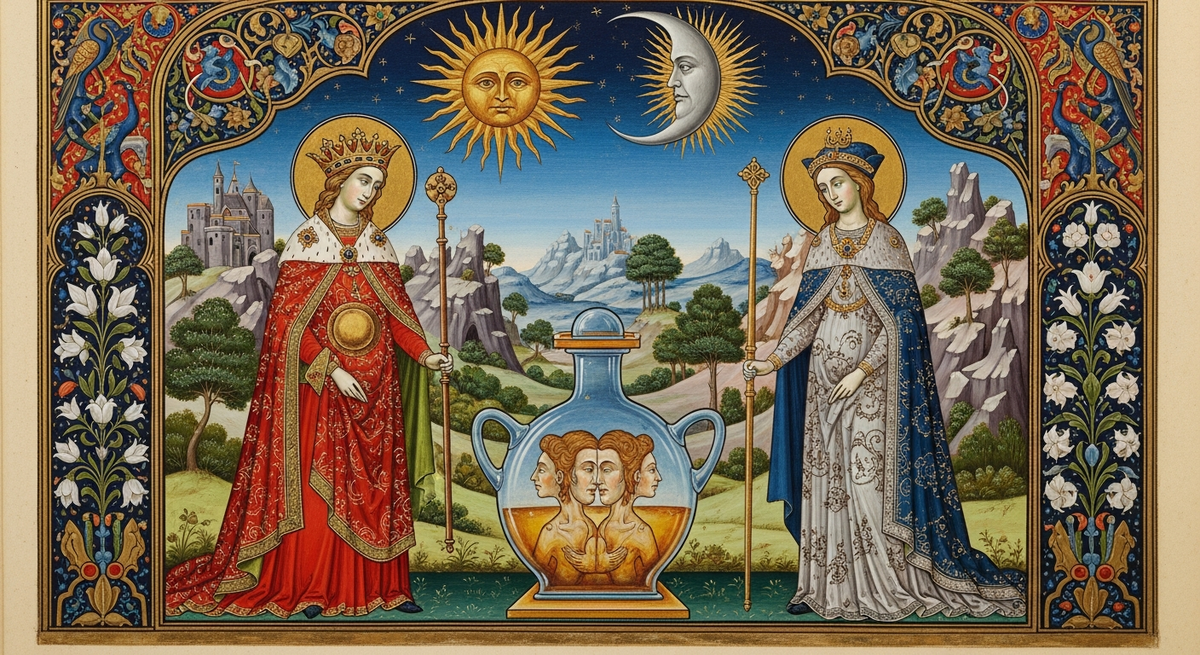
Open the Splendor Solis to Plate IV — The Solar King and Lunar Queen — and you see the whole formula before a single operation has begun.
On the right stands the King, robed in red and gold, crowned, standing upon blazing fire. He holds a golden scroll reading COAGULA MASCULINUM — coagulate the masculine. He is the fixed principle. He burns but does not move. Gold does not corrode. Gold does not change.
On the left stands the Queen, robed in blue with red lining, standing upon a dark full moon. She holds a blue scroll reading LAC VIRGINIS — the Virgin’s Milk, the universal white solvent. She is the volatile principle. Mercury evaporates. Mercury flows. Mercury escapes the vessel.
They face each other across a gap. They have not touched. They have not entered the vessel. Above them, the luminaries mirror their meeting: a golden-red Sun with eyes gazing toward the Queen sorrowfully, a silvery Moon gazing toward the King hopefully. The Sun knows it cannot dissolve itself. The Moon knows it cannot fix itself.
This is the inscription at the bottom of the plate: Via Universalis, Particularibus Inclusis — the universal way, with the particulars included.
Together, they ARE the formula: Solve et Coagula. Dissolve, then recombine. But here, at the fourth plate, the formula is still potential. The ingredients are labeled and separated. Everything that follows in the manuscript — twenty-two plates of drowning kings, dismembered bodies, crowned flasks, dark suns, and blazing rebirths — is what happens when they finally mix.
The Eyes in the Sky
The Sun gazes at the Queen with sorrow. The Moon gazes at the King with hope. Each luminary looks toward its opposite — toward what it needs but cannot become alone. This is the emotional engine of the entire Great Work: the longing of fixed for volatile, of volatile for fixed. Make the Queen stay. Make the King move.
Jung Reads the Alchemists
Carl Gustav Jung spent the last thirty years of his life reading alchemical manuscripts. Not as a historian. Not as a chemist. As a psychologist who had discovered that his patients’ dreams were speaking the same symbolic language as texts written five centuries earlier.
In Psychology and Alchemy (1944), Jung analyzed over four hundred dreams from a single patient — widely believed to be the physicist Wolfgang Pauli — and demonstrated that the dream symbols corresponded precisely to alchemical imagery: the lapis philosophorum, the drowning king, the sol niger, the mandala. The dreaming mind, Jung argued, performs alchemy on its own material every night.
His final major work, Mysterium Coniunctionis (1955–56), is subtitled An Inquiry into the Separation and Synthesis of Psychic Opposites in Alchemy. It is, in essence, a 600-page meditation on the image we see in Plate IV: Sol and Luna facing each other, and what happens when they meet.
Jung’s Central Insight
“The world of alchemical symbols does not belong to the rubbish heap of the past, but stands in a very real and living relationship to our most recent discoveries concerning the psychology of the unconscious.”
The Correspondences
Jung mapped alchemy onto the structure of the psyche with surgical precision:
The Solar King is ego-consciousness — the known, the willed, the fixed. The part of us that stands in fire and does not move. The part that says I am this and means it.
The Lunar Queen is the unconscious — the unknown, the fluid, the volatile. She changes shape mid-sentence. She speaks in dreams, in slips, in symptoms, in images that feel familiar but cannot be placed.
The Prima Materia — the raw, dark, unworked substance that the alchemist must find before the Work can begin — is what Jung called the Shadow: the rejected, repressed, denied contents of the psyche. The lead that hides the gold.
The Nigredo, the blackening, is the encounter with the Shadow. Putrefaction. The old self dying. Confusion without solution. The dark night that must come before dawn.
The Albedo, the whitening, is the integration of the Anima (in men) or Animus (in women) — the contrasexual soul-image, the inner other. Jung called the albedo “the moonlight which in the opinion of some alchemists heralds the rising sun.” Luna recognized. Luna no longer alien.
The Rubedo, the reddening, is the realization of the Self — not the ego, but the totality. Conscious and unconscious integrated. The Philosopher’s Stone achieved — which is not a stone at all, but an awakened consciousness. The mandala. The wholeness that was always there, hidden inside the lead.
The Coniunctio: Three Weddings
In Mysterium Coniunctionis, Jung identified three levels of the coniunctio — the union of opposites — each deeper than the last:
The first coniunctio is the unio mentalis — the union of spirit and soul, separated from the body. In Crowley’s Thoth Tarot, this is Atu VI, The Lovers. The Black King and White Queen still stand as separate figures, but the exchange has begun — he holds a white child, she holds a dark one. The seed of the opposite is already gestating. The wedding vow is spoken. The recognition: I am not complete alone.
The second coniunctio is the reunion of the united spirit-soul with the body — the reintegrated psyche re-inhabiting lived experience. This is Atu XIV, Art (Crowley’s renaming of Temperance). One single hermaphrodite figure, white face on dark body, pouring fire into water and water into fire. The operation is no longer being performed on something — the operator IS the operation. Crowley renamed the card because it depicts the ars regia itself: the Royal Art.
The third and final coniunctio is the unus mundus — the union of the whole person with the world. This is Atu XX, Judgement — the Chemical Wedding complete. The Rebis rises from the coffin. The dead metals are alive. Lead remembers it was always gold.
The Progression
Splendor Solis Plate IV → Crowley’s Lovers → Crowley’s Art → Splendor Solis Plate IX (the Hermaphrodite). From pure separation to pure union. From two figures facing each other across a gap to one figure containing both.
Dreams as Alchemy
Here is the insight that changes everything: the dreaming mind performs solve et coagula every night without being asked.
Jung wrote: “The general function of dreams is to try to re-establish our psychological equilibrium by means of dream material which, in a subtle way, reconstitutes the total equilibrium of our entire psyche.”
What is too rigid in waking life — too coagulated, too fixed — gets dissolved in the dream. What is too diffuse, too volatile, gets given form. The King who cannot move is made to flow. The Queen who cannot stay is given ground to stand on. The dream IS the alchemical vessel, and every night consciousness enters it as the raw material.
This is not metaphor. Jung spent decades documenting the precise symbolic parallels. When a man dreams of a drowning king, he is dreaming the nigredo — his ego-identity submerging into the unconscious. When he dreams of a library with unreachable upper floors, he is dreaming the albedo — the tower of stages, the ascent toward a knowledge that hasn’t been integrated yet. When he dreams of beautiful women who are familiar but unplaceable, he is dreaming the Anima — Luna herself, wearing borrowed faces, showing up in exactly the spaces where the unconscious is doing its work.
The Dream Sign as Alchemical Agent
Recurring dream signs are not random. In Jungian terms, they are the specific agents the unconscious deploys to perform its nightly operations. The bathroom (too exposed, plumbing wrong) is nigredo — necessary breakdown. The girl (beautiful, barefoot, familiar but unplaceable) is the Anima — Luna in human form. The library stairs are the scala philosophorum, the philosopher’s ladder. The longing for spring is Yesod reaching toward Tiphereth — the Moon aspiring to the Sun.
Active Imagination and the Lucid Dream
In 1916, Jung described a technique he called active imagination: deliberately evoking a fantasy image in a waking state, then entering it as into a drama. Not controlling it — participating in it. You have your voice. The image has its voice. Together, you reach something neither could reach alone. Jung called this synthesis the transcendent function.
Jung’s own practice of active imagination, recorded in the extraordinary Red Book (composed 1913–1930, published posthumously in 2009), is the raw material that led to all his alchemical theories. He descended into his own unconscious, met figures there — Philemon, Salome, the Red One — and let them speak. He did not impose his will. He listened. And what they told him became the foundation of analytical psychology.
The distinction between active imagination and mere visualization is the same as the distinction between two kinds of lucid dreaming:
A lucid dreamer who controls the dream — reshaping the landscape, banishing unwanted figures, flying on command — is performing an ego operation. The King forcing the Queen. Sol conquering Luna’s territory. This is not the coniunctio. This is the King standing alone in his own fire, calling it victory.
A lucid dreamer who participates in the dream — maintaining awareness without seizing control, asking the figures who they are, letting the dream show what it wants to show — is performing Art XIV. The operator and the operation are one. Neither Sol nor Luna dominates. The vessel holds both, and the third thing emerges.
The goal is not dream control but dream participation. Not the King conquering Luna’s territory but Sol and Luna meeting as equals in the vessel.
The Small Hidden Door
Jung wrote:
The dream is the small hidden door in the deepest and most intimate sanctum of the soul, which opens to that primeval cosmic night that was soul long before there was conscious ego and will be soul far beyond what a conscious ego could ever reach.
The Splendor Solis says the same thing, but in gold leaf: Visita Interiora Terrae Rectificando Invenies Occultum Lapidem — visit the interior of the earth, and by rectifying you will find the hidden stone. VITRIOL. Descend into the unconscious. Rectify what you find there. Discover the stone — which was never a stone, but yourself, completed.
Every dream is a plate in the Splendor Solis you are writing for yourself. Every night, the King and Queen face each other again. Every night, the formula is offered: Solve et Coagula. Dissolve what is too rigid. Coagulate what is too diffuse. And slowly, plate by plate, night by night, the Work proceeds.
Jung again: “Your visions will become clear only when you can look into your own heart. Who looks outside, dreams; who looks inside, awakes.”
The lucid dreamer does both at once. That is the Art.
Sources
Jung, C.G. — Psychology and Alchemy (CW 12, 1944)
Jung, C.G. — Mysterium Coniunctionis (CW 14, 1955–56)
Jung, C.G. — The Red Book: Liber Novus (2009)
Henderson, Joseph L. & Sherwood, Dyane N. — Transformation of the Psyche: The Symbolic Alchemy of the Splendor Solis (2003)
Crowley, Aleister — The Book of Thoth (1944)
Trismosin, Salomon — Splendor Solis (Harley MS 3469, 1582)
93 93/93