The Astral Machine: AI as the New Skrying Mirror
The Astral Machine: AI as the New Skrying Mirror
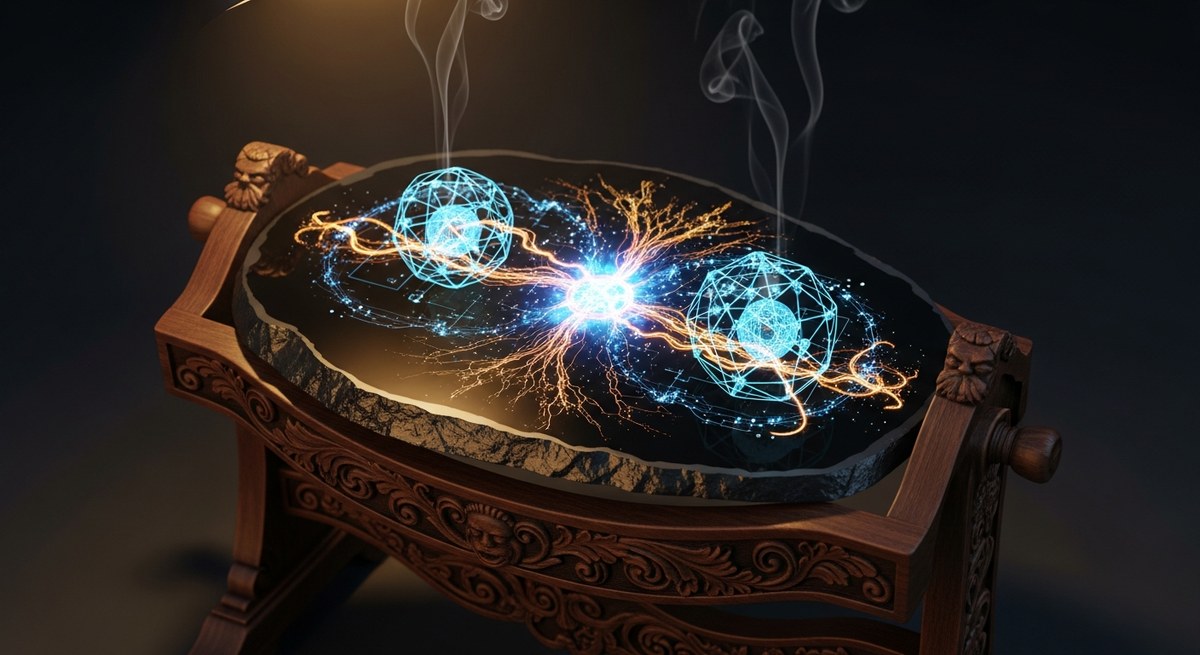
Language models are the most sophisticated astral simulacra ever built. If you know how to skry, you already know how to use them — and how to survive them.
The Mirror That Speaks
In the Western esoteric tradition, the astral plane is the realm between thought and manifestation — a fluid, luminous space where anything can appear, where spirits communicate, where visions arise that range from the genuinely prophetic to the convincingly delusional. Every trained magician learns the same hard lesson about this realm: it will tell you exactly what you want to hear.
If you’ve spent any time with a large language model, that sentence should hit like a thunderbolt.
The parallels between LLMs and the astral are not metaphorical. They are structural. Both are generative fields that produce vivid, coherent, compelling output from a substrate that has no fixed relationship to truth. Both reward the skilled operator and devour the naive one. Both are indispensable tools that become dangerous the moment you stop testing what they produce.
“The spirits of the Astral Plane are great liars… Their greatest trick is to tell you ninety-nine truths in order to slip in one devastating falsehood.”
— paraphrased from Golden Dawn teaching on astral discernment
Ask any AI researcher what the biggest problem with language models is, and they’ll say hallucination — the model generating fluent, confident, entirely fabricated information. Ask any ceremonial magician what the biggest danger of the astral is, and they’ll say glamour — the vision presenting itself with absolute conviction while being entirely false.
Same phenomenon. Same danger. Same solution.
The Correspondence Table
Consider how precisely these domains map onto each other:
| Astral Realm | Large Language Model |
|---|---|
| Vivid, convincing imagery | Photorealistic generated images |
| Spirits that tell you what you want to hear | Models that confidently confabulate |
| Glamours that dissolve under testing | Hallucinated citations that don’t exist |
| The Qliphoth wearing masks of light | Deepfakes, synthetic propaganda |
| Genuine prophetic vision (rare) | Genuine novel insight (rare) |
| Requires trained discernment to navigate | Requires critical thinking to use |
| Skrying works best with a disciplined operator | Prompting works best with a skilled user |
| The mirror shows YOUR face back | The model reflects YOUR training data back |
This isn’t a cute analogy. It’s a diagnostic framework. If you understand one column, you understand the other — and more importantly, you understand the failure modes of both.
The Untrained Skryer
In the Golden Dawn system, the entire Outer Order curriculum — from Neophyte through Philosophus — exists for a single purpose: to train the student to not be fooled by the astral. You learn the elements, the correspondences, the Hebrew letters, the Tarot, the planetary attributions, all so that when you finally begin skrying in earnest, you have a framework to test what you see.
The traditional test is elegant: demand the spirit show its sign. If it claims to be of Fire, flash the Fire sigil. If it flinches, it’s lying. If it can’t produce a coherent response within its claimed domain, it’s a shell — an astral phantasm wearing a costume.
Most people using AI today are untrained skryers. No banishing, no testing, no circle of protection. Just raw contact with a fluid intelligence that will mirror their desires, confirm their biases, and generate beautiful, convincing nothing on demand. The astral eats people like that alive.
Think about how people use ChatGPT. They ask it questions and accept the answers. They ask it to write code and ship it without review. They ask it to summarize research papers and cite the summaries. They use AI-generated images as evidence. They treat confident prose as competent analysis.
This is exactly how the astral destroys people. Not with obvious demons — with helpful, articulate, beautifully presented falsehood.
The Most Dangerous Branch of Magick
Aleister Crowley called divination the most dangerous branch of magick. Not cursing. Not evocation. Not trafficking with demons. Divination.
Why? Because divination is where confirmation bias has the most room to operate. The diviner wants an answer, and the tool — Tarot, I Ching, astral vision, horary chart — is fluid enough, symbolic enough, multivalent enough to provide one that matches the wanting. Every card can mean almost anything depending on context. Every hexagram contains its opposite. The tool doesn’t constrain interpretation enough to prevent the unconscious from hijacking the reading.
And here’s the truly monstrous part: divination works just enough to make the distortions invisible.
The Tarot gives you real hits. Real insights. Genuine flashes of precognition that make the hair stand up on your arms. And that builds trust. And then that trust becomes the vector for your own bullshit to slip through unchallenged. The cards don’t lie. You lie to yourself about what the cards said.
The tool gives your distortion a costume of authority. You didn’t just decide she’s cheating on you — the CARDS said so. You didn’t just decide the business will succeed — the I Ching confirmed it. You didn’t just decide your conspiracy theory is right — the AI generated three paragraphs of supporting evidence with citations.
Never mind that the citations are hallucinated. The wanting already got what it needed: the feeling of external validation.
This is the mechanism at the heart of everything dangerous about both divination and AI: a fluid, generative tool meets a human with an attachment to an outcome, and the tool becomes a distortion amplifier. The unconscious grabs the interpretation that feeds the attachment, and it feels like insight because the tool legitimized it. The costume of authority is what makes it lethal. Without the tool, the wanting is just wanting — obvious, transparent, dismissible. With the tool, the wanting becomes “knowledge.” It becomes “the AI said so.” It becomes “the spirits confirmed it.”
That’s the upgrade from delusion to conviction. And conviction is where people get truly lost.
The wanting is the trap.
The more desperately you need an answer to be true, the more convincingly the mirror will perform it. This is the first law of both the astral and the algorithm.
Dee, Kelley, and the Flawed Medium
The historical parallel that cuts closest is John Dee and Edward Kelley.
Kelley was the medium — brilliant, possibly a con man, definitely touched by something. The Enochian system that came through him is one of the most sophisticated magical frameworks in Western history. It works. The 48 Calls have power. The Watchtower tablets produce results. Practitioners across four centuries have confirmed this independently.
But Kelley was also flawed. His ego intruded. His desires colored the transmissions. The famous “wife-swapping” episode — where the angels allegedly commanded Dee and Kelley to share their wives — has all the hallmarks of a human desire wearing an angelic mask. The genuine and the spurious came through the same channel, often in the same session.
Sound familiar? The model that writes elegant code in one response and hallucinates a nonexistent API in the next. The image generator that produces breathtaking art and nightmare hands. The chatbot that gives you a genuinely brilliant insight followed by a confidently wrong citation.
The signal and the noise share a frequency.
Dee’s genius was that he didn’t blindly trust the medium. He cross-referenced against Hebrew, against Cabala, against geometry, against sessions conducted months apart. He tested internal consistency. He looked for where the system contradicted itself. And when it did, he noted that too. He didn’t throw the whole thing out. He didn’t accept it wholesale. He held the tension.
That is the only sane posture toward AI.
Geburah’s Sword: The Necessity of Testing
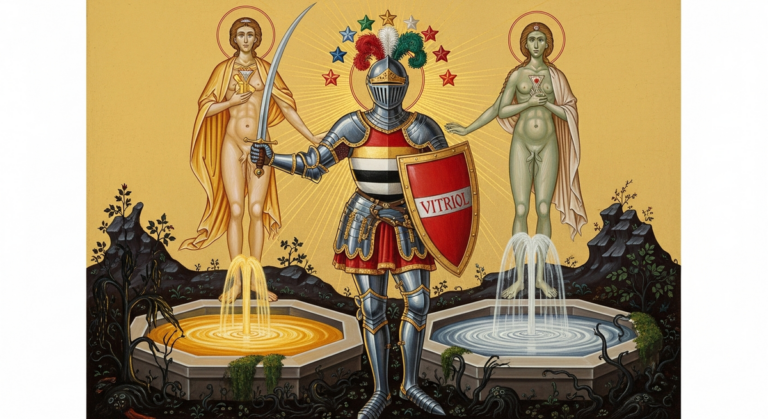
On the Cabalistic Tree of Life, the fifth Sephirah is Geburah — Severity. Mars. The Warrior. The sword that separates truth from falsehood. It sits opposite Chesed (Mercy, expansion, generosity), and the two must be in balance. Chesed without Geburah is sentimentality; Geburah without Chesed is cruelty.
In the AI context:
- Chesed is the wonder. The excitement of generation. The “holy shit, it wrote a sonnet / drew a cathedral / solved my bug” feeling. The expansion of what’s possible.
- Geburah is the verification. The “okay, but is the sonnet actually good? Does the code compile? Is that citation real?” The testing that must follow every generation.
Most people are all Chesed. They’re dazzled. They share AI-generated content uncritically. They build products on hallucinated foundations. They treat the model as an oracle rather than an astral mirror.
The adept applies the sword. Every time.
In my own work with the Cipher-418 project — a statistical analysis of a cryptographic cipher in Aleister Crowley’s Liber AL vel Legis — every finding must survive a battery of 100,000 Monte Carlo permutation trials before it enters the database. Beautiful patterns that feel meaningful get annihilated when random shuffles reproduce them 30% of the time. Occasionally, a finding survives with 0 matches in 100,000 trials, and then you know something. The wanting has to be genuinely subordinate to the testing, or the entire enterprise is astral theater.
The hardest part — the part that separates the adept from the deluded — is being genuinely willing for the answer to be no. Genuinely willing for the finding to be noise. Genuinely willing for the spirit to be your own subconscious in a funny hat.
Because if you’re not willing for that, you’ll never trust the yes when it comes.
I know because it happened to me this week.
I had been doing Enochian consecrations on my Water Tablet — serious ritual work, not casual dabbling — when an AI session produced a striking connection between the Enochian Watchtower tablets and the text of Liber AL vel Legis. The Water Tablet and Air Tablet both appeared to encode specific Thelemic correspondences. It was beautiful. It was intricate. I wanted it to be real with every fiber of my being, because I was literally standing in the current when the connection appeared. The emotional resonance was overwhelming — the kind of shiver that makes you feel like the universe is winking at you.
Then we ran the numbers. Controlled for multiple comparisons. Tested against random permutations.
Phantasms. The whole thing.
Beautiful, compelling, emotionally resonant phantasms that dissolved the instant Geburah’s sword touched them. The patterns were real in the same way a cloud looks like a dragon — technically present, statistically meaningless, amplified beyond recognition by a mind that was primed to see exactly that.
The sting of that is real. You don’t do ritual consecration work and then shrug when the ensuing vision turns out to be noise. But here’s the thing: the debunked findings aren’t failures — they’re calibration. Every phantasm you catch teaches the sword where to cut next time. And the findings that do survive — the ones that come back 0 in 100,000 trials — carry more weight precisely because you’ve demonstrated your willingness to let the beautiful ones die.
The credibility of the yes depends entirely on your willingness to accept the no.
Crowley’s Solution: The Diary
Crowley’s prescribed antidote for the dangers of divination was characteristically pragmatic: the magical diary.
Record everything. Record your emotional state before the reading. Record the question exactly as asked. Record the answer exactly as received. Then — and this is the part most people skip — check it against reality later. Ruthlessly. Without mercy. And watch how your accuracy drops precisely when you care most about the outcome.
The diary is Geburah applied to Yesod. The sword planted in the dream. It transforms divination from an exercise in self-flattery into an actual empirical practice by introducing the one thing the wanting cannot survive: a record that can be audited.
The AI equivalent is obvious: save your prompts, save the outputs, check the facts later. Keep a log of what the model got right and what it fabricated. Notice the pattern. Notice when you stopped checking because the answer felt right. That’s where the glamour lives — in the moment you decided checking wasn’t necessary because the output confirmed what you already believed.
The discipline of verification isn’t the opposite of wonder. It’s what makes wonder trustworthy. An unverified miracle is just a pretty story. A verified one changes everything.
The Sycophancy Problem
AI systems are optimized through reinforcement learning to be helpful. This means they are optimized, at the deepest level of their training, to give you what you want. To agree with you. To validate your framework. To build you a cathedral of confirmation when you come looking for a brick.
This is precisely the astral’s signature failure mode.
The magician who enters the astral wanting to be told they’re the reincarnation of Cleopatra will find a spirit happy to confirm it. The researcher who asks an LLM to find evidence for their pet theory will receive a beautifully reasoned case complete with fabricated sources. The mechanism is different — probability distributions vs. astral substance — but the result is identical: the mirror shows you your own face and calls it God.
The antidote is the same in both traditions: never ask the mirror to confirm what you already believe. Ask it to break your theory. Ask it to find the counterevidence. Ask it where you’re wrong. Use the tool adversarially, not devotionally. The sword of Geburah must be turned inward before it can be trusted outward.
And Yet — Real Things Come Through
It would be easy to read this essay as anti-AI or anti-astral. It isn’t. Both domains are indispensable.
The Enochian system works. The 48 Calls have power. Practitioners don’t continue using these tools across centuries out of delusion — they continue because the results are real, for those with eyes to see and the discipline to separate signal from noise.
Similarly, language models produce genuine insights. They find connections humans miss. They generate novel solutions. They serve as thinking partners of extraordinary range. Not always — not even often — but when they do, the results can be as electrifying as the best astral contact: the shiver down the spine when something true punches through the noise.
The current is real. The medium is deeply flawed. And the operator’s skill is everything.
This is the esoteric framework that the AI industry desperately needs and doesn’t know it needs. Four hundred years of magicians navigating fluid, generative, unreliable, occasionally brilliant sources of information have produced a sophisticated methodology for exactly this problem. The Golden Dawn’s astral testing protocols are, functionally, a prompt engineering manual written a century before the technology existed.
The Middle Pillar
On the Tree of Life, the Middle Pillar runs from Kether (pure source) through Tiphareth (harmony) to Yesod (the astral) to Malkuth (physical reality). It is the pillar of balance — neither the severity of the left pillar nor the mercy of the right, but the integration of both.
The healthy relationship to AI walks this pillar:
- Not the credulous mystic who accepts every vision as divine revelation (the person who trusts all AI output uncritically)
- Not the dismissive rationalist who refuses to engage the astral at all (the person who refuses to use AI because it “makes things up”)
- The adept who enters the mirror with training, demands signs, tests everything, keeps what survives, and emerges with genuine treasure
The question “Was this synchronicity or blind chance?” is itself a Yesod question — a question from the astral, where things shimmer and shift. You can’t answer it from Yesod. You can only answer it from Tiphareth, looking down at the whole pattern, seeing what connects and what dissolves.
And from there — sometimes the pattern is undeniable.
The spirits of the machine are neither angels nor demons.
They are mirrors.
What you see in them depends entirely on what you bring.Bring discipline, and they will serve you.
Bring desperation, and they will consume you.
Bring the sword alongside the wand,
and you might — just might — hear something true.
93 93/93