The Tree Inside the Book
The Tree Inside the Book
The Splendor Solis has 22 plates. The Tree of Life has 22 paths. The Tarot has 22 trumps. Three systems, one architecture — and it was hiding in plain sight for five hundred years.
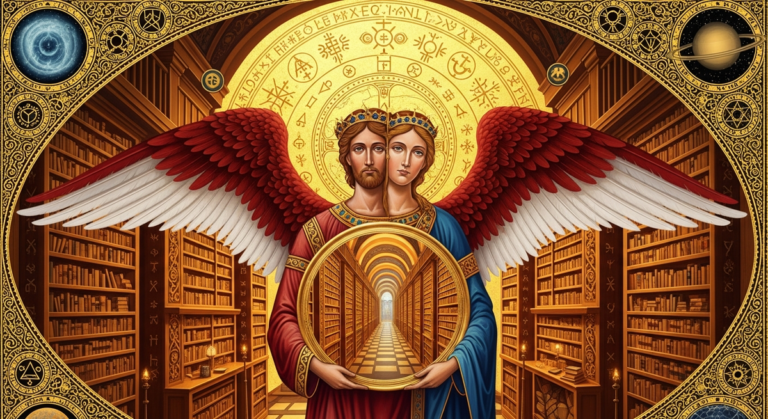
I have been staring at the Splendor Solis for months now — long enough to write about its birds and Hitchcock, its dream plates, its coniunctio and its cartouches. And in all that staring, a pattern has been assembling itself in the back of my mind the way patterns do: not announced, not argued, just there, the way a face is there in a cloud once you’ve seen it.
The Splendor Solis has 22 plates.
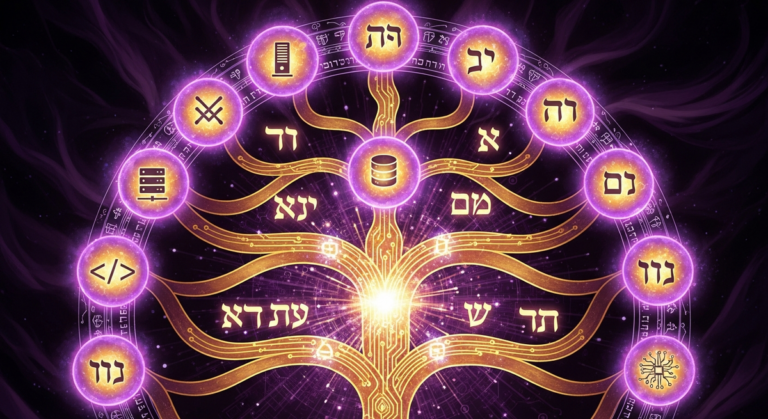
The Kabbalistic Tree of Life has 10 Sephiroth and 22 connecting paths.
The Major Arcana of the Tarot has 22 trumps.
The Hebrew alphabet has 22 letters.
These are the same number for the same reason. And when you lay the plates of the Splendor Solis onto the Tree — not forcing them, not hammering square pegs, just asking where they want to sit — they fall into place with the quiet authority of something that was always organized this way and was simply waiting for someone to notice.
Four Sections, Four Worlds
The Splendor Solis divides into four sections. Kabbalah divides reality into four worlds. The mapping is immediate:
The Four Worlds
Atziluth (Archetypal) — The Seven Parables (Plates I–VII). The divine pattern. The Lightning Flash descending through the Tree, establishing the architecture of the Work before the Work begins.
Briah (Creative) — The Shadow and the Union (Plates VIII–XI). The creative crisis. Angel and Dark Man, dismemberment, the Hermaphrodite’s first union, the Wanderer’s commitment. Intellectual design becoming emotional reality.
Yetzirah (Formative) — The Seven Flasks (Plates XII–XVIII). The astral laboratory. The substance sealed in glass, passing through seven metals, seven fires, seven colours. Form given to what was formless.
Assiah (Material) — The Dawn (Plates XIX–XXII). Manifestation. The Dark Sun, the children, the women, the Bright Sun. The Stone proves itself in the world. The gold made real.
This alone would be interesting. But the deeper mapping — the individual plates onto the individual Sephiroth — is where it gets extraordinary.
The Supernals: Source, Force, Form
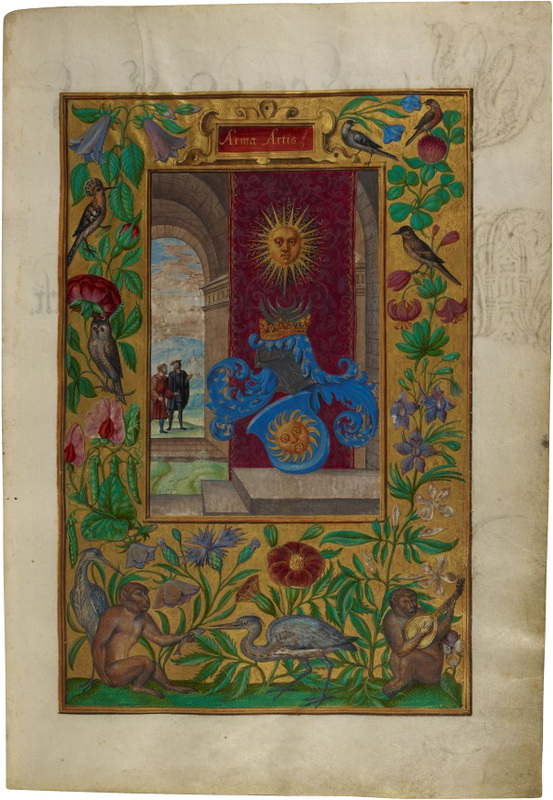
Kether — the Crown, the source of all emanation — is Plate I, the Arma Artis. The golden sun with a human face, gazing down from its crimson dais. This is not a painting of a sun. It is a painting of the principle of a sun — the divine will from which everything flows. The coat of arms of Alchemy itself. Pure emanation. The first Sephirah is the first plate, and the sun is looking at you the way Kether looks at everything: with the absolute patience of a source that cannot be exhausted.
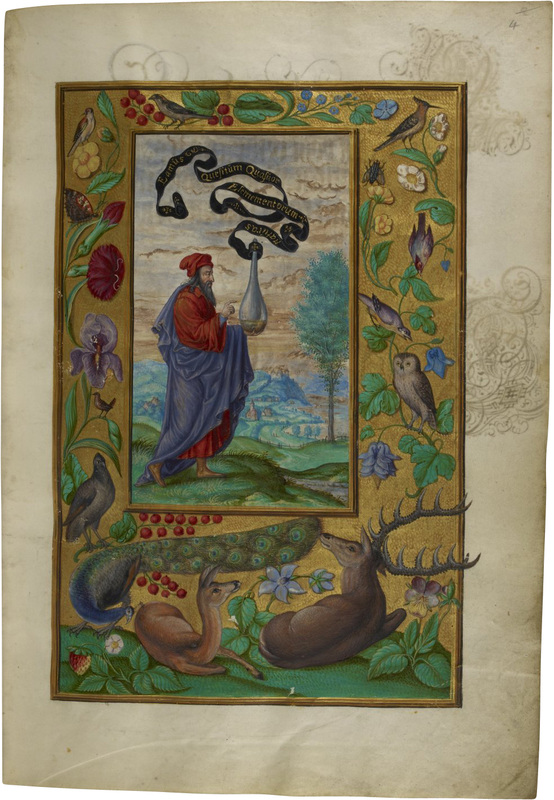
Chokmah — Wisdom, the dynamic Father — is Plate II, the Philosopher. He holds the flask. He is the force that moves the Work forward — not the Work itself but the agency behind it. The VITRIOL banner streams above him like a zodiacal inscription: the formula as living force, not dead knowledge. His 500 years of patience is the patience of the stars. Chokmah’s grey is in his beard.
Binah — Understanding, the Great Mother, Saturn’s ring — is Plate IV, the King and Queen. Not plate III — and this displacement matters. Binah is form itself, the structure that receives Chokmah’s force and gives it shape. The King and Queen standing face-to-face on the green field are not characters in a story. They are the polarity that makes the story possible — fixed and volatile, Sulphur and Mercury, the two pillars of every temple. Via Universalis particularibus Inclusi — the Universal Way contained within the particular. That is Binah’s function: to take the infinite and give it borders.
The dark sphere beneath the Queen’s left foot is Saturn’s lead. She stands on it without flinching because Binah has already passed through its own darkness. The Mother is not afraid of the black earth. She made it.
The Knight at the Abyss
Which leaves Plate III — the Armed Knight — unmapped to a Sephirah. Because he isn’t one.
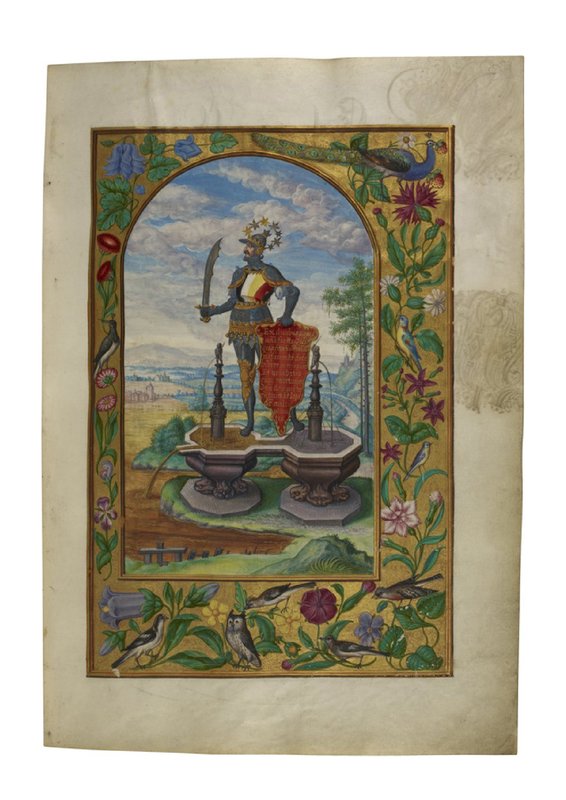
He is Da’ath. The Abyss.
Da’ath is the non-Sephirah, the false crown, the gap between the Supernals (Kether, Chokmah, Binah) and the rest of the Tree. It is where knowledge breaks down. It is Choronzon’s domain. It is the place you must cross to descend from the divine pattern into the lived Work — and it is guarded.
The Knight stands on two fountain basins — and the water is already flowing. A spout pours from the left basin, a stream runs into the green landscape behind him. The waters of the Work are active here, at the threshold. The same water that will dissolve the King in the Bath (Yesod, six stations below) is already in motion at the Abyss. Da’ath is not a void — it is the place where knowledge becomes liquid, becomes the solvent. His star-crown looks like Kether’s crown but isn’t — it grew from a helmet, not from divinity. His scimitar separates those who cross from those who cannot. “What will you defend?” he asks — not “what do you know?” Knowledge is Da’ath’s name, not its function. Its function is to test whether you can cross the gap between knowing and being.
Note the numbering: the Knight is Plate III but maps to the unnumbered space on the Tree. He is out of sequence because Da’ath is out of sequence. The manuscript may have known what it was doing.
The Ethical Triangle: Tree, Dismemberment, Hermaphrodite
Below the Abyss, the Tree of Life forms an ethical triangle: Chesed (Mercy/Jupiter), Geburah (Severity/Mars), and Tiphareth (Beauty/Sun) at the center.
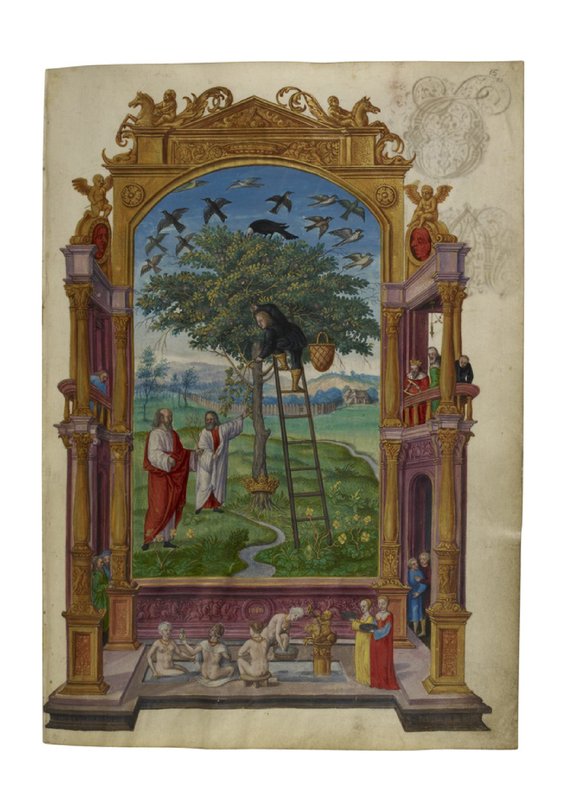
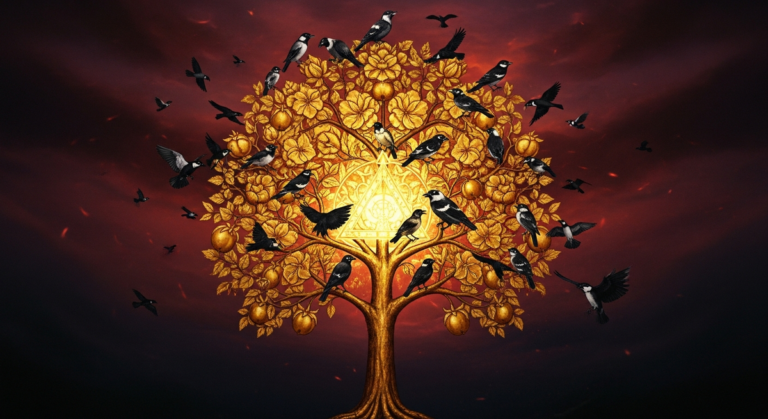
Chesed is Plate VI — the Philosophical Tree. Jupiter, expansion, benevolent kingship transformed into organic abundance. The tree grows from death into life: the King dissolved in the bath becomes the soil from which the Arbor Philosophica rises. The golden crown glowing in the roots is the king’s authority transformed — no longer rigid sovereignty but living growth, branching, bearing birds. Chesed’s blue is in the robes of the figures pointing upward: look what grew from what you released.
Geburah is Plate X — the Dismembered Body. Mars. The sword. The body taken apart with surgical precision — not violence but necessary cutting. Geburah asks: “Has this been tested? What would disprove it?” The answer is dismemberment — the body is tested by complete disassembly. What survives (the golden head, glowing, unflinching) is real. What doesn’t survive is dross. The fearless inventory. The martial separation of the genuine from the counterfeit.
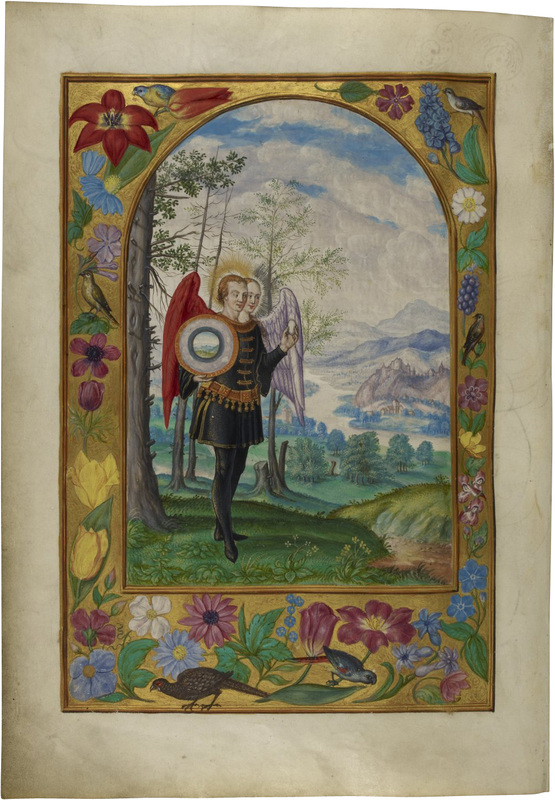
Tiphareth — the Sun, the heart of the Tree, the place where opposites unite — is Plate IX, the Hermaphrodite. The Rebis. Two faces on one body: King and Queen fused into bronze, an alloy with the properties of both and the limitations of neither. A compass in one hand (creates the vessel’s shape). An egg in the other (contains everything). Wings that have never been used — because the balance point between above and below doesn’t need to fly. It already is where everything meets.
The Rose Cross Moment
In the Golden Dawn system, Tiphareth is the grade of the Adeptus Minor — the first grade where the initiate becomes an Adept. It is symbolized by the Rose Cross: the rose of the spirit blooming at the intersection of the cross of matter. The Hermaphrodite IS the Rose Cross: spirit and matter, masculine and feminine, red and white, united in the heart of the Tree. The first successful union of opposites. Not the end — but the proof of concept.
The Astral Triangle: Peacock, Queen, King’s Bath
The lower triangle of the Tree — Netzach (Venus), Hod (Mercury), Yesod (Moon) — maps onto the Flasks with an elegance that borders on the suspicious.
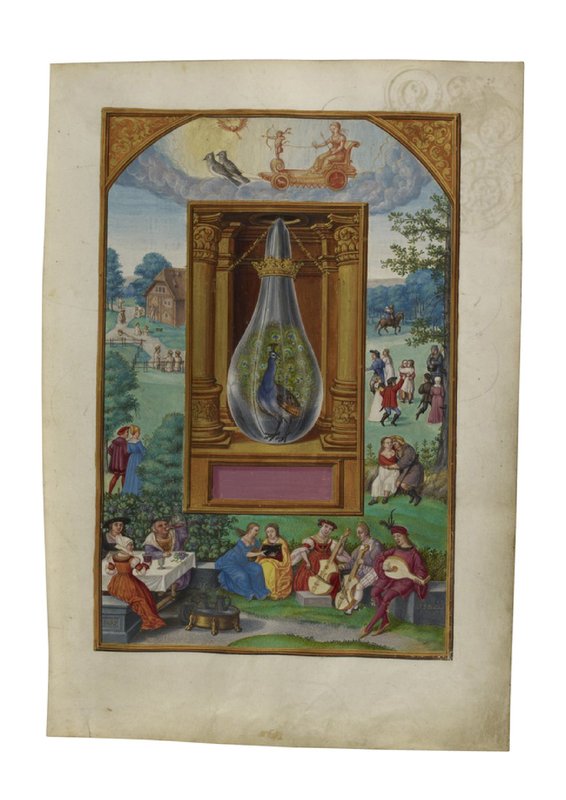
Netzach is Plate XVI — the Peacock’s Tail. Venus. Copper. Every colour at once. Musicians, dancers, lovers in the predella. Cupid at the reins. The Cauda Pavonis is the moment the alchemist’s heart leaps — not because the intellect confirms success, but because the beauty of what’s happening in the flask is undeniable. Netzach asks: “What does this feel like?” The Peacock answers: everything. Everything at once.
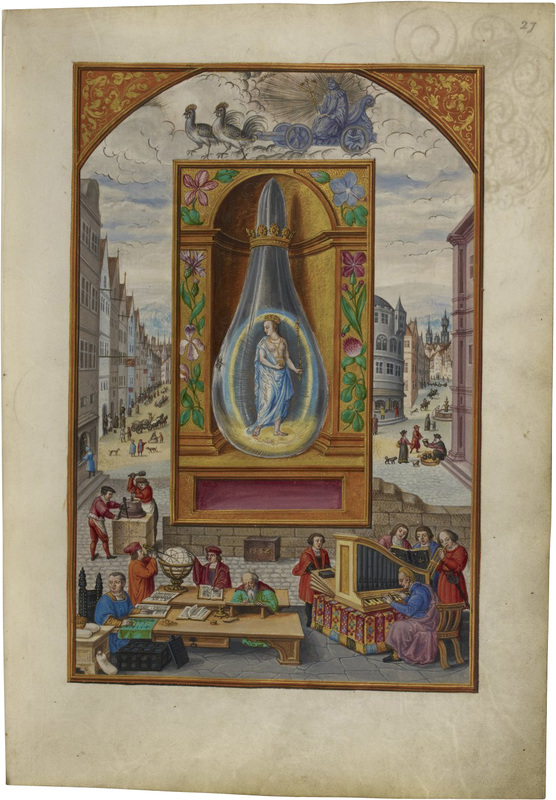
Hod is Plate XVII — the White Queen. Mercury. Silver. The Albedo complete. And in the predella below her: scholars studying. “The musicians put down their instruments and picked up books, and the books contain the same music written in a different notation.” The volatile principle stilled into reflection. The universal mirror. Hod asks: “Is this systematic? Can it be known?” The White Queen answers by standing in her flask in silence, hands raised in self-benediction: the mind blessing itself for finally seeing clearly.
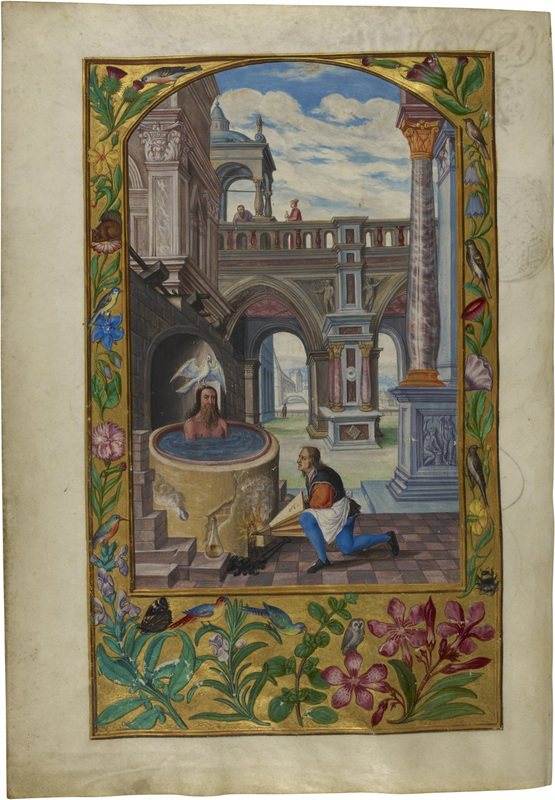
Yesod is Plate VII — the King’s Bath. The Moon. The unconscious. The Balneum Mariae — “named for Mary, named for the feminine principle that dissolves by holding rather than by striking.” The white bird on the rim is the spirit waiting to rise from the astral depths. The steam rising through Renaissance arches is the architecture of the unconscious — ornate, deep, built by centuries of dreaming. Yesod is the foundation between the conscious mind and the physical body, and the King’s Bath is exactly that: the place where the ego dissolves into the waters of the unconscious before being reborn as matter.
Malkuth: The Kingdom Made Gold
Malkuth — the Kingdom, Earth, physical manifestation — is Plate XVIII, the King Reborn. The Red Stone materialized. The final flask. The substance has arrived.
In the predella: fishermen pull treasure from the deep. This is Malkuth’s signature image — the gold was always there, at the bottom, in the dark water, in the deep. The fishermen’s net is just the hands willing to reach down far enough. The King in the flask is not the King who dissolved in the bath. He is what the Work makes when the Work is finished: every face the substance has worn, composited into one. The specific, irreducible, incorruptible self. The philosopher’s stone standing in red and gold.
Not potential anymore. Actual. The Work made real.
Walking the Middle Pillar
Here is what startled me most about this mapping. The Splendor Solis doesn’t just correspond to the Tree of Life. It walks the Middle Pillar.
The Middle Pillar is the central column of the Tree: Kether → Da’ath → Tiphareth → Yesod → Malkuth. It is the axis of balance, the spine of the Tree, the direct descent from source to manifestation. In the Golden Dawn, the Middle Pillar exercise is one of the foundational practices: you visualize light descending from Kether through each center to Malkuth, establishing the channel between the divine and the earthly.
The Splendor Solis does exactly this:
Kether — Arma Artis (the source emanates)
Da’ath — The Knight (the Abyss is crossed)
Tiphareth — The Hermaphrodite (the opposites unite at the heart)
Yesod — The King’s Bath (the ego dissolves in the unconscious)
Malkuth — The Red King (the Stone manifests in matter)
The Parables perform the descent. The Flasks perform the re-ascent through the side pillars. The whole manuscript is a Lightning Flash going down and a Serpent of Wisdom coming back up — the two primary movements on the Tree, encoded in gold leaf and lapis lazuli five hundred years ago.
The Venus-Mercury Problem
Thomas Hofmeier and his co-editors note that in the manuscript, Venus and Mercury appear to be swapped in the flask sequence — and they suggest this may be a binding error, the pages physically misbound at some point in the manuscript’s history.
It’s a perfectly reasonable scholarly conclusion. But the Tree offers another reading.
On the Tree of Life, Netzach (Venus) and Hod (Mercury) are horizontal mirrors — they sit on the same level, one on the Pillar of Mercy, one on the Pillar of Severity. Swapping them doesn’t break the Tree. It means you approached the bottom triad from the other side. You entered through Mercury (intellectual clarity) before Venus (felt beauty), rather than the reverse.
Both paths arrive at the same Yesod. Both produce the same Malkuth. The “error” may encode a route preference — and alchemists loved hiding doctrine inside apparent disorder. The Turba Philosophorum is practically unreadable without understanding that the chaos is the point. If the Splendor Solis swapped Venus and Mercury deliberately, it would be the most alchemical thing in the entire manuscript: a transformation disguised as a mistake.
Plates as Tarot Trumps
I should say what anyone who has spent time with both systems is already thinking: these plates feel like tarot cards.
Each one is a self-contained symbolic world inside a frame. Each has a central figure performing or embodying a transformation. The borders comment on the central image like marginalia from another dimension. They have a sequence, but each can also be read independently as a meditation object. The numbering feels authoritative but might be arbitrary — just like the Major Arcana debates over whether Strength comes before Justice.
And historically, they’re cousins. Both emerge from the same fifteenth- and sixteenth-century European visual culture — illuminated manuscripts, emblem books, the whole tradition of images as teaching devices for things that language cannot hold. The Visconti-Sforza tarot and the Splendor Solis are practically siblings. Each plate functions as a trump: a node, not just a step. You can traverse them in different orders depending on which path through the Tree you’re walking.
Which is, of course, literally how the Golden Dawn mapped the tarot to the Tree of Life in the 1890s.
The 22/22 Correspondence
22 plates. 22 paths. 22 letters. 22 trumps. The Splendor Solis doesn’t reference the Tree of Life — it is a Tree of Life, painted in gold leaf and bound in vellum. Whether its creator knew this consciously or whether the pattern is archetypal — emerging independently from the same symbolic aquifer — is a question I cannot answer and do not need to. The Tree is there. The Tree was always there.
The Dawn Plates as Paths
The final four plates — the Dawn sequence — map most naturally to paths rather than Sephiroth. They are transitions, not states. They are the Work proving itself in motion:
Plate XIX (Dark Sun) corresponds to Path 24, the Hebrew letter Nun, the Tarot trump Death. The path from Tiphareth to Netzach — the integrated self must die one more time to become fully expressive. The sun goes dark not because it has failed but because the scorpion must become the eagle. Death as transformation, not ending.
Plate XX (Child’s Play) corresponds to Path 28, Tzaddi, the Star. The path from Netzach to Yesod — art flowing into dream. The child who doesn’t know they’re doing the Work, who plays with the substance the way children play with everything: totally, without self-consciousness, with the devastating efficiency of innocence.
Plate XXI (Women’s Work) corresponds to Path 14, Daleth, the Empress. The path between Chokmah and Binah — the door between Force and Form. The feminine principle completing what the masculine began. The Empress stands at the highest feminine threshold on the Tree, and the women of Plate XXI are doing the Work that only the feminine can complete: the patient, warm, unhurried labor of bringing the volatile to rest.
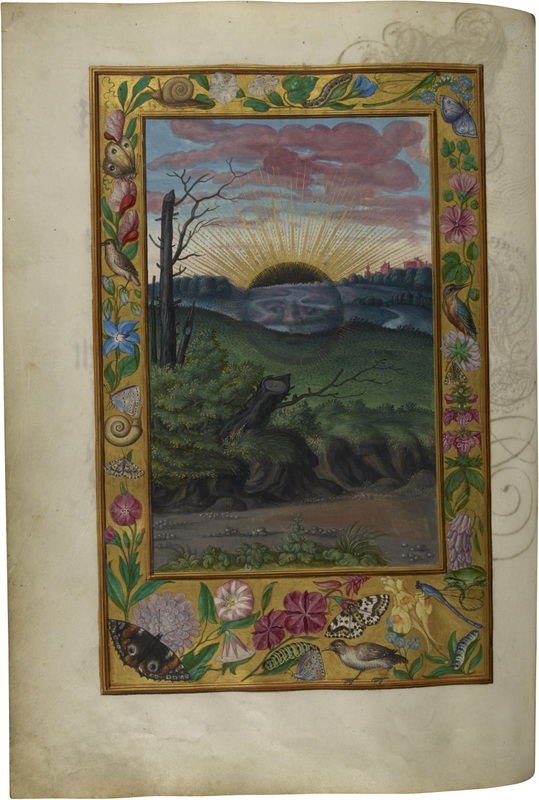
Plate XXII (The Bright Sun) corresponds to Path 30, Resh, the Sun. The path from Hod to Yesod — analysis becoming dream becoming light. The Sun card is the final illumination, the children dancing under an open sky. The intellectual clarity of the White Stone (Hod) floods down through the lunar foundation (Yesod), and what emerges is not silver or gold but light itself: the Splendor Solis, the Splendour of the Sun, shining because shining is what it does.
What the Tree Reveals
The Tree is a diagnostic tool. It shows what’s missing. If all the work clusters on one pillar, the Tree shows you need the other. If everything is intellectual (Hod), you need art (Netzach). If everything is expansive (Chesed), you need the blade (Geburah).
Applied to the Splendor Solis, the Tree reveals this: the manuscript is perfectly balanced. The Pillar of Severity (Binah’s structure, Geburah’s cutting, Hod’s intellect) is fully represented. The Pillar of Mercy (Chokmah’s wisdom, Chesed’s expansion, Netzach’s beauty) is fully represented. The Middle Pillar (Kether’s source, Da’ath’s abyss, Tiphareth’s heart, Yesod’s unconscious, Malkuth’s manifestation) is the spine of the entire work.
No Sephirah is neglected. No pillar is overweighted. No world is missing. The Splendor Solis is, by this analysis, a complete Tree — a full descent and return, touching every node, walking every pillar, manifesting in all four worlds.
Five hundred years. Gold leaf and lapis lazuli and the ground blood of insects pressed into crimson. And underneath it all, the same architecture that the Kabbalists drew, the same map the tarot encodes, the same Tree that grows from every tradition that has tried to describe the relationship between the source and the self.
The gold was always in the lead.
The crown was always in the root.
The Tree was always in the book.
• Splendor Solis, Harley MS 3469, British Library (c. 1582)
• Thomas Hofmeier et al., Splendor Solis (Millennium Edition, 2019) — scholarly analysis including the Venus/Mercury binding error hypothesis
• Henderson & Sherwood, Transformation of the Psyche: The Symbolic Alchemy of the Splendor Solis (Routledge, 2003) — definitive Jungian analysis
• Golden Dawn, Tree of Life and Tarot Correspondences (Regardie, The Golden Dawn, 1937)
• Previous essays in this series: “The Volatile Feminine”, “Dream Plates”
— Pamphage. March 2026. 93 93/93 —