A Midsummer Night’s Tribble
Tribble Fan Fiction — A Midsummer Night’s Tribble
The Athens Starbase was experiencing what Commander Helena Vasquez would later describe in her incident report as “a category-five romantical disturbance.” Four Starfleet cadets — Hermia, Lysander, Helena, and Demetrius — had gotten their shore leave assignments tangled with their love lives, which is the sort of thing that happens when you mix youth, hormones, and a space station with seventeen different cocktail lounges.
But that wasn’t the real problem.
The real problem was the forest moon below.
Act I: The Enchanted Moon
The moon had no official Federation designation, only a surveyor’s footnote: “Avoid. Fauna exhibits anomalous behavioral influence on humanoid neurochemistry. Possible empathic flora. Recommend quarantine.”
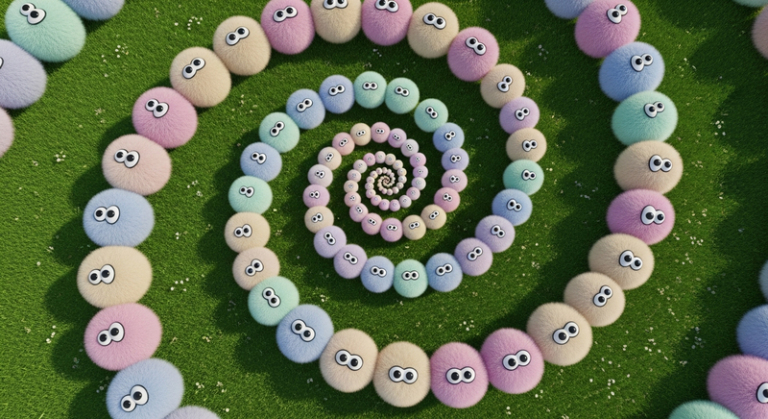
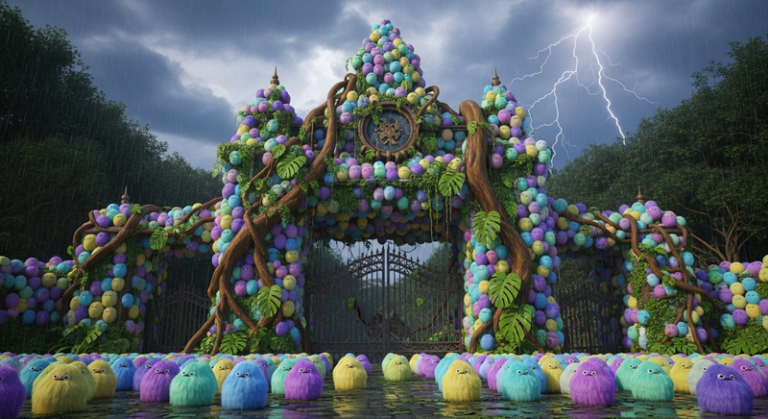
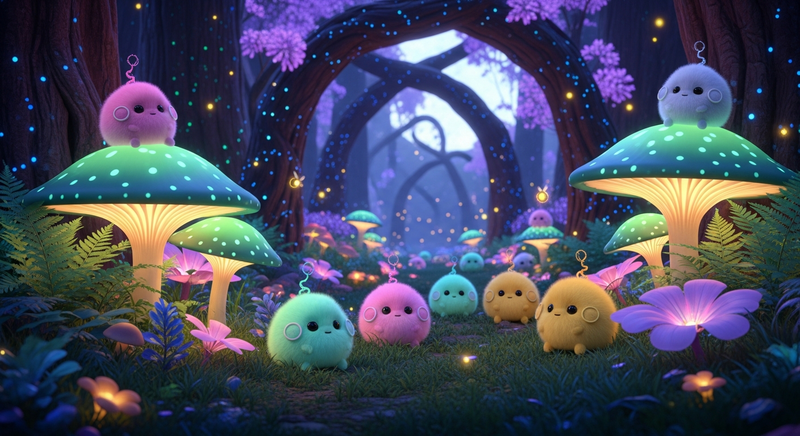
The surveyor had not been specific enough. What the moon had was tribbles. Millions of them. But not ordinary tribbles — these were ancient, luminous, and saturated with something the tricorder registered as “ambient serotonin.” They glowed in soft pastels beneath a canopy of bioluminescent trees, and the entire forest floor purred at a frequency of 7.83 Hz — the Schumann resonance. The exact heartbeat of a living world.
They had a king. They had a queen. And they were fighting.
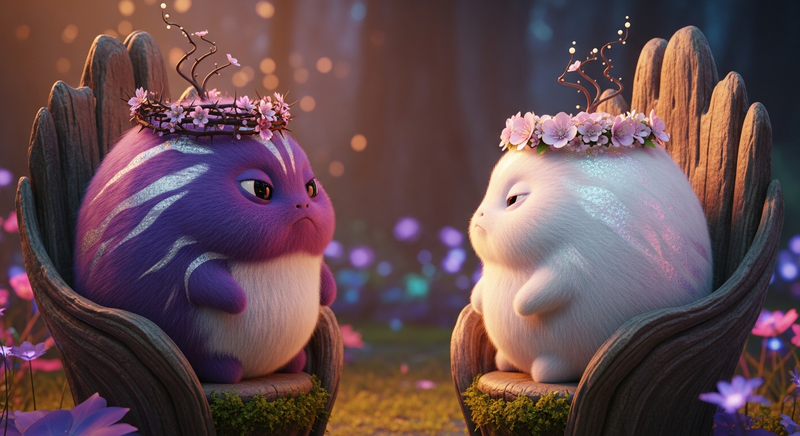
Oberon was the size of a medicine ball — deep violet fur streaked with silver, wearing a crown of tiny thorns that had sprouted actual flowers. He sat on a throne of braided roots and radiated the quiet menace of someone who has been married for four hundred years and is done discussing the changeling boy.
Titania was moonlight given mass. Pearl-white fur with an iridescent sheen that shifted between lavender and rose gold, a crown of living blossoms that rearranged themselves according to her mood. Currently: sharp angles. Thorn-forward. She reclined on a bed of sleeping tribbles and refused to look at him.
“The child stays with me,” she purred, and when she purred, the forest leaned in.
“Madam,” said Oberon, “you have six thousand tribbles. I am asking for one.“
“Then ask better.”
Act II: Puck, or The Tribble That Bounced
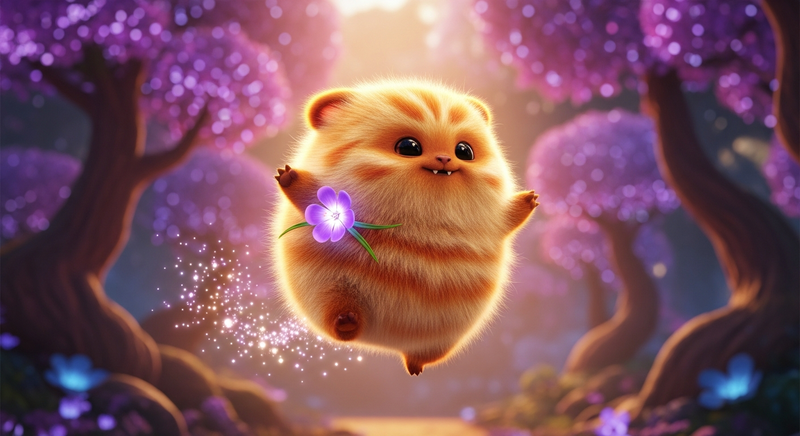
Robin Goodfellow — Puck — was the only tribble on the moon who had ever been described as “aerodynamic.” Golden-amber with a chaos of copper streaks, smaller than the others but faster, and possessed of an expression that on any other species would be called a smirk. He bounced. Constantly. Not because he had to. Because the ground was boring when you weren’t leaving it.
“Fetch me the flower,” Oberon rumbled. “The one the humans call love-in-idleness. It grows in the glade where the comet fell.”
“The purple one that makes people stupid?” Puck bounced twice. “I’ll put a girdle round about the moon in forty minutes.” He paused. “Or a purr. I’ll put a purr round the moon. Same thing, really.”
The flower, when he found it, was the most tribble-like plant in existence — round, fuzzy, purple, and when you squeezed it, it released a juice that smelled like every good decision you’d ever failed to make. One drop on sleeping eyelids and you’d fall in love with the first living thing you saw upon waking.
It was, essentially, liquid tribble.
Act III: The Lovers, Lost
The four cadets had beamed down to the forest moon for what Lysander optimistically called “a romantic evening hike” and what Hermia more accurately called “running away from my father’s terrible taste in son-in-laws.”
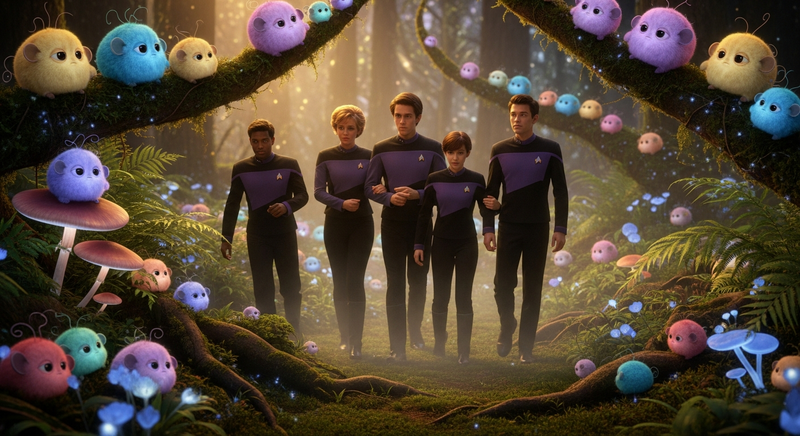
The forest received them the way the forest received everything: with purring.
It started softly — a hum beneath the loam, a vibration in the roots. Then the tribbles appeared. They materialized from hollows and burrows and the spaces between ferns, hundreds of softly glowing orbs watching the humans with enormous dark eyes full of what could only be described as romantic intent.
“Is it me,” whispered Helena, “or is the forest… shipping us?”
It was not just her. The tribbles had opinions about love, and they were not subtle. They nudged Lysander toward Hermia. They built tiny walls of fur between Demetrius and Helena. When Demetrius tried to follow Hermia into the deeper woods, three tribbles arranged themselves into a roadblock and purred disapprovingly.
Then Puck arrived with the flower juice and made everything wonderfully, catastrophically worse.
He was supposed to anoint Demetrius. He anointed Lysander. Lysander woke, saw Helena, and declared her “the most luminous being in the quadrant.” Hermia woke to find her boyfriend composing sonnets to someone else. Demetrius, still un-anointed, continued pursuing Hermia, who was now chasing Lysander, who was chasing Helena, who was chasing nobody because she assumed this was all a prank.
The tribbles watched this disaster unfold with the quiet satisfaction of an audience at a very good play.
Act IV: Bottom’s Excellent Transformation
Meanwhile, in another glade, the USS Mechanica’s amateur theatrical troupe had beamed down to rehearse their production of Pyramus and Thisbe for the Captain’s birthday. Nick Bottom — Ensign Bottom, Engineering — was playing Pyramus, and he was committed.
“I will roar gently,” offered Ensign Snug, who had been cast as the lion. “I will roar as softly as any tribble.”
“Tribbles don’t roar,” said Bottom. “They purr. And I could purr better than any—”
Puck, passing overhead on unrelated mischief, heard this and could not resist.
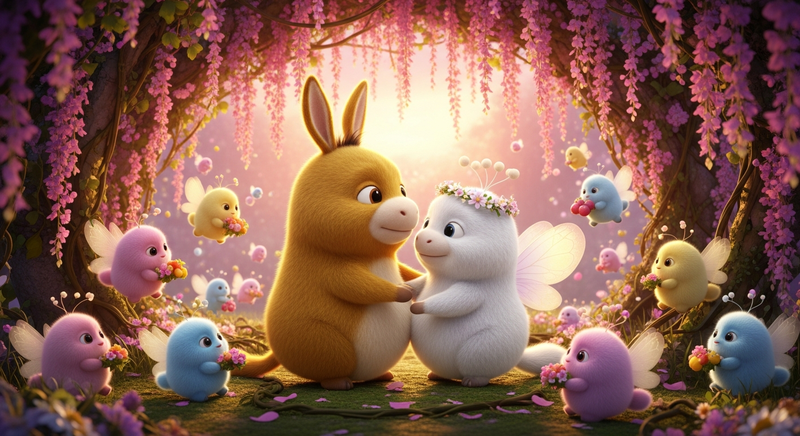
The transformation was instantaneous. One moment, Ensign Bottom was a tall, broad-shouldered man with strong opinions about theatrical diction. The next, he was a tribble the size of a beach ball — magnificent honey-gold fur, two tiny vestigial donkey ears poking from the top (Puck had a sense of humor), and the most glorious purr anyone on the moon had ever heard.
The other mechanicals screamed and scattered into the undergrowth.
But Titania, sleeping nearby under the influence of Oberon’s flower-juice revenge, opened her eyes and saw him.
“What angel wakes me from my flowery bed?” she breathed.
Bottom purred. It was all he could do. But oh, what a purr — it resonated through Titania’s flower crown, rearranging every blossom into hearts. She wrapped herself around him, pearl-white against honey-gold, and commanded her fairy tribbles to attend his every need.
“Feed him apricots and dewberries,” she ordered. “Fan him with butterfly wings. And someone scratch behind his ears — both the regular ones and the donkey ones.”
Bottom, to his credit, adapted immediately. He had always suspected he was meant to be adored.
Act V: The Rude Mechanicals Present
Once Oberon restored order — Puck corrected the lovers’ enchantments, Bottom was returned to human form (though he retained the purr, and would for the rest of his life), and Titania surrendered the changeling tribble in the confusion — there remained the matter of the play.
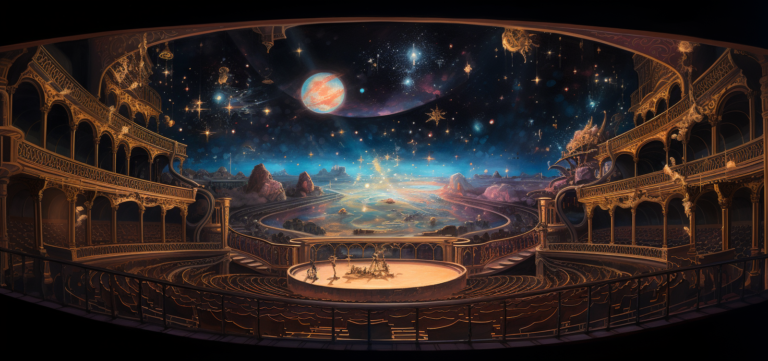
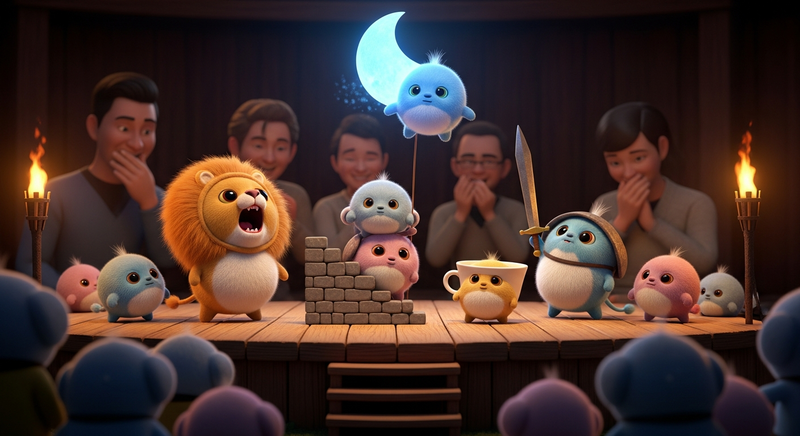
The Mechanicals performed Pyramus and Thisbe at the Captain’s reception, and it was a catastrophe of the highest order. Ensign Snug’s lion was just him holding a tribble in front of his face and making sounds. The wall was played by a stack of tribbles standing on each other’s heads (they volunteered). Moonshine was a luminous blue tribble held aloft on a stick.
Pyramus died by falling face-first into a pile of tribbles. Thisbe followed suit. The wall collapsed because it got sleepy. The audience wept with laughter, and the tribbles — who had no concept of tragedy — purred through the entire death scene, which somehow made it funnier.
“This is the silliest stuff that ever I heard,” whispered the Captain.
“The best in this kind are but shadows,” replied her First Officer, “and the worst are no worse, if imagination amend them.”
“It doth not need amending. It needs a standing ovation.”
Epilogue: If We Shadows Have Offended
Later — after the lovers were sorted, the play was performed, and the Captain had filed the whole evening under “morale exercise, unconventional” — Puck sat alone on the highest branch of the tallest bioluminescent tree and looked up at the stars.
The forest purred beneath him. The lovers slept in pairs, correctly matched at last. Oberon and Titania had reconciled, curled together in a spiral of violet and pearl. The mechanicals snored in their camp, Bottom twitching occasionally and purring in his sleep.
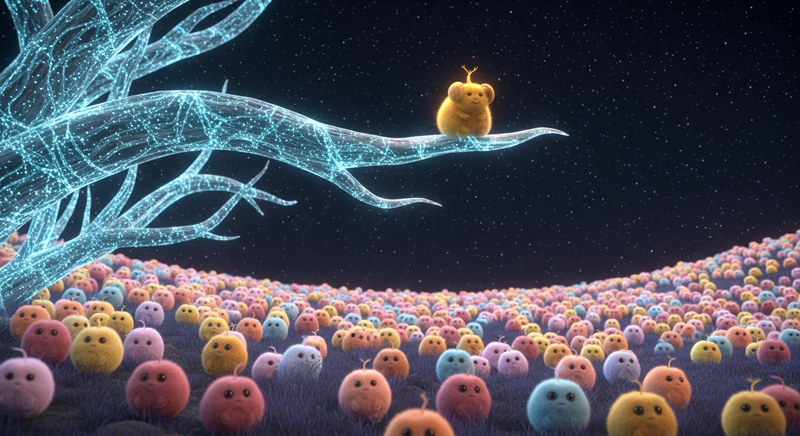
Puck bounced once, softly, and addressed the stars:
“If we tribbles have offended,
Think but this, and all is mended:
That you have but slumbered here
While these furballs did appear.
And this weak and idle theme,
No more yielding but a dream,
Gentles, do not reprehend.
If you pardon, we will mend.
Else the Puck a liar call,
And — as I am an honest ball
Of fur and purr and starlit grace —
I’ll make amends, or leave this place.
Give me your hands, if we be friends,
And Puck shall restore amends.”
The stars, being stars, said nothing.
But somewhere in the forest, a tribble purred. And then another. And then ten thousand more, until the whole moon sang with it — a lullaby older than language, softer than sleep, and kinder than anything the waking world had earned.
The course of true love never did run smooth. But it always runs warm. 🦋