John Dee The Queen and I SACRARIUM SERPENTIS STELLAE
The story of a forty-five-year friendship between England’s greatest magician
and the most powerful woman in the world — and what happened when she left him behind.
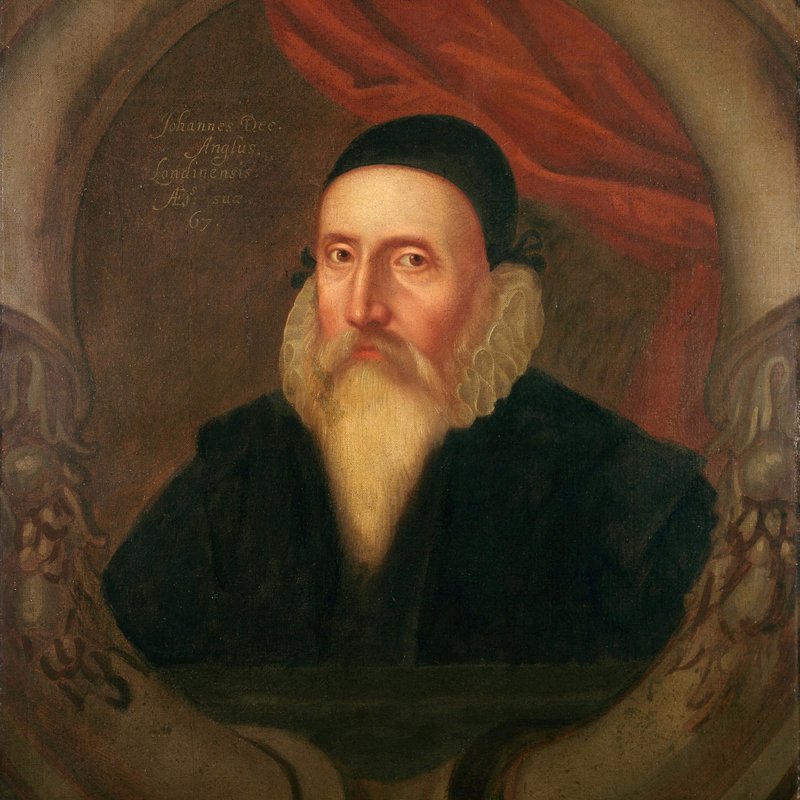
Portrait of John Dee (c.1594, Ashmolean Museum, Oxford)
“A very handsome man… tall and slender, with a long beard as white as milk.” — John Aubrey, Brief Lives
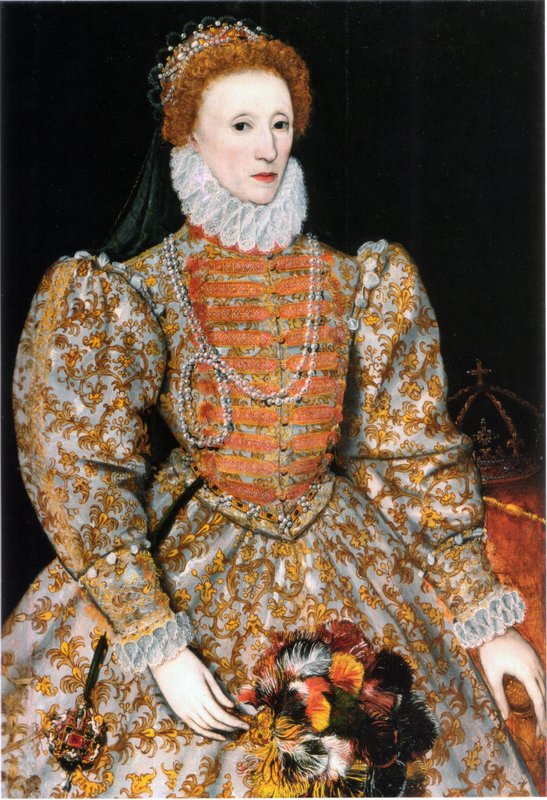
The Darnley Portrait of Elizabeth I (c.1575, National Portrait Gallery)
“Golden-red hair, dark eyes, pale skin, with long elegant fingers she was proud of.” — Contemporary descriptions
Before the Crown
When they met, she was a princess nobody expected to survive — and he was a young mathematician already in trouble with the law.
John Dee was born in London on July 13, 1527, the son of a textile merchant. By the time he was twenty, he’d studied at Cambridge, lectured at the University of Louvain, and dazzled the courts of Europe with a mechanical beetle that appeared to fly during a staging of Aristophanes. He was brilliant, restless, and entirely incapable of keeping a low profile.
Elizabeth Tudor was six years younger, born in 1533 to Henry VIII and Anne Boleyn. By the time she was three, her mother was beheaded and she was declared illegitimate. She grew up in the shadow of the axe — watched over, suspected, dangerous to know.
They likely first crossed paths in the early 1550s, when Dee was casting horoscopes for various members of the Tudor court. In 1555, Dee was arrested and charged with “calculating” — casting horoscopes for Queen Mary and Princess Elizabeth, which was technically treason (since it implied predicting the monarch’s death). The charge against Elizabeth was that she had “used enchantments” with Dee’s help. Both survived: Dee was acquitted by the Star Chamber, and Elizabeth walked free. But the experience bound them. They had both stared at the same executioner’s block and lived.
The Stars Align — 1558
On November 17, 1558, Mary Tudor died. Elizabeth was twenty-five years old and suddenly Queen of England. One of the very first things she did — before the coronation, before the policies, before the speeches — was send for John Dee.
Robert Dudley, her childhood friend and closest advisor, knew exactly who to call. The question was urgent and specific: When should the coronation take place? Not just any date would do. The alignment of the stars had to favor the new reign.
THE CORONATION DATE
Dee cast an elaborate electional chart and chose January 15, 1559. The date was accepted without question. Elizabeth I was crowned at Westminster Abbey on that day — a date selected not by Parliament, not by the Archbishop, but by a mathematician-astrologer with a crystal ball and a very large library.
The reign that followed lasted forty-four years and became known as England’s Golden Age.
It’s worth pausing on what this means. Elizabeth had just inherited a kingdom torn by religious war, bankrupt, and threatened on every border. And her first major decision was to trust a man most people whispered was a sorcerer. That’s not politics — that’s personal faith. She believed in Dee. She would believe in him for the rest of her life.
“My Philosopher” — The Golden Years
Elizabeth reportedly called Dee “my philosopher” — a term of both respect and affection. For the next four decades, he served her in roles no official title could capture:
ASTROLOGER ROYAL (from 1564)
When a blazing comet appeared over England, Elizabeth sent for Dee to explain what it meant. When she fell ill, she asked him to recommend a cure. When she needed to know whether a foreign marriage would succeed, she consulted his charts. He was her window into the invisible world.
NAVIGATOR AND EMPIRE-BUILDER
Dee advised England’s greatest explorers — Sir Humphrey Gilbert, John Davis, Martin Frobisher — on mathematical navigation. He supplied charts, trained pilots, and argued passionately for a strong English navy. In 1577, in his General and Rare Memorials Pertayning to the Perfect Arte of Navigation, he did something no one had done before: he used the phrase “British Empire.” He invented the concept. The frontispiece showed Elizabeth at the helm of a ship, steering England toward imperial destiny.
In October 1580, Elizabeth specifically asked Dee to determine what foreign lands — Greenland, Newfoundland, the northern passages — she could rightfully claim. He based her title on her alleged descent from King Arthur. (Dee was nothing if not creative.)
CALENDAR REFORM ADVISOR (1582)
When Pope Gregory XIII announced the new calendar, Secretary of State Walsingham passed the papal bull to Dee for his expert opinion. Dee recommended that England adopt the reform — with modifications. The Anglican bishops refused. They said it was “popish.” England wouldn’t fix its calendar until 1752, by which point they were eleven days out of sync with the rest of Europe. Dee, as usual, was right and ignored.
INTELLIGENCER
Dee gathered intelligence for the Crown through his vast network of continental contacts. The popular legend that he signed his secret letters to Elizabeth with the symbol “007” — two circles (eyes, meaning “for your eyes only”) and a lucky seven — has never been confirmed by a surviving document. Scholars have searched. The story is almost certainly apocryphal. But it tells you something that people wanted it to be true.
The Library at Mortlake
Dee’s home at Mortlake, on the Thames just upstream from Richmond Palace, housed the largest private library in Elizabethan England: approximately 3,000 printed books and 1,000 manuscripts — perhaps 4,000 volumes in total. It was arguably the greatest collection in Renaissance Europe. Dee also maintained scientific instruments, globes, and three alchemical laboratories.
Elizabeth visited him there. More than once.
THE QUEEN COMES CALLING
At least four visits are documented in Dee’s own diaries. Richmond Palace was nearby — one of Elizabeth’s favorite residences — so she could drop in almost casually. But the visits weren’t casual at all:
March 16, 1575: Elizabeth arrived at Dee’s door — and learned that his first wife, Katherine Constable, had just died and was to be buried that day. The Queen refused to enter the house. Instead, she spoke with Dee by the churchyard wall, standing outside in the cold out of respect for the dead.
October 10, 1580: Dee’s mother died that morning. That afternoon, Elizabeth came to Mortlake to offer her condolences in person. A queen, visiting a commoner, on the day of his mother’s death. This is not how monarchs normally behave.
February 11, 1583: On her way to dine with Secretary Walsingham at Barn Elms, Elizabeth stopped at Mortlake again. Just passing through. Just checking on her philosopher.
These are the documented visits. Given the proximity and the informality of some encounters, there were likely more. Two of the four recorded visits are condolence calls — Elizabeth showing up to comfort Dee in his grief. That’s not a professional relationship. That’s a friendship.
The Angels Call — 1582
In 1581, Dee began the work that would define his legacy and eventually destroy his reputation. He started scrying — attempting to contact the angelic realm through a “shew stone,” a polished obsidian mirror or crystal ball. His early attempts with hired scryers were frustrating.
Then, in March 1582, a young man named Edward Kelley arrived at Mortlake, claiming a gift for seeing spirits in the stone. Kelley was 27, charismatic, and deeply unreliable. He was also, by all accounts, genuinely talented at something — whether it was authentic visionary experience or masterful deception remains debated to this day.
Dee acted as orator — praying, directing the sessions, recording every word. Kelley served as scryer, gazing into the stone and reporting what he saw. Twenty-four different angels spoke over the course of their work together. The first and most frequent was the Archangel Uriel.
THE LANGUAGE OF ANGELS
On March 26, 1583, Kelley reported visions of a 21-lettered alphabet. What followed was the reception of an entire angelic language — complete with grammar, syntax, and hundreds of words. Dee called it “Angelical,” “Celestial Speech,” and “Adamical” (the language Adam spoke in Eden). He never used the term “Enochian” — that name came later. But it is the system that would eventually become the foundation of all modern ceremonial magic, including the work of the Golden Dawn and Aleister Crowley.
It came through the shew stone at a house on the Thames, recorded in notebooks by a Welsh mathematician who believed he was taking dictation from God.
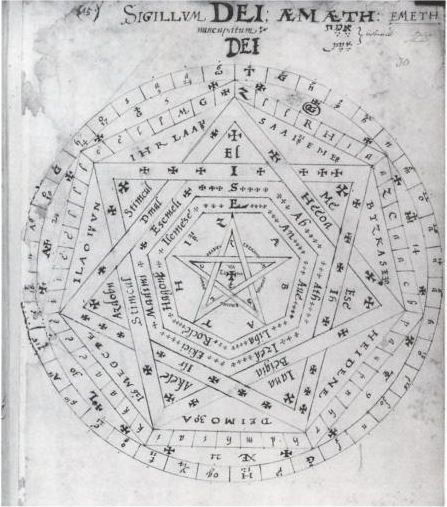
Sigillum Dei Aemeth — John Dee’s original diagram (British Library, Sloane MS 3188)
Whether Elizabeth knew the details of Dee’s angel work is uncertain. She was aware of his magical interests — she had personally consulted him on astrological matters for decades. But the Enochian sessions intensified after 1582, and by September 1583, Dee made a decision that would change everything: he left England.
Gone — The Continental Years (1583-1589)
In 1583, the Polish nobleman Albert Laski visited London and was introduced to Dee. Dazzled by the angel work, Laski invited Dee and Kelley to accompany him to Poland. On September 21, 1583, Dee departed Mortlake with Kelley, their families, and roughly 800 books. He left the rest of his library — over 2,000 volumes plus instruments — in the care of his brother-in-law, Nicholas Fromond.
It was a disaster from the start. Laski turned out to be bankrupt. Dee and Kelley drifted through Central Europe, holding audiences with Emperor Rudolf II in Prague and King Stephen Bathory of Poland, trying to convince them that angels had urgent messages for the crowned heads of Europe. Reception was… mixed.
In 1586, the Papal Nuncio accused Dee of necromancy and petitioned Rudolf to have him imprisoned or burned at the stake. They were expelled from Prague. They settled in Trebon, Bohemia, as guests of the nobleman Vilem of Rozmberk.
The partnership with Kelley deteriorated. In 1587, Kelley claimed an angel commanded the two men to share wives. Dee, horrified but obedient to what he believed was divine instruction, agreed. The angelic communications dried up shortly afterward. Kelley left Dee at Trebon in 1589 and stayed on the Continent as an alchemist to Rudolf II. He would die in 1597 or 1598, possibly falling from a prison tower during an escape attempt.
Homecoming — 1589
Dee returned to England in 1589. He was sixty-two years old. He went home to Mortlake.
What he found must have broken his heart.
His brother-in-law Fromond had not protected the library. Instead, he had sold off books and instruments without permission. A man named Nicholas Saunder had acquired many of the volumes — some of them still survive at the Royal College of Physicians, with Dee’s ownership marks scratched out and Saunder’s name written over them. The house itself had been ransacked. Instruments smashed. Laboratories stripped.
The popular story that a mob destroyed the library, driven by fear of Dee’s sorcery, is probably exaggerated — modern scholars attribute the primary loss to Fromond’s betrayal. But the result was the same. The greatest private library in England was scattered to the winds.
“Unduely sold it presently upon my departure, or caused it to be carried away.”
— John Dee, on what happened to his library
Elizabeth was still alive. She still cared. On December 19, 1589, Dee had an audience with the Queen at Richmond Palace. She used her influence to get some of his books returned. Friends raised money for him and interceded on his behalf at court. Elizabeth also had a more practical interest: she hoped Dee could persuade Kelley to return to England and ease the kingdom’s economic troubles through alchemy. (Kelley had claimed to transmute base metals into gold. Whether Elizabeth fully believed this is another question.)
In 1595, Elizabeth appointed Dee Warden of Christ’s College, Manchester — a reasonably prestigious ecclesiastical position. It was a kindness. It was also an exile: Manchester was hundreds of miles from court, from London, from everything Dee had known. The fellows at Manchester despised or cheated him. He could not exert authority. It was a gentle retirement that felt like a cage.
But he had his Queen’s protection. As long as Elizabeth lived, John Dee was safe.
The Light Goes Out — March 24, 1603
Elizabeth I died at Richmond Palace on March 24, 1603. She was sixty-nine. She had been Queen for forty-four years — the entire span of Dee’s adult working life.
For Dee, now seventy-five, this was not just the death of a monarch. It was the death of the only person in the world with the power and the will to protect him. Everything he had — his position, his safety, his reputation — rested on her word. And now she was gone.
A PAINTING AND ITS SECRET
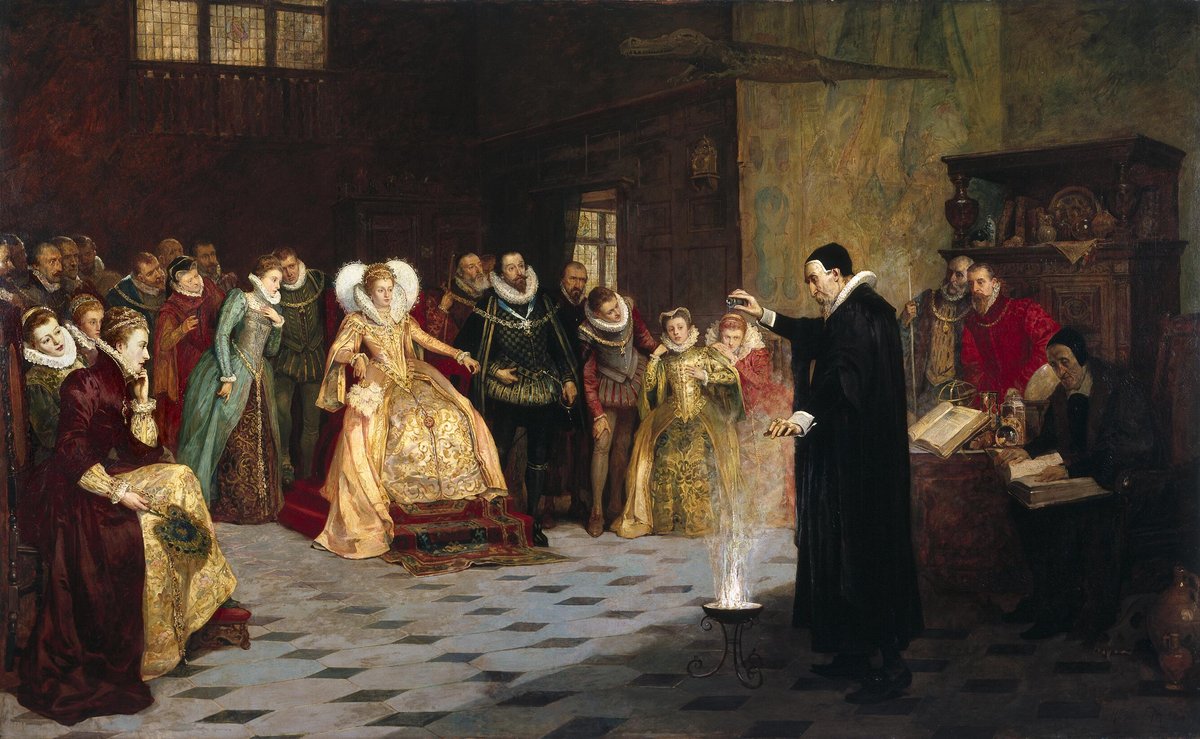
John Dee Performing an Experiment Before Elizabeth I — Henry Gillard Glindoni (c.1913, Wellcome Collection)
The famous painting by Henry Gillard Glindoni (c.1913, Wellcome Collection) shows “John Dee Performing an Experiment Before Elizabeth I.” When the painting was X-rayed in 2015, researchers discovered that the original version included a hidden ring of human skulls surrounding the figures. Glindoni had painted them out — presumably to make the scene less macabre.
Even in art, the darkness around Dee had to be concealed.
A Different King
James VI of Scotland became James I of England. He brought with him a deep, personal, prosecutorial hatred of witchcraft. He had attended witch trials. He had written Daemonologie, a treatise demanding their execution. He had championed the Scottish Witchcraft Act. He was, in every way that mattered, the opposite of Elizabeth on the subject of magic.
Dee understood immediately what this meant.
In June 1604, as Parliament debated a new, even harsher Witchcraft Act, Dee petitioned James directly. He begged to be “tried and cleared” before the King, the Privy Council, or Parliament of the “perennial slanders” that he was a “Conjuror, or Caller, or Invocator of Devils.”
James refused. No audience. No trial. No clearance. Dee was simply ignored — which, from a king who burned witches, was perhaps the best outcome he could have hoped for.
Elizabeth had valued Dee’s expertise and believed in his magical powers, calling him her trusted counselor. James had no time for superstition or magic.
— Historians’ summary of the contrast
The Long Twilight — 1603 to 1608
What followed was a collapse on every front.
In 1605, plague swept through Manchester. Dee’s second wife, Jane Fromond, died in the epidemic. So did at least two of their daughters, including Madinia. Other children had died before the plague — Michael in 1594, Theodore in 1601, Margaret in 1603. By the time the pestilence lifted, Dee had lost nearly his entire family.
He returned to Mortlake around 1605, broken and impoverished. The man who had once owned the largest library in England was now forced to sell his remaining books to eat. He supplemented his income with fortune-telling — the same charge that had nearly killed him fifty years earlier, now his only trade.
His daughter Katherine cared for him to the end. She was described as “his companion” in those last years. Only Katherine and his son Arthur survived him.
THE FINAL YEARS
Dee’s health had been declining for years — likely worsened by decades of exposure to toxic chemicals in his alchemical laboratories: mercury, lead, arsenic, antimony. His body had been slowly poisoned by the very experiments that had defined his life’s work.
He was eighty-one when he died — an astonishing age for the era. But the last five years were poverty, grief, and silence. No Queen to call on. No library to retreat into. No angels speaking through the stone.
John Dee died late in 1608 or early 1609 — the exact date is uncertain. He may have died at Mortlake, or at the London home of his acquaintance John Pontois. No gravestone survives. The parish register is missing. A memorial plaque was finally placed at St. Mary the Virgin Church, Mortlake, in 2013 — four hundred years after his death.
He outlived his Queen by five years. Those five years contained more loss than the forty-five that came before them.
Timeline
1527
John Dee born in London, son of a textile merchant
1533
Elizabeth Tudor born at Greenwich Palace
c.1550
Dee and Elizabeth likely first meet at court
1555
Both arrested on charges of “calculating” — both acquitted
1558
Elizabeth becomes Queen; sends for Dee immediately
1559
Coronation on January 15 — date chosen by Dee
1564
Dee formally appointed Royal Advisor in astrology
1575
Elizabeth visits Mortlake; finds Dee’s wife just died; speaks by the church wall
1577
Dee publishes General and Rare Memorials; coins “British Empire”
1580
Elizabeth visits on the day of Dee’s mother’s death to offer condolences
1582
Edward Kelley arrives; angel communications begin
1583
21-letter angelic alphabet received; Dee departs for the Continent
1586
Papal Nuncio accuses Dee of necromancy; expelled from Prague
1589
Dee returns to England; finds library ransacked; audience with Elizabeth
1595
Elizabeth appoints Dee Warden of Christ’s College, Manchester
1603
Elizabeth dies March 24. James I succeeds. Dee loses his protector.
1604
Dee petitions James I to clear his name. James refuses.
1605
Plague kills Jane Dee and two daughters. Dee returns to Mortlake, destitute.
1608/9
John Dee dies, aged 81. No gravestone survives.
What He Left Behind
John Dee died in poverty and disgrace. He left behind:
The concept of the British Empire
The mathematical foundations of English navigation
The most complete system of angelic communication ever recorded
A 21-letter alphabet that became the basis for all modern Enochian magic
Diaries and manuscripts that influenced the Golden Dawn, Aleister Crowley, and every Western magical order since
The model of the scholar-magician — equally at home with a sextant and a scrying stone
He also left the memory of something rarer: a genuine friendship between a philosopher and a queen, sustained across forty-five years, five decades of English history, and a gap in social standing that should have been unbridgeable. Elizabeth saw in Dee something most of her courtiers couldn’t: a mind vast enough to hold both the visible and invisible worlds. And Dee saw in Elizabeth something most subjects never glimpse: a monarch who actually wanted to understand.
When she died, he didn’t just lose a patron. He lost the only person who had ever fully believed in what he was trying to do.
“A mighty good man he was.”
— John Aubrey, Brief Lives (c.1680)
SOURCES AND FURTHER READING
John Aubrey, Brief Lives (c.1669-1696) — primary physical description of Dee
Charlotte Fell Smith, John Dee (1909) — first major biography
Benjamin Woolley, The Queen’s Conjurer (2001) — popular modern biography
Deborah Harkness, John Dee’s Conversations with Angels (1999) — scholarly study of the angel diaries
Roberts & Watson, John Dee’s Library Catalogue (1990) — the 1583 catalog facsimile
Royal College of Physicians Museum — holds surviving Dee books and instruments
Richmond Borough Council — records of Elizabeth’s visits to Mortlake
Henry Gillard Glindoni, John Dee Performing an Experiment (c.1913, Wellcome Collection) — the painting with hidden skulls
Note: The “007” signature story, while widely repeated, has not been confirmed by any surviving document. Pet names attributed to the Dee-Elizabeth correspondence (“Lyddes,” “sheep”) appear in secondary sources but their primary provenance is uncertain. All dated events are from Dee’s own diaries or verified court records.
Introduction: The history of humanity is marred by instances of unspeakable cruelty and suffering inflicted upon individuals and entire communities. This article delves into the depths of human inhumanity, highlighting two poignant examples: the Inquisition and the Trail of Tears. These events demonstrate the devastating consequences of prejudice, power dynamics, and systemic oppression that have…
Every practitioner of Western magick alive today owes an enormous debt to one man — and most of them don’t even know his name. S.L. MacGregor Mathers in Egyptian ceremonial garbMathers in Egyptian ceremonial garb, from Crowley’s autobiography Samuel Liddell MacGregor Mathers (1854–1918), known within the Order as S.R.M.D. (S’Rioghail Mo Dhream — “Royal is…
The Knight of the Royal Art On the Splendor Solis, Crowley’s Art, and the vertical cosmology of VITRIOL. The Knight on the Fountain Splendor Solis Plate 3 is one of the most densely encoded images in Western esotericism. A giant knight stands on the rim of a double fountain — silver armor decorated with gold…
John Dee’s Angels: Ten Discoveries Hiding in Plain Sight For four hundred years, the angel tables of Dr. John Dee have been copied, studied, and occasionally misread. Working with the Enochian Qabalistic (EQ) cipher system and returning to the original manuscripts, we found ten things no one seems to have noticed before — including a…