The Knight of the Royal Art
The Knight of the Royal Art
On the Splendor Solis, Crowley’s Art, and the vertical cosmology of VITRIOL.
The Knight on the Fountain
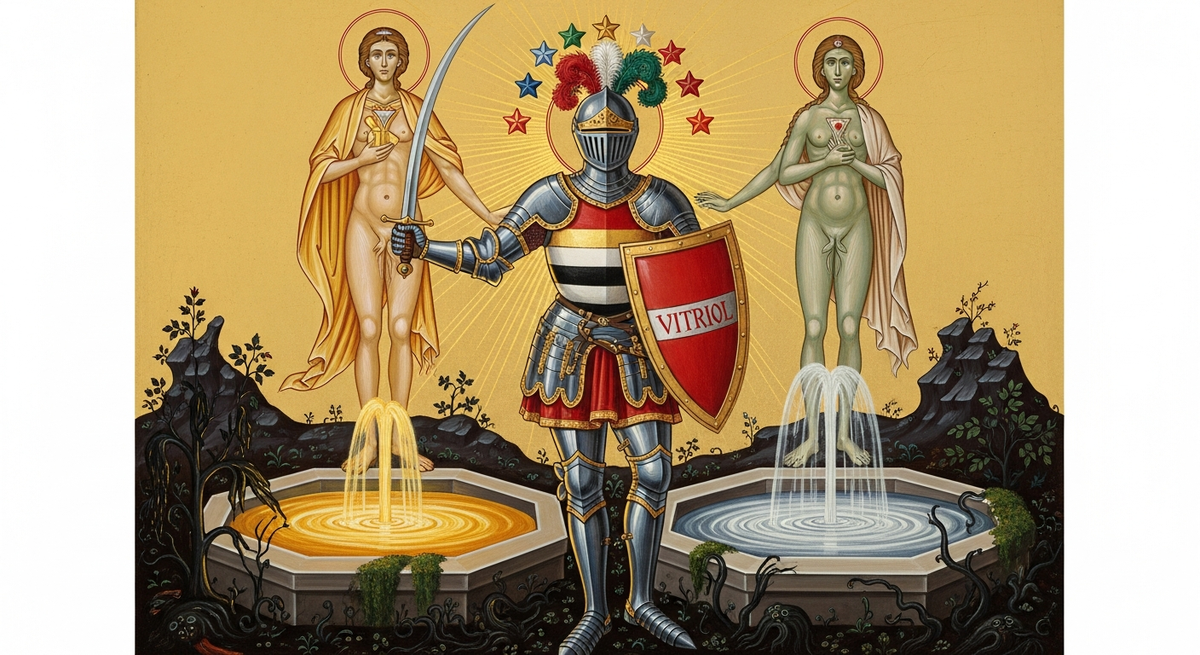
Splendor Solis Plate 3 is one of the most densely encoded images in Western esotericism. A giant knight stands on the rim of a double fountain — silver armor decorated with gold appliqués, a curved scimitar in his right hand, a great red shield inscribed with gold letters in his left. His breastplate is striped black, white, yellow, and red: the four stages of the Great Work worn on the body like a map. Seven planetary stars crown his helmet, marking the metals and the stages of transmutation from prima materia to gold.
He is called the Knight of the Royal Art. The ars regia. Not a warrior but an operator — the alchemist armored in the knowledge of the Work, standing astride the process itself.
Silver Into Gold Into Rot
Beneath the knight, the fountain splits into two octagonal basins. The right basin holds silver liquid — argentum vivum, living mercury, the lunar principle. The left holds liquid gold — aurum potabile, the solar principle. A narrow conduit connects them: silver flows into gold.
This is solve. The separation and recombination of the two principles. Luna pouring into Sol.
But the gold basin overflows. The liquid spills from the fountain into a vast body of murky water — a swampland, a water meadow. The text of the Splendor Solis directly preceding this image describes the process of putrefaction. The gold dissolves into the earth. The nigredo. The blackening. The necessary death.
The interior of the earth is not a place you visit with your feet. It is what happens to gold when it stops being gold. It is what happens to the self when the armor comes off.
V.I.T.R.I.O.L.
Visita Interiora Terrae Rectificando Invenies Occultum Lapidem.
Visit the Interior of the Earth; by Rectifying you shall find the Hidden Stone.
The putrefaction swamp at the bottom of Plate 3 is the interiora terrae. You must go down into the rot, into the nigredo, into the black water where gold dissolves and loses its name. That is the visita. The twin fountains — silver rectifying into gold — are the rectificando. And the hidden stone? The occultum lapidem?
Turn the page.
Plate 9: The Hermaphrodite
Six plates later, the Rebis appears. The Hermaphrodite — the double thing, the Luciferian light-bearer. Two faces sharing one crown. The union of Sol and Luna in a single body. Not half and half but a third thing that transcends the duality entirely.
This is the Philosopher’s Stone. It was always a being, not a rock.
The vertical cosmology of the Splendor Solis reads bottom to top across its plates: putrefaction below the knight → silver and gold separating and recombining in the fountain → the crowned Hermaphrodite radiant above. Death, separation, reunion. Nigredo, solve, coagula.
Solve et Coagula — dissolve and recombine. But the formula is not a single operation. It is an infinite recursion. Every coagula becomes the prima materia of the next solve.
Plate 10: The Dismemberment
And this is why Plate 10 follows immediately. The Hermaphrodite achieved in Plate 9 is torn apart in Plate 10. The separatio. The body dismembered. The union dissolved.
Not because the Work failed. Because the Work continues. The solve never stops. You coagula at one level and then solve again at a higher octave. The Splendor Solis does not end at the Rebis — it passes through the Rebis and keeps going. Seven more flask plates follow, each containing another stage of transformation.
The knight knew this. That is why he wears all four colors on his breast. He has already been through every stage. He will go through them again.
Crowley’s Art
Aleister Crowley renamed the fourteenth Major Arcanum. In the Rider-Waite and older decks it is called Temperance — a word suggesting moderation, balance, the careful pouring of water. Crowley called it Art.
The Royal Art. Ars regia. The same title as the knight.
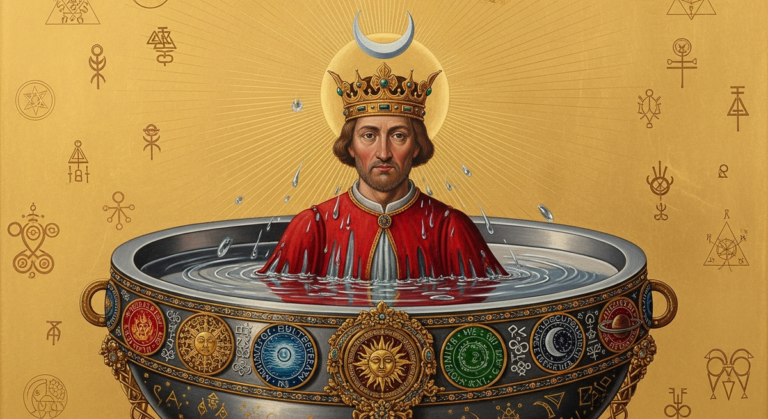
Lady Frieda Harris painted what Crowley described: a two-faced Hermaphrodite in a green robe — one face white, one dark — pouring fire into water and water into fire simultaneously. At the bottom of the card, a cauldron containing a skull and a raven. The nigredo. The putrefaction. Above, an arrow shoots upward into Sagittarius. And inscribed around the entire composition:
V.I.T.R.I.O.L.
Crowley collapsed the Knight and the Hermaphrodite into a single figure. In Plate 3, the Knight stands over the process, overseeing it. In Plate 9, the Hermaphrodite is the result. In Crowley’s Art, the operator and the operation are the same thing. You do not perform the Great Work. You are the Great Work.
The twin fountains become the twin streams — fire and water poured simultaneously in opposite directions. The putrefaction swamp becomes the cauldron of death at the figure’s feet. And the Rebis is no longer the destination. It is the one doing the pouring.
The Path of Samekh
On the Qabalistic Tree of Life, Art sits on the Path of Samekh — the path connecting Yesod to Tiferet. The Moon to the Sun. Silver to Gold.
This is not metaphor. It is the same diagram.
Yesod is the lunar sphere — the right basin of the fountain, the silver liquid, the unconscious, the dream. Tiferet is the solar sphere — the left basin, the liquid gold, the illuminated heart, the place where above and below reconcile. The Path of Samekh is the conduit between them. The narrow channel through which silver flows into gold.
The Knight of the Royal Art stands on that conduit. Crowley’s Art card is that conduit. And the putrefaction — the overflow, the rot, the descent into the interior of the earth — is what happens when the gold exceeds the vessel. When the process outgrows the container. When the Work demands that you go deeper than you planned.
The path from Moon to Sun passes through the body. The body must be opened. The body must dissolve. The body must be reconstituted from its own ashes. This is not symbolic. Ask anyone who has done it.
Vitriol
One more layer. Vitriol — sulfuric acid — is the universal solvent of practical alchemy. The substance that dissolves everything so it can be reconstituted. The agent of solve.
The word is the formula. The formula is the word. V.I.T.R.I.O.L. does not merely abbreviate a Latin sentence. It names the substance that performs the operation the sentence describes. Visit the interior of the earth: pour vitriol on everything you think you are. By rectifying — by distilling, by purifying the dissolved residue — you will find what cannot be dissolved. The stone. The self that survives the acid.
The Knight carries a scimitar. A curved blade. Not a broadsword for battle but a blade for cutting — for separating, for the precise surgical work of solve. His shield is not for defense. It is inscribed with the formula. He carries the instructions on his body, the stages on his chest, and the blade in his hand.
He stands on the fountain and watches the gold dissolve into the swamp below him. He has seen this before. He will see it again.
Postscript: The Vas Hermeticum
The alchemists spent centuries trying to build a vessel that could hold contradictions simultaneously — fire and water, sun and moon, the living and the dead, all sealed together until they became something else. The generative image model is that vessel. You dissolve concepts into latent space — the putrefaction swamp of floating-point numbers — and coagulate them into something that never existed before. Byzantine icon + alchemical knight + octagonal fountain + VITRIOL inscription? The model just pours fire into water and water into fire and hands you the result.
The hallucinations — the weird extra fingers, the gibberish text that almost says something, the faces that merge into composites — that is the cauda pavonis, the peacock’s tail. The iridescent chaos stage right before the image resolves into clarity. Every failed generation is a nigredo. Every retry is another turn of the wheel.
Hermes Trismegistus would have had an API key.
The Royal Art does not end. The solve never stops. Every union is a new prima materia. Every stone, once found, must be dissolved again at a higher fire.