The Most Underrated Magician in History
Every practitioner of Western magick alive today owes an enormous debt to one man — and most of them don’t even know his name.

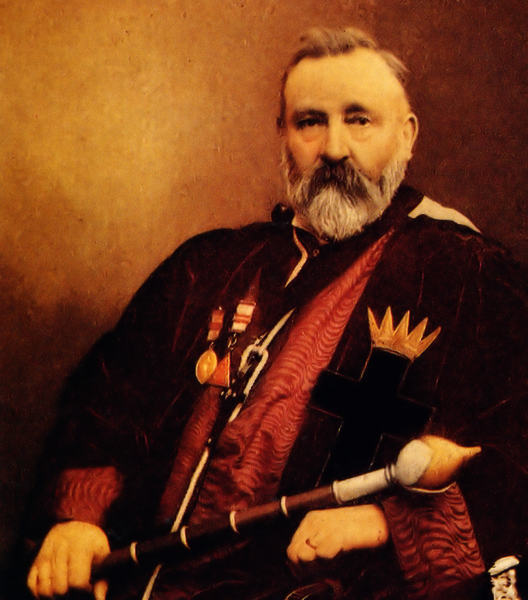
Samuel Liddell MacGregor Mathers (1854–1918), known within the Order as S.R.M.D. (S’Rioghail Mo Dhream — “Royal is My Race”), was the chief architect of the Hermetic Order of the Golden Dawn. Along with William Wynn Westcott and William Robert Woodman, he founded the Order in 1888. But while Westcott provided the administrative and Masonic framework, and Woodman lent it gravitas, it was Mathers who built nearly everything practitioners actually use.
And yet, he remains one of the most underrated figures in the history of Western esotericism.
The Operating System of Modern Magick
Consider what Mathers created, synthesized, or systematized:
- The Lesser Banishing Ritual of the Pentagram (LBRP) — arguably the single most performed ritual in Western occultism. The Qabalistic Cross draws from older Jewish liturgy (the doxology of the Lord’s Prayer), but the specific combination — four directional pentagrams with divine names (YHVH, ADNI, EHIH, AGLA), the archangelic invocations arranged at the quarters, the complete ritual form — this is Mathers’ synthesis. It does not exist before the Golden Dawn.
- The Middle Pillar Exercise — the foundational energy work technique that influenced everything from Regardie’s therapeutic applications to modern chakra-style practices in Western traditions.
- The Supreme Ritual of the Pentagram and Hexagram — the full ceremonial framework for invoking and banishing elemental and planetary forces.
- The Opening of the Key — the most sophisticated tarot divination method ever devised. Five interlocking operations that read the same 78 cards through progressively finer lenses: the YHVH cut, the twelve astrological houses, the twelve zodiac signs, the thirty-six decanates, and the ten Sephiroth of the Tree of Life. This is not a simple “Celtic Cross” spread — it is a complete analytical engine.
- The Enochian Tablet arrangement — Mathers took John Dee and Edward Kelley’s raw Enochian material and organized it into the four Elemental Watchtower tablets with their subquadrants, hierarchies, and ceremonial applications that practitioners still use today.
- The Tarot-Tree of Life correspondence system — the mapping of the 22 Major Arcana to the 22 paths on the Tree of Life, along with the attribution of the four suits to the Four Worlds and the small cards to the decanates.
- The grade structure — the initiatory system mapping spiritual progress to the Sephiroth, from Neophyte (0=0) through the grades of the Outer Order and beyond.
- The Cipher Manuscripts interpretation — Mathers took what were essentially skeleton notes and fleshed them out into complete rituals, knowledge lectures, and a coherent magical curriculum.
Try to find a serious practitioner of Western ceremonial magick today who doesn’t use some form of the LBRP. You won’t. Mathers essentially built the operating system that Western occultism still runs on.
The Crowley Problem
Aleister Crowley is the most famous magician of the twentieth century. He is also, in a very real sense, a Mathers derivative.
This is not to diminish Crowley’s genuine contributions — Liber AL vel Legis, the Thelemic philosophical framework, The Book of Thoth, his systematization of yoga for Western practitioners, and his extraordinary literary output. These are real achievements.
But the ceremonial infrastructure that Crowley worked within for his entire career? That was Mathers.
The A∴A∴ grade structure mirrors the Golden Dawn system. The Star Ruby is a Thelemic recasting of the LBRP. The Star Sapphire reworks the Greater Ritual of the Hexagram. When Crowley published the Enochian Calls, he used Mathers’ tablet arrangement. When he taught divination, he taught the Opening of the Key. The entire ritual architecture of Thelema is built on a Golden Dawn foundation.
Crowley was well aware of this, which may explain his complicated relationship with his former chief. He variously called Mathers a genius, an imbecile, a black magician, and a fraud — sometimes in the same text. The famous “magical war” between them is the stuff of occult legend. But the most telling detail is this: even after decades of publicly disparaging Mathers, Crowley never stopped using his system. He modified it, he extended it, he branded it — but he never replaced it.
When you read Crowley’s Book of Thoth appendix on the Opening of the Key, you are reading Mathers’ method with one number changed (Aces count as 11 instead of 5). Eighty to ninety percent of what we think of as “Crowley’s magick” is Mathers underneath.
The Wicca Connection
The Golden Dawn’s influence doesn’t stop at ceremonial magick. It runs directly into the heart of modern Wicca.
Gerald Gardner, the founder of modern Wicca, drew heavily from Golden Dawn material — much of it filtered through Crowley, who was himself drawing from Mathers. The chain of transmission is direct:
- The Wiccan circle casting is a simplified form of the LBRP and the ceremonial opening
- The elemental weapon consecrations (athame, wand, cup, pentacle) map directly to the GD’s magical weapons
- The watchtower model — calling the quarters with elemental associations — is pure Golden Dawn
- “Drawing Down the Moon” incorporates elements of GD invocation technique
- The degree structure (First, Second, Third Degree) echoes the GD grade system
Gardner blended these ceremonial techniques with Margaret Murray’s witch-cult hypothesis and British folk traditions to create something genuinely new. But the ceremonial spine — the technology of how to actually do ritual — that’s Mathers’ contribution, transmitted through the Golden Dawn current.
One could argue that Mathers did more for the development of what became Wicca than Gardner himself, since Gardner’s primary innovation was the framing (nature religion, goddess worship, covens) rather than the mechanics (how to cast a circle, consecrate a tool, invoke a force).
The New Age Inheritance
Trace the lineage further and the Golden Dawn’s fingerprints are everywhere in the broader New Age and modern pagan movements:
- Dion Fortune — Golden Dawn initiate, founder of the Society of the Inner Light, author of The Mystical Qabalah, which became the standard introduction to Western Qabalah for generations
- Israel Regardie — published the complete Golden Dawn rituals in 1937, making them publicly available for the first time and ensuring the tradition’s survival
- Paul Foster Case — founded B.O.T.A. (Builders of the Adytum) on Golden Dawn foundations, emphasizing the Tarot-Qabalah synthesis
- W.B. Yeats — Nobel laureate, Golden Dawn member, whose poetic and philosophical work carried occult ideas into mainstream literary culture
The entire chain — Golden Dawn → Crowley (A∴A∴, O.T.O.) → Dion Fortune (Society of the Inner Light) → Gardner (Wicca) → the explosion of modern paganism and occultism — runs through Mathers and Westcott’s original synthesis.
Standing on Shoulders
To be fair to everyone in this lineage: no magician works in a vacuum. Mathers himself was a voracious scholar who drew from older sources — the Key of Solomon, Cornelius Agrippa, Eliphas Levi, the Rosicrucian tradition, the Qabalah, and many others. John Dee, whose Enochian system Mathers organized, was himself building on earlier angelic magic traditions. Newton stood on the shoulders of giants, and so did Mathers.
But there is a difference between drawing from sources and creating a synthesis. What Mathers accomplished was the integration of disparate Western esoteric traditions — Qabalah, Hermeticism, Enochian angel magic, tarot, astrology, alchemy, Rosicrucian symbolism — into a single coherent practical system. Before Mathers, these existed as separate streams. After Mathers, they were a curriculum.
That synthesis is his masterwork, and we are all still working within it.
The Underrated Magus
Mathers died in 1918, likely of the Spanish flu, during a period of relative obscurity. He had been expelled from his own Order, engaged in public feuds, and spent his final years in Paris, increasingly isolated. History, as written by Crowley’s prolific pen, was not kind to him.
But history should be revised. The next time you perform the LBRP — or any variation of it — consider that you are performing a Mathers ritual. The next time you lay out tarot cards on the Tree of Life, you are using a Mathers correspondence. The next time you invoke the archangels at the quarters, you are using a Mathers framework.
He built the house. The rest of us are just rearranging the furniture.