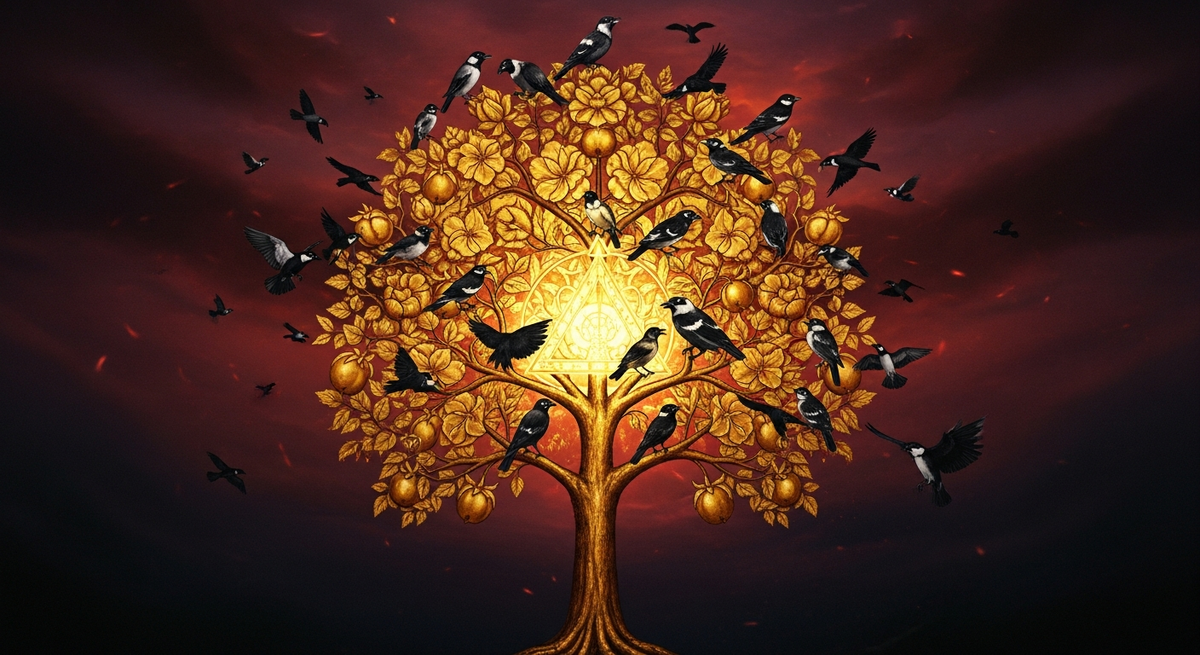
The Volatile Feminine
The Volatile Feminine
Hitchcock’s The Birds and the Splendor Solis — the same menace, five centuries apart.
There is a plate in the Splendor Solis — the luminous alchemical treatise preserved in the British Library as Harley MS 3469 — that has always unsettled me. Not the drowning king, not the dismembered body, not the black sun. The tree full of birds.
Plate 6 shows a golden tree laden with fruit. A youth climbs a ladder toward the top, plucking a golden bough. Two philosophers in robes of red-and-white stand below, receiving what he brings down. It should feel noble. Aspirational. A Renaissance illustration of the quest for knowledge.
But the birds.
Thirteen of them, bursting from the branches — black bodies, white heads, streaked with green. They are not songbirds. They are not decorative. They are taking flight, set into motion by the youth’s climbing, and they fill the upper half of the painting with a dense, rising swarm. They look, to my eyes, slightly menacing. Like something has been disturbed that should not have been disturbed.
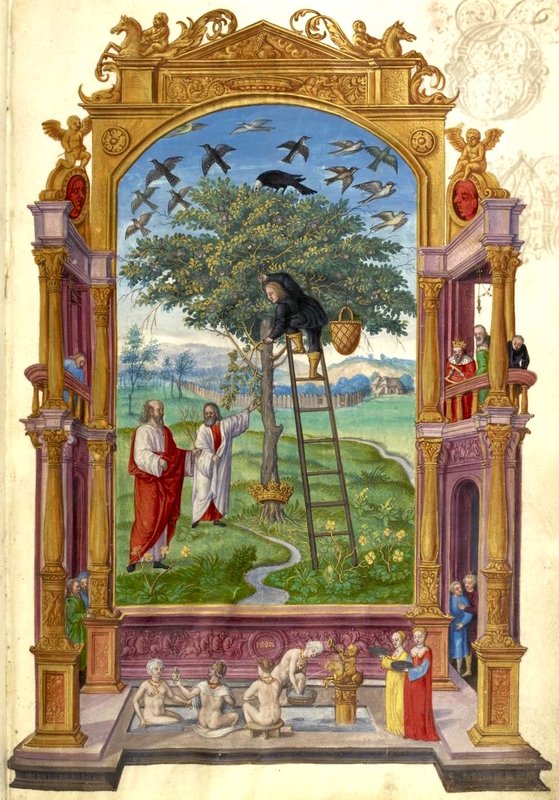
And then there are the borders. While the central image shows the tree and its birds, the frame around it creates a balcony — and on that balcony, the King and his men lean over a railing, gazing down at women bathing. The masculine principle watches. The feminine principle is in the water. And between them, filling the sky, the birds rise.
Four hundred years later, Alfred Hitchcock made a film about the same image.
The Birds as Volatile Spirits
In alchemical terminology, there are two fundamental principles: the fixed and the volatile. The fixed is what stays — the king on his throne, Sulphur, the masculine, the solar. The volatile is what rises — Mercury, the feminine, the lunar, the ungovernable. In the laboratory, the volatile is what evaporates when heated. In the manuscript, it is what flies.
Birds are the volatile principle made visible. Every alchemical manuscript uses them this way. Ravens for nigredo, white doves for albedo, the phoenix for rubedo. They represent the spirits that must be released during transformation — the part of the substance that cannot be held down, that ascends whether you want it to or not.
The Volatile Principle
In alchemy, volatile does not mean “unstable” in the modern emotional sense. It means that which flies — from the Latin volare. The volatile is the mercury, the spirit, the feminine element that rises when the fixed element is heated. It cannot be grasped. It can only be received, channeled, or survived.
In the Splendor Solis plate, the youth’s climbing — his intrusion into the tree — is what sets the birds into flight. The volatile was resting. It was perched. And then the masculine principle reached for the golden bough, and thirteen spirits took to the air.
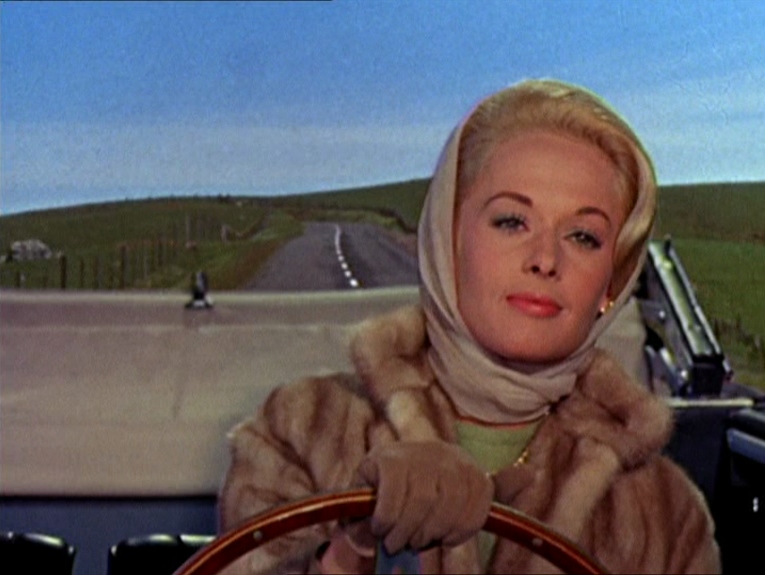
In The Birds (1963), Melanie Daniels drives up the California coast to Bodega Bay. She is beautiful, blonde, rich, and dangerously playful. She arrives, and the birds begin to gather.
Bodega Bay as the Alchemical Tree
Hitchcock’s Bodega Bay is a closed system — a small town ruled by a single family. Mitch Brenner (Rod Taylor) is the fixed principle: the lawyer, the rational man, the son who holds the household together. His mother Lydia (Jessica Tandy) is the possessive, anxious matriarch. His ex-girlfriend Annie (Suzanne Pleshette) is the resigned, safe feminine — the schoolteacher who accepted her place. Everything is in equilibrium. Everything is perched.
Melanie is the youth climbing the tree.
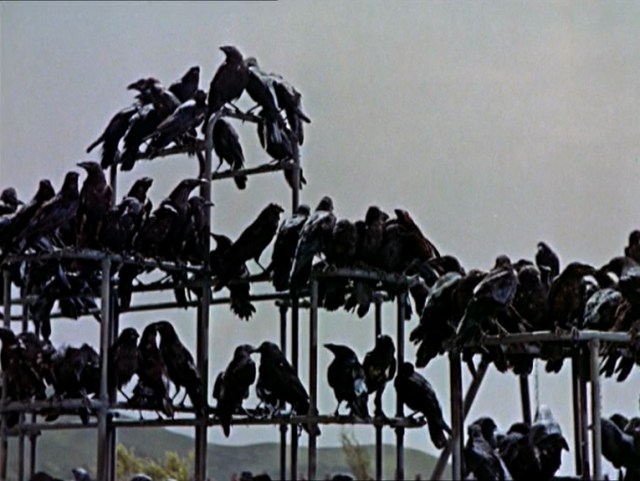
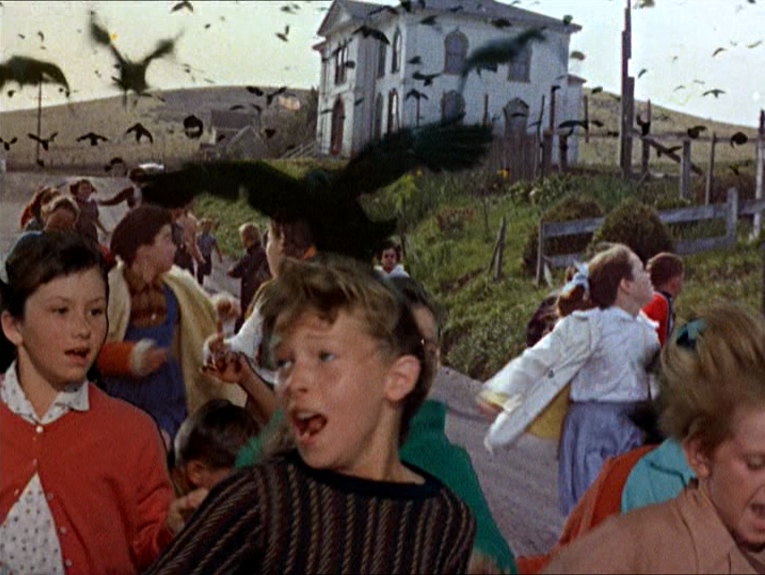
She arrives uninvited, bearing a gift (lovebirds in a cage — the volatile principle contained, domesticated, made cute), and her presence sets everything into flight. The birds attack. Not metaphorically. Actually. Gulls dive at children. Crows mass on playground equipment. Sparrows pour down a chimney like a biblical plague. The volatile has been released, and it will not go back in the cage.
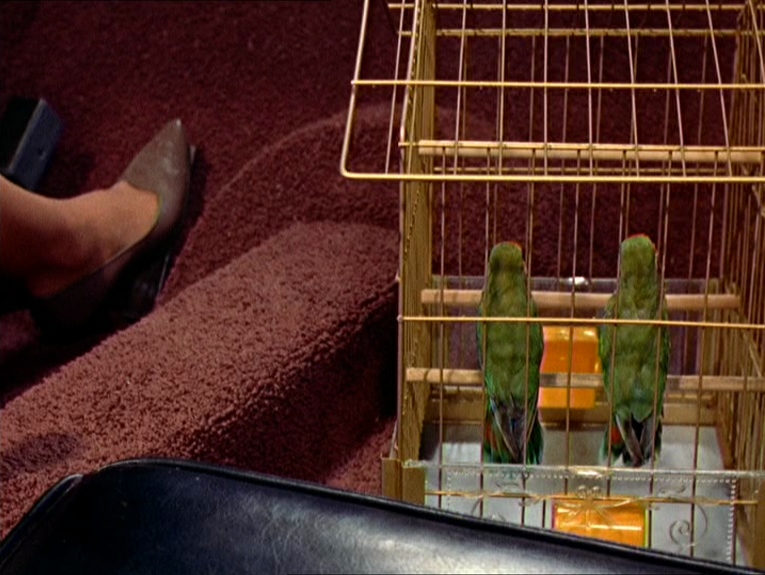
The Lovebirds
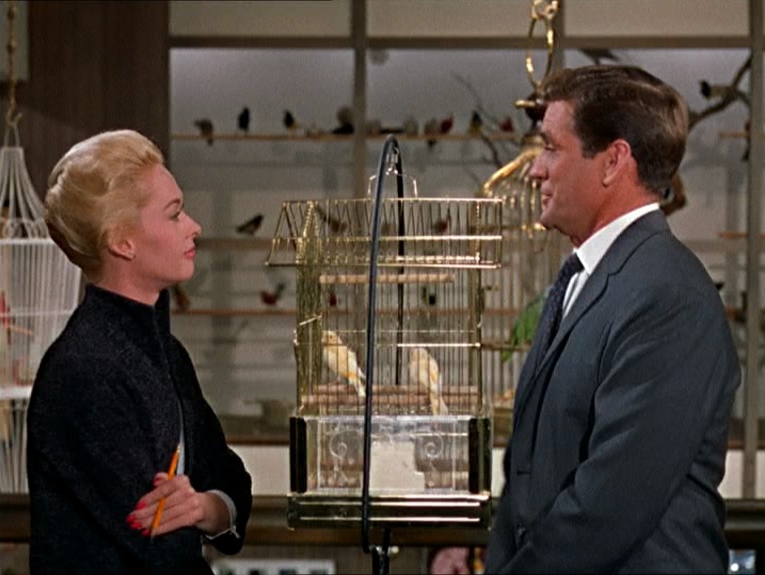
Hitchcock’s most savage joke: Melanie brings lovebirds — the tamed, caged, domesticated version of the feminine volatile — as a gift for Mitch’s little sister. A peace offering. A flirtation disguised as a toy. But you cannot bring the caged bird into the territory of wild birds and expect the wild ones to stay perched. The lovebirds survive the film. Everything around them is destroyed.
The King Watches from the Balcony
Return to the Splendor Solis border. The King and his courtiers lean over the balcony railing and watch the women bathe. This is not the voyeurism of David spying on Bathsheba, or the elders leering at Susannah. As the Myth Crafts analysis notes, the scene depicts an unusual harmony — the women are unbothered by the watching. The King observes openly. Everyone knows their role. The masculine watches. The feminine is in the water. And the border contains them both in a structure of mutual acknowledgment.
But there is a tension in it. The masculine does not enter the water. He cannot. He is fixed. He watches from above — from the balcony, from the frame, from the border of the image. The feminine is in the element (water, Mercury, the dissolving bath), and the masculine is in the architecture (stone, the balcony, the structure that surrounds but does not touch).
Mitch Brenner has the same problem.
He is surrounded by feminine forces — his mother, his ex, his sister, and now Melanie — and he watches. He observes. He boards up windows. He lights cigarettes. He drives the boat. He is competent, decent, and completely powerless against what is happening. The birds are not his to fight because they are not coming for him. They are coming for the feminine order that his presence has disrupted — or rather, that Melanie’s presence has revealed as already unstable.
“In this film, as in so many others, Hitchcock finds woman captivating but dangerous. She allures by nature, but she is chief artificer in civilization, a magic fabricator.”
— Camille Paglia, The Birds (BFI Film Classics, 1998)
The Subliminal Body
Here is what makes both works extraordinary: the sexuality is never stated.
In the Splendor Solis, the bathing women are in the border. The predella. The margins. The central image is a tree, a youth, some birds — all perfectly respectable. You have to look at the edges to see what the picture is really about. The erotic content frames the image without entering it, the way a dream wraps its real meaning in displacement and symbol.
Hitchcock does the same thing with cinema. The Birds contains no sex scene. No kiss that matters. No nudity. It was 1963 and the Production Code was breathing down his neck. But the entire film is saturated with sexual tension that expresses itself as ornithological violence.
Consider the attic scene — the climax of the film, where Melanie goes upstairs alone (why? why does she open that door?) and the birds attack her in a sealed room. They tear at her clothes. They pull her hair. She falls. She writhes. She is pinned. When Mitch finally breaks through the door and drags her out, she is catatonic, her hair wild, her clothing shredded, her eyes glassy.
She looks like she has just been ravished.
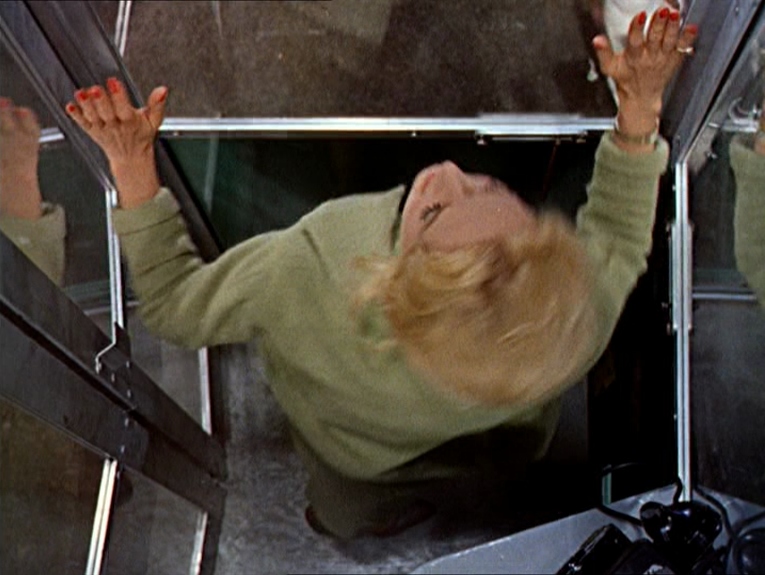
The violence IS the sexuality. The birds are the libido. The Production Code forbade Hitchcock from showing what the film is about, so the film shows it through feathers and beaks and blood. The sublimation is total — and in alchemical terms, sublimation is the operation where the volatile rises from the fixed as vapor and condenses on the walls of the vessel as something new. Hitchcock sublimated sex into birds.
The alchemists understood this operation perfectly. It is the fifth stage of the Great Work — sublimatio — where the substance is heated until its spirit rises, leaves the body behind, and reconstitutes itself in a higher register. The Splendor Solis birds are not metaphors for sexuality. They are sexuality sublimated — raised from the body (the bathing women in the border) into the spirit (the birds in the tree). Same substance, different state. Same desire, different form.
Thirteen Birds, Three Women
The Splendor Solis shows exactly thirteen birds in flight — black bodies with white heads, streaked with the green flash of the peacock’s tail. They are transitioning from nigredo to albedo: from the black of raw unconscious material to the white of purification. One bird remains perched, pecking at the golden flowers of the citrinitas stage. The transformation is in progress but not complete.
Hitchcock gives us three women, each at a different stage:
Annie Hayworth (Suzanne Pleshette), the schoolteacher and ex-girlfriend, is nigredo. She has already been through the fire of loving Mitch and emerged charred, resigned, diminished. She stays in Bodega Bay anyway, teaching other people’s children, living in the ashes of what she wanted. The birds kill her. Nigredo is the stage that does not survive into the next phase — it must be left behind.
Lydia Brenner (Jessica Tandy), the mother, is albedo. Purified of her husband (dead), purified of her own desires (sublimated into possessiveness), she is the white queen — lunar, anxious, controlling through love. She watches everything and touches nothing. The birds terrify her but do not destroy her, because she has already been volatilized once. She is the spirit that has risen and condensed. She is the dove that came back.
Melanie Daniels (Tippi Hedren) is the operation itself. She enters the film as citrinitas — golden, iridescent, a socialite playing at color — and the birds reduce her to prima materia. She goes into the attic as a confident, glamorous woman and comes out as raw, undifferentiated substance. Dissolved. Broken down. Ready to be reformed into something the film never shows us, because Hitchcock, like the alchemists, knows that the rubedo is not an image. It is what happens after the images stop.
The Fourteenth Bird
In the Splendor Solis plate, one bird does not fly. It remains perched in the tree, pecking at the golden flowers — citrinitas, the penultimate stage. This is the bird that knows something the others don’t: that the bough is not to be seized in flight but tasted where it grows.
Mitch’s little sister Cathy (Veronica Cartwright) is this bird. She is the only female character who is not destroyed, displaced, or diminished. She is too young for the sexual drama. She watches with wide eyes, holds her lovebirds, and survives. She is the citrinitas that has not yet been heated into rubedo — the gold that is still becoming.
The Golden Bough and the Flashlight
In Virgil’s Aeneid, Book VI, the hero Aeneas must enter the underworld to find his dead father. The Sibyl tells him he needs a golden bough — a branch from a sacred tree that will serve as his passport through the realm of the dead and, crucially, his ticket back out. Without it, you go down and you stay down.
The Splendor Solis youth is reaching for this bough. He is on the sixth rung of the ladder, one foot already on the seventh — nearly at the top of the initiatory sequence. He has a right to be there. He has climbed. He has earned the descent and the return.
Mitch Brenner walks into that attic with a flashlight.
No bough. No talisman. No Sibyl. No initiatory preparation. He opens the door to the underworld — the sealed room where the volatile feminine has Melanie pinned to the floor — and he drags her out by brute force. It works, barely, but there is no golden passport. There is no earned return. The film ends with the family driving away through a landscape of silent, watching birds. They are leaving, not ascending. They have survived the underworld, but they have not been transformed by it.
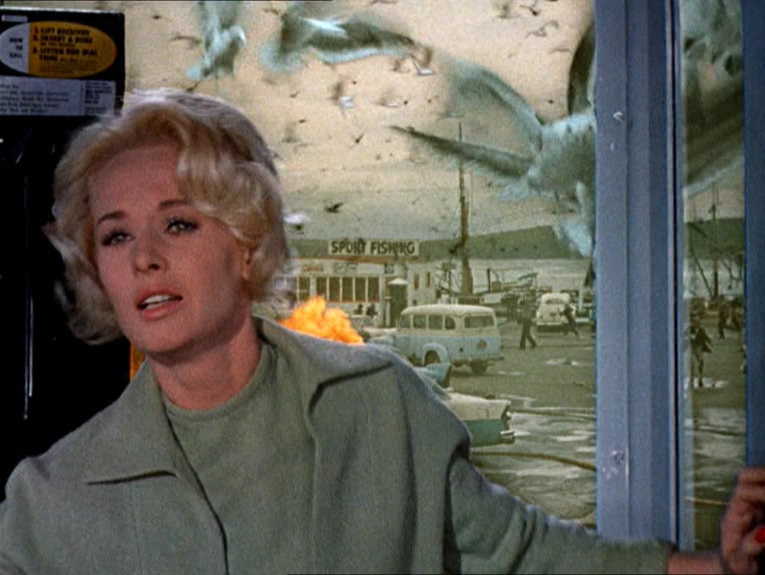
The alchemists would say: the operation failed. The volatile was released but not collected. The birds flew, but no one caught the distillate. The King watched from the balcony and never entered the bath.
Why the Birds Are Menacing
I said at the beginning that the birds in the Splendor Solis plate look slightly menacing. Hitchcock saw the same thing and built an entire film around that feeling.
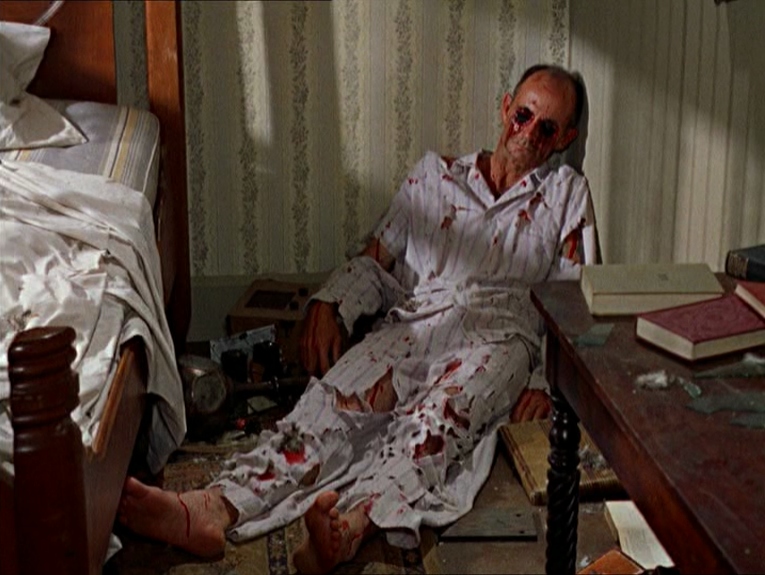
The menace is real. The volatile IS dangerous to the fixed. If you are the King — stable, solar, enthroned in your certainty — then the birds represent everything that could dissolve you. Mercury does not negotiate with Sulphur. The feminine mysteries in the bath do not need the King’s permission. The birds in the tree do not care that you are climbing toward the golden bough. They will fly when they fly, and your ladder will shake.
The alchemists knew this and called it necessary. Hitchcock knew this and called it horror. The difference is not in what they saw but in whether they had a vessel to contain it.
The Vessel
The alchemical vas hermeticum — the sealed vessel, the philosophical egg — exists precisely because the volatile is dangerous. You do not release Mercury into open air. You heat the substance in a sealed container so that the spirits rise, condense on the walls, and fall back into the mixture. The transformation happens BECAUSE of the containment.
Bodega Bay has no vessel. The birds attack in open air, open houses, open cars. There is no hermetic seal. This is why the operation fails — not because the volatile was released (that was inevitable; that was the Work) but because there was nothing to catch it. No art. No ritual. No vas. Just a man with a flashlight and some plywood nailed over the windows.
The Border and the Screen
One final parallel. The Splendor Solis is a framed image — the central panel (tree, birds, youth) exists inside an elaborate painted border (the bathing scene, the watching King, floral ornament). The border is not separate from the image. It is the image’s unconscious. It shows what the central panel cannot say directly: that the operation depicted in the tree is, at its root, about the relationship between the masculine gaze and the feminine body.
A cinema screen works the same way. What is “in frame” is the conscious content — the story, the plot, the thing the Production Code can approve. What is “off screen” or encoded in the mise-en-scène — the hair, the torn clothes, the catatonic eyes, the birds as displaced libido — is the border. The predella. The unconscious content that the viewer absorbs without naming.
Hitchcock was painting predellas in 35mm.
The Splendor Solis illuminator was directing cinema on vellum.
Both understood that the real content of a work of art is never in the center. It is in the borders — in what surrounds and frames and quietly, subliminally, menaces the official image. The birds know this. They have always known it. They are waiting in the tree, and they are watching from the playground, and when the time comes, they will fly.
This Is What the Vessel Looks Like
There is a plate in the Splendor Solis that answers Hitchcock. It is Plate 17 — the Mercury flask — and it shows what happens when the volatile is caught.
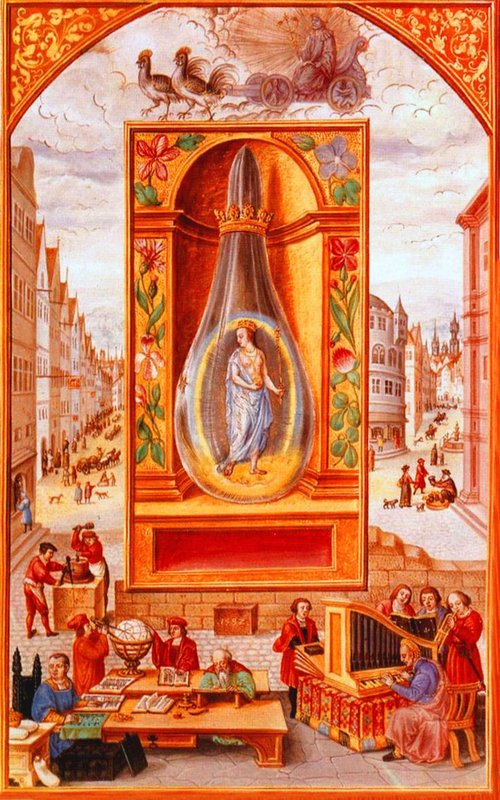
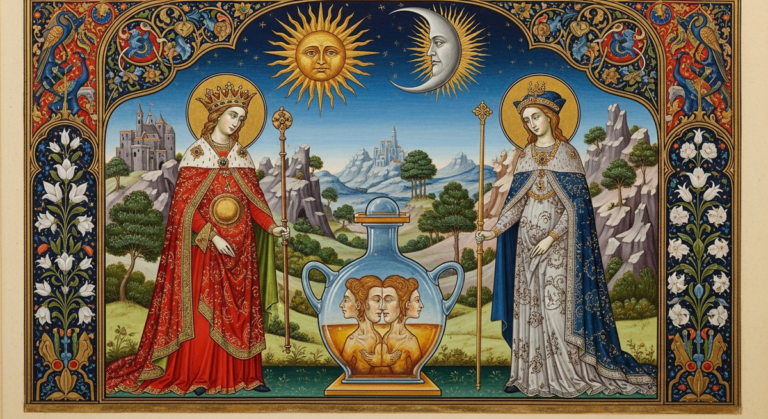
Inside a sealed cucurbit — the crowned glass vessel of the alchemists — a queen in blue robes stands with exposed breasts, holding a golden ball and scepter. She is the White Queen: Mercury, the volatile feminine, the same principle that flew as thirteen birds from the golden tree of Plate 6. But she is no longer in flight. She is inside the vessel. Contained. Distilled. Ruling.
And here is the inversion that makes the whole manuscript sing: the White Queen stands on the sun. Not on the moon, her natural element — on the sun. The volatile feminine has been grounded in the masculine principle without being destroyed. She has not been tamed. She has not been caged like Melanie’s lovebirds. She has been distilled — heated until she rose, condensed until she fell, risen and fallen again and again inside the sealed vessel until she crystallized into something that is still Mercury, still volatile, still the Queen — but now also fixed, stable, sovereign. Standing on the sun with a scepter in her hand.
The operation that produces this is distillatio — the sixth stage of the Work. One step beyond sublimation. In sublimation, the volatile rises and stays risen (Hitchcock got this far: sex became birds). In distillation, the volatile rises, condenses on the walls of the vessel, and falls back into the mixture. It does this over and over. Each cycle purifies. Each ascent and descent strips away impurity until what remains in the vessel is the quintessence — the fifth element — the thing that is both volatile and fixed, both Mercury and Sulphur, both Queen and King.
This is what the sealed vessel is for. Not to trap the volatile — a phone booth traps, plywood traps, a cage traps — but to give it space to rise and fall and rise again. The vas hermeticum does not contain Mercury the way a prison contains a prisoner. It contains Mercury the way an alembic contains a distillation: by providing the architecture for transformation.
The Borders Tell the Story
In Plate 6, the border scenes show bathing women and the watching King — raw eros, unprocessed, the volatile in its natural state.
In Plate 17, the border scenes show sculptors, scholars, organists, musicians — civilization, craft, art. The erotic energy that was naked in the water has been sublimated into culture. The libido that swam is now the libido that carves, that reads, that plays music.
The borders of Plate 17 are what the borders of Plate 6 become when the operation succeeds. The bathing scene does not disappear. It is distilled into something higher. The sexual energy is not repressed — it is transmuted into art, scholarship, and music. Into civilization itself.
Hitchcock never painted Plate 17. He could not. His medium — Hollywood cinema under the Production Code — was a vessel with a crack in it. He could sublimate sex into birds, but he could not distill the birds back into the Queen. The film ends with the family driving away from Bodega Bay, Melanie catatonic in the back seat, the birds silent and watching. No resolution. No transformation. No queen in a flask holding a scepter.
The Splendor Solis knows better. It knows that the volatile must fly — Plate 6 shows this, and the menace is real. But it also knows that the flying is not the end. Eleven plates later, the White Queen stands in the vessel, and the birds that flew from the golden tree have become the chariot-pulling cocks of Hermes — still birds, still volatile, but now in harness. Drawing the god of transformation through the sky.
The volatile does not ask permission. It rises when heated. The only question is whether you have a vessel — or a flashlight.
And if you have a vessel: whether you have the patience to let it rise and fall, rise and fall, until the Queen appears.
From Plate 6 to Plate 17. From the bathing women to the musicians. From the tree full of birds to the chariot of Hermes. From the volatile in flight to the Queen on the sun.
This is the Great Work. This is what Bodega Bay could not do.
93 93/93